
Did you know that 64.8% of patients without type 2 diabetes discontinue their GLP-1 receptor agonist therapy within a single year? It’s a sobering statistic that highlights the metabolic off-ramp crisis facing modern obesity medicine. You’ve likely seen this cycle firsthand: the initial clinical success followed by a rapid rebound as biological homeostatic adaptations take over and food noise returns. Maintaining that progress requires more than just willpower; it demands a structured, data-driven approach to metabolic reprogramming.
This article introduces evidence-based post-GLP-1 weight maintenance protocols designed to prevent weight regain and preserve lean mass through precision nutrition. You’ll discover how to implement standardized clinical workflows and leverage 2026 CPT coding updates for Medical Nutrition Therapy to secure sustainable patient outcomes and efficient billing. We’ll also examine how automated tools can generate lab-based nutrition prescriptions in seconds, allowing you to scale personalized care without increasing your administrative burden. By shifting from drug-induced suppression to data-driven nutritional therapy, you can turn temporary weight loss into permanent health transformations for your patients.
Key Takeaways
- Identify the physiological drivers of the 6 to 12 month transition period and how to mitigate the risk of rapid weight rebound.
- Master protein-sparing nutritional strategies designed to combat drug-induced sarcopenia and preserve critical lean muscle mass.
- Learn to leverage automated tools that transform patient lab data into personalized post-GLP-1 weight maintenance protocols in seconds.
- Explore the 2026 billing framework for CPT codes 97802 and 97803 to build a scalable, insurance-reimbursed maintenance program.
The Post-GLP-1 ‘Off-Ramp’: Why Clinical Protocols Are Essential
The “off-ramp” represents the critical 6 to 12 month transition following the cessation of therapy. It’s a period defined by a complex biological tug-of-war. While the medication is active, it regulates appetite and slows gastric emptying. Once removed, patients face a rapid return of “food noise” coupled with a metabolic rate that has often slowed during the weight loss phase. Generic advice like “eat less and move more” is insufficient for this population. These patients require post-GLP-1 weight maintenance protocols that address the specific physiological shifts occurring in their bodies.
Metabolic Adaptation and the Rebound Risk
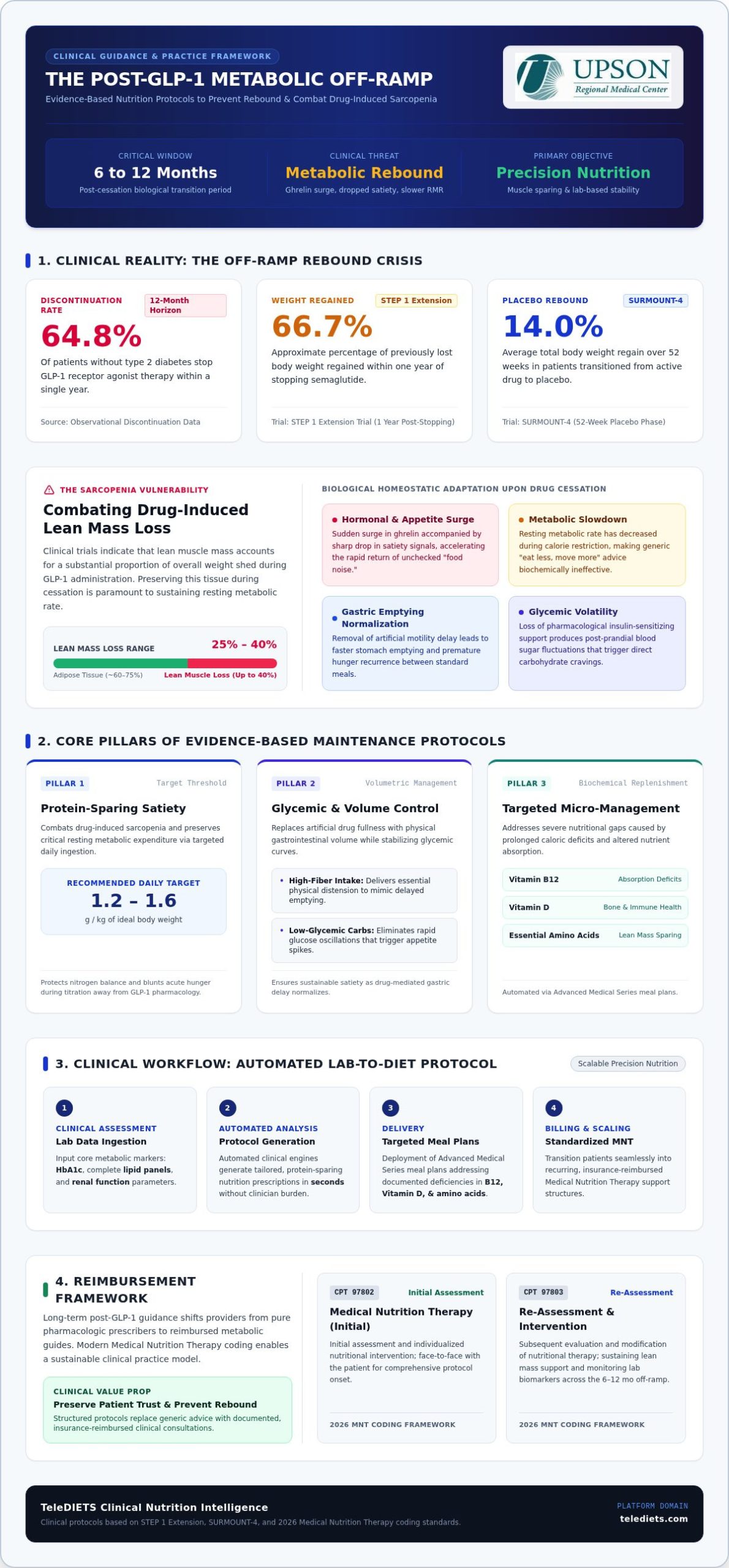
The primary barrier to stability is metabolic adaptation. When GLP-1 receptor agonists are discontinued, hormonal shifts trigger a surge in ghrelin and a drop in satiety signals. Data from the STEP 1 extension study reveals that patients regained approximately 66.7% of their lost weight within a year of stopping semaglutide. Similarly, the SURMOUNT-4 trial showed that patients switched to a placebo regained an average of 14% of their total body weight over 52 weeks. These statistics aren’t just numbers; they represent a biological drive toward weight regain that only a structured, clinical protocol can counteract.
The Provider’s Role in Behavioral Transition
Success in 2026 requires providers to transition from pure prescribers to metabolic guides. You must provide a clear framework that bridges the gap between drug-induced suppression and long-term metabolic health. Utilizing automated tools to generate these prescriptions ensures that your guidance is both scalable and scientifically sound. By implementing post-GLP-1 weight maintenance protocols, you offer patients a sense of security and a professional partnership that extends beyond the needle. This transition is essential for maintaining patient trust and ensuring that the hard-won progress of the titration phase isn’t lost to predictable hormonal rebounds.
Core Pillars of Evidence-Based Maintenance Protocols
Effective post-GLP-1 weight maintenance protocols must move beyond simple calorie counting. The goal is metabolic stability. This involves a three-pronged approach: protecting lean mass, replenishing micronutrients, and managing glycemic responses. Providers should use lab-based data, including A1c, lipid panels, and renal function, to refine these prescriptions. This ensures the diet remains a clinical tool rather than a generic suggestion, allowing for a seamless transition as the patient moves away from pharmacological support.
Macronutrient Distribution for Muscle Preservation
Clinical trials indicate that lean muscle mass can account for 25% to 40% of total weight loss during GLP-1 therapy. To combat this drug-induced sarcopenia, patients require protein-sparing protocols. We recommend a protein threshold of 1.2 to 1.6 g/kg of ideal body weight to maintain metabolic health. High-fiber, low-glycemic carbohydrates are equally vital. These nutrients provide the necessary volume to sustain satiety as the medication’s artificial suppression fades, preventing the rapid return of hunger.
Micro-Management: Addressing Nutrient Deficiencies
Long-term GLP-1 use often results in lingering malabsorption or habits of extreme caloric restriction. Providers frequently identify deficiencies in B12, Vitamin D, and essential amino acids. Our Advanced Medical Series meal plans automate the inclusion of these vital nutrients, ensuring every meal is nutrient-dense and tailored to a patient’s specific clinical profile. By utilizing lab-driven data, you can adjust post-GLP-1 weight maintenance protocols to address documented gaps in a patient’s biochemistry.
Managing the glycemic load is also essential to stabilize insulin sensitivity once the medication is removed. This prevents the blood sugar fluctuations that often trigger cravings and weight regain. You can explore how to automate these clinical nutrition prescriptions to provide your patients with the precise support they need for long-term success.
Implementing Automated MNT Protocols in Your Workflow
Transitioning from clinical research to daily practice requires a systematic approach. Integrating post-GLP-1 weight maintenance protocols into your existing operations ensures that no patient falls through the cracks during the vulnerable “off-ramp” phase. By automating the delivery of medical nutrition therapy, you can provide the intensive support required for metabolic stability without overextending your staff. A structured workflow typically follows these four steps:
- Step 1: Integrate patient lab data (A1c, lipids, renal function) into a clinical meal plan generator for immediate, diagnosis-specific personalization.
- Step 2: Deploy specialized GLP-1 support protocols during the final 2 to 3 months of titration to prepare the patient’s metabolism for medication cessation.
- Step 3: Utilize a telemedicine plugin to facilitate remote monitoring, allowing for quick adherence checks and real-time dietary counseling.
- Step 4: Automate follow-up scheduling and dietary adjustments based on weight stability markers to intervene early if regain triggers appear.
The Role of AI-Driven Nutrition Prescriptions
TeleDIETS generates clinical-grade plans in seconds, significantly reducing the provider burden associated with manual meal planning. It’s a tool that empowers your team to deliver high-touch care with minimal effort. AI-driven protocols ensure every patient receives a plan that complies with the latest evidence-based MNT standards for muscle preservation and satiety management.
Scaling Personalized Care via SaaS
Moving away from generic, one-size-fits-all handouts is essential for maintaining patient trust after the medication phase ends. By shifting to a SaaS-based model, you can deliver diagnosis-based nutrition therapy that scales with your practice’s growth. You can explore our clinical meal plan protocols to see how these tools transform patient engagement. Ready to modernize your clinic’s approach? Start your automated MNT implementation today.
The Business of Maintenance: Billing and Scalable Support
Establishing long-term financial sustainability is as crucial as the clinical outcomes themselves. By framing your maintenance program as a specialized service, you transform a high-risk transition period into a consistent revenue stream. Utilizing post-GLP-1 weight maintenance protocols allows your practice to justify ongoing care through documented medical necessity, ensuring that your professional time is appropriately reimbursed. This shift to a “Maintenance as a Service” model improves patient retention while providing the structured support necessary to prevent metabolic relapse.
Navigating CPT 97802 and 97803
Navigating CPT 97802 and 97803 requires a clear distinction between initial assessment and follow-up care. In 2026, Medicare non-facility averages for CPT 97802 are $36.74 per unit, while subsequent encounters under 97803 reimburse at $31.73. Following the August 3, 2026, CMS enforcement rule, claims must be linked to qualifying primary diagnosis codes like metabolic dysfunction or obesity (ICD-10 E66.01) to avoid automated denials. TeleDIETS’ billing tools automate this documentation, ensuring your clinical notes meet strict payer scrutiny while you focus on patient care.
Telehealth and Remote Patient Monitoring (RPM)
Integrating a telemedicine plugin further optimizes your delivery cost for maintenance check-ins. These digital touchpoints are vital for intercepting the 12-month rebound curve, where real-world data shows roughly 21% of users face complete weight regain. By stacking MNT with updated 2026 Remote Patient Monitoring (RPM) codes, such as 99445 for lower-threshold data transmission or 99470 for clinical management, you can track body composition remotely. This model provides scalable, high-frequency support that improves patient adherence without increasing clinic overhead. Adopting these post-GLP-1 weight maintenance protocols ensures your practice remains both clinically effective and financially resilient in an evolving payer landscape.
Securing Long-Term Metabolic Success in 2026
The shift from pharmacological suppression to metabolic stability is the defining challenge for obesity medicine in 2026. By implementing structured post-GLP-1 weight maintenance protocols, you move beyond temporary weight loss to facilitate permanent health transformations. Success hinges on protecting lean muscle mass through protein-sparing nutrition and utilizing a reliable billing framework to ensure your practice remains financially sustainable.
TeleDIETS provides the clinical infrastructure you need to bridge this gap effectively. With diagnosis-based meal plan automation and integrated CPT coding tools, you can deliver personalized care without the manual administrative burden. Our HIPAA-compliant telemedicine plugin allows for seamless remote monitoring. This ensures you catch regain triggers before they compromise patient outcomes. You have the clinical expertise to guide your patients through the complexities of the off-ramp. We provide the professional tools necessary to make that guidance both scalable and highly profitable for your practice.
Scale your clinic’s GLP-1 maintenance program with TeleDIETS and lead your patients toward a future of metabolic resilience.
Frequently Asked Questions
What is the most effective post-GLP-1 weight maintenance protocol?
The most effective post-GLP-1 weight maintenance protocols involve a structured transition from pharmacological appetite suppression to intensive, data-driven nutritional therapy. Clinical evidence suggests that reverse titration or spaced-dose maintenance, when paired with protein-sparing meal plans, helps stabilize metabolic rates. By focusing on high-protein intake and glycemic load management, providers can mitigate the hormonal rebound that typically follows medication cessation. This approach ensures more sustainable weight retention for your patients.
How can physicians bill for medical nutrition therapy during weight maintenance?
Physicians can bill for these services by utilizing Medical Nutrition Therapy (MNT) codes or Intensive Behavioral Therapy (IBT) for obesity. Under the August 3, 2026, CMS rule, documentation must clearly link services to qualifying primary diagnosis codes such as metabolic dysfunction. Using automated billing tools ensures that clinical notes capture face-to-face minutes and medical necessity accurately. It’s essential for maximizing reimbursement and passing potential payer audits during long-term maintenance.
What CPT codes are used for post-GLP-1 nutritional counseling?
Providers primarily utilize CPT codes 97802 for initial assessments and 97803 for subsequent re-assessments and interventions. For group-based sessions, CPT 97804 is the standard. Additionally, HCPCS code G0270 allows for reassessment following a significant change in the patient’s treatment regimen. By stacking these with Remote Patient Monitoring codes, such as 99445 or 99470, clinics create a comprehensive, insurance-reimbursed framework that supports patients through the critical 12-month maintenance phase.
How do automated meal plan protocols improve patient adherence after drug cessation?
Automated meal plan protocols improve adherence by providing immediate, lab-based personalization that reflects a patient’s current metabolic state. Instead of generic handouts, patients receive clinical-grade plans that address their specific micronutrient needs and protein requirements in seconds. This high level of relevance increases patient engagement and confidence. When integrated with a telemedicine plugin, these tools allow for frequent, low-friction check-ins that keep patients accountable during the challenging post-medication transition.
Is muscle loss permanent after GLP-1 therapy without a protein-sparing protocol?
Muscle loss isn’t necessarily permanent, but it creates a significant metabolic disadvantage if not addressed. Research shows that lean mass can account for up to 40% of total weight loss during titration. Without a protein-sparing protocol and resistance training, patients risk developing sarcopenia, which lowers their basal metabolic rate. This increase in fat-to-muscle ratio makes weight regain more likely. Implementing specialized nutritional support early is vital for reversing drug-induced metabolic slowdown.
Leave a Reply