
Did you know that medical nutrition therapy can trigger an absolute reduction in HbA1c of up to 2.0% for Type 2 patients, yet many practices still refer this critical care out? You likely recognize the clinical value of nutrition, but the administrative weight of manual meal planning and the complexity of CPT coding often make in-house services feel unsustainable. Implementing the right diabetes MNT software for endocrinologists is no longer just about digital handouts. It’s about integrating automated nutrition prescriptions directly into your clinical workflow to improve outcomes and practice efficiency.
You deserve a system that bridges the gap between lab results and patient plates without increasing your team’s workload. This guide will show you how to select a platform that automates dietary protocols based on real-time data, supports patients on GLP-1 receptor agonists, and simplifies insurance billing to capture lost revenue. We’ll examine the essential features for 2026, including SMART-on-FHIR integrations and automated CPT coding tools that ensure your practice remains both clinically effective and financially sound.
Key Takeaways
- Understand why specialized diabetes MNT software for endocrinologists is required to manage metabolic complexity, moving beyond the static templates found in generic EHR systems.
- Explore how lab-integrated engines can automate clinical prescriptions, providing precise nutritional support for patients on GLP-1 receptor agonists through advanced medical protocols.
- Learn how to keep MNT services in-house and capture practice revenue using integrated CPT coding tools that simplify insurance billing and reimbursement.
- Evaluate the most efficient way to integrate nutrition therapy into your workflow, whether you need a standalone SaaS solution or a licensed AI engine plugin for your current EHR.
Beyond the EHR: Why Endocrinologists Need Specialized Diabetes MNT Software
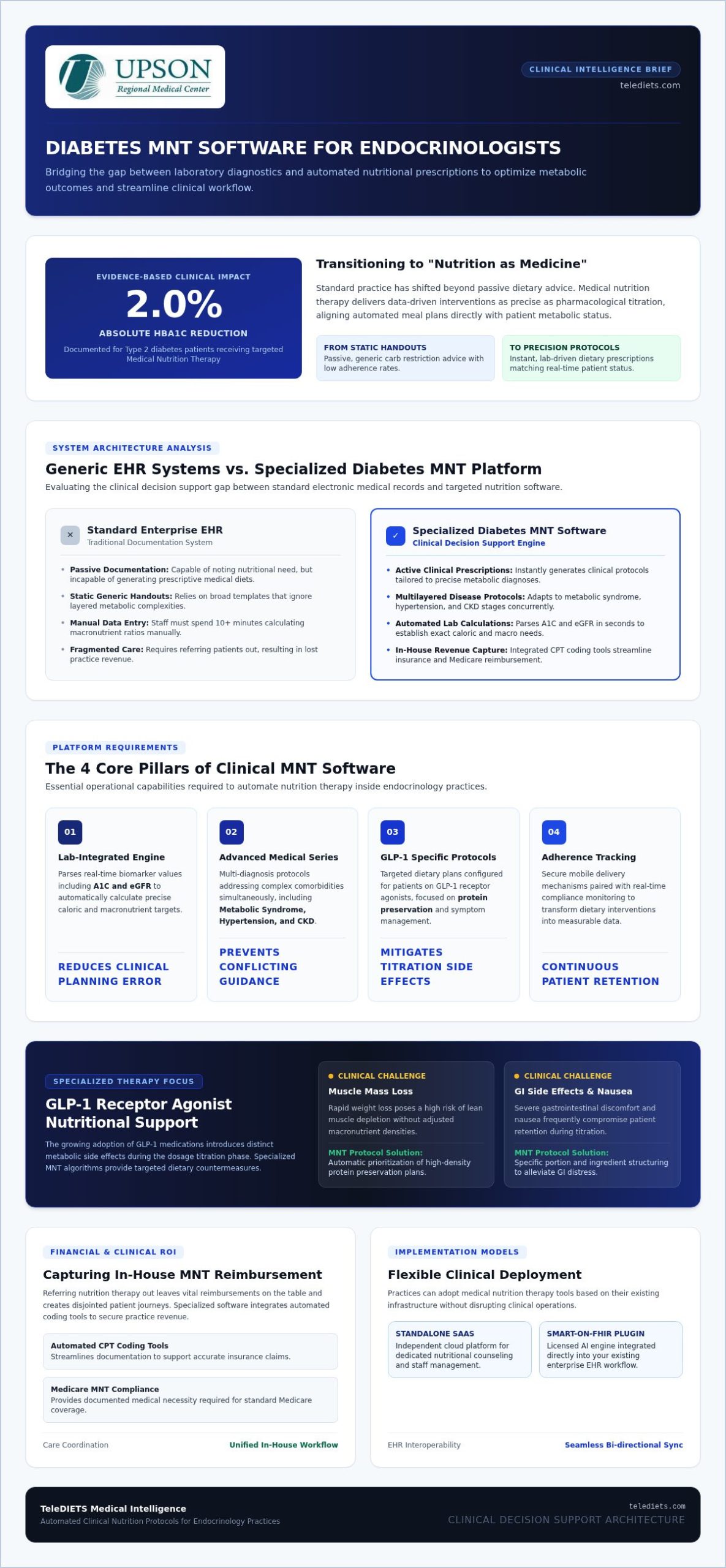
Most endocrinology practices rely on their EHR for every clinical task. While enterprise EHRs excel at billing and medication orders, they often lack the clinical depth required for effective medical nutrition therapy. Modern diabetes MNT software for endocrinologists functions as a clinical decision support tool rather than a simple recipe database. It bridges the gap between identifying a nutritional need and delivering a precise, lab-driven intervention. In 2026, the standard of care has shifted toward “Nutrition as Medicine,” where dietary protocols are as specific and data-dependent as insulin titration.
The Gap Between Documentation and Prescription
Traditional systems allow you to note that a patient needs a low-carb diet, but they don’t help you prescribe one. Specialized diabetes management software changes this dynamic. Instead of spending ten minutes explaining macronutrient ratios or printing generic handouts, you can generate a clinical protocol in seconds. This automation ensures that patients leave with a clear, actionable plan. It’s a shift from passive advice to active intervention, which directly correlates with improved adherence and an absolute reduction in HbA1c of up to 2.0% for Type 2 patients.
Managing Metabolic Syndrome with Evidence-Based Protocols
Diabetes rarely exists in a vacuum. Effective diabetes MNT software for endocrinologists must account for metabolic syndrome, hypertension, and CKD stages. Generic templates can’t adjust for these layered complexities. By utilizing Advanced Medical Series meal plans, you provide protocols that adapt to multiple diagnoses simultaneously. This level of precision ensures your nutritional advice supports the entire metabolic profile. It prevents the conflicting dietary signals that often lead to patient frustration. When you offer specific solutions for complex cases, you empower your patients to achieve better long-term outcomes.
Core Features of High-Performance MNT Platforms
High-performance diabetes MNT software for endocrinologists must do more than just provide templates. It must act as a seamless extension of your clinical expertise. To be effective in a modern practice, the software requires four core pillars: lab-integrated prescription engines, a library of Advanced Medical Series protocols, secure mobile delivery, and real-time adherence tracking. These features ensure that your nutritional interventions are as scientifically grounded as your pharmacological ones. When these elements work together, they transform dietary advice into a measurable clinical outcome.
Lab-Based Nutrition Prescription Automation
Clinical precision starts with data. Advanced platforms parse specific lab values, such as A1C and eGFR, to automatically calculate the optimal caloric and macronutrient mix for each patient. AI engines like TeleDIETS reduce clinical error in dietary planning by ensuring every meal plan aligns with the patient’s current metabolic status. This automation is critical for maintaining compliance with Medicare MNT coverage and billing guidelines, as it provides the documented medical necessity required for reimbursement. By automating this process, your team can focus on patient counseling rather than manual data entry.
Specialized Support for GLP-1 Receptor Agonists
The rise of GLP-1 receptor agonists has created a new set of nutritional challenges. Patients often face muscle mass loss and gastrointestinal side effects that require specific dietary adjustments. High-performance software includes specialized GLP-1 Meal Plan Protocols designed to prioritize protein preservation and manage nausea. These protocols are essential for patient retention and long-term success, helping users navigate the titration phase with fewer complications. If you’re ready to modernize your approach, you can implement these advanced medical protocols to enhance your practice’s standard of care.
Capturing Revenue: MNT Billing and ROI for Endocrinology
Referring patients out for medical nutrition therapy often results in fragmented care and lost practice revenue. By keeping these services in-house, you can capture significant reimbursements while ensuring patients follow NIDDK diabetes nutrition and meal planning guidance. Implementing diabetes MNT software for endocrinologists allows your practice to transition from a cost center to a profit center by integrating billing directly into the clinical encounter. This approach is vital for success in value-based care models, where patient outcomes and cost-efficiency are prioritized.
Navigating CPT Codes 97802 and 97803
Effective billing hinges on two primary codes. CPT 97802 covers the initial assessment and intervention, while CPT 97803 is used for follow-up reassessments. In 2026, the national Medicare rate for 97802 is $36.74 per 15-minute unit, totaling approximately $147 for a full hour. Specialized software automates the generation of ADIME notes and PES statements, providing the robust documentation needed to justify these claims. You can explore TeleDIETS membership options for clinical billing support to see how these tools streamline your administrative burden.
Streamlining Insurance Reimbursement Workflows
Claim denials often stem from missing timestamps or improper referrals. Integrated billing tools track CPT coding at the point of care, ensuring every 15-minute increment is recorded according to the Medicare 8-minute rule. This precision protects your practice during audits and maximizes commercial payer rates, which can reach $48 per unit. High-quality diabetes MNT software for endocrinologists hard-codes these rules into your workflow, preventing common errors before they reach the clearinghouse. To secure your practice’s financial future, start utilizing integrated billing tools today.
Integrating MNT Software into Your Clinical Workflow
Integrating diabetes MNT software for endocrinologists into a busy practice shouldn’t mirror the multi-month burden of a full EHR overhaul. Success begins with a modular approach. First, assess your current EHR for FHIR R4 API compatibility. This ensures that lab data flows into the nutrition engine and clinical notes write back to the patient chart without manual entry. Once compatibility is confirmed, you must decide on the deployment model that best fits your infrastructure. Proper staff training then shifts the focus from manual meal planning to the efficient delivery of automated nutrition prescriptions.
SaaS vs. AI Engine Licensing Models
Independent clinics often find the greatest value in a cloud-based SaaS platform. This model provides immediate access to Standard and Advanced Medical Series meal plans with minimal upfront technical configuration. Conversely, larger health systems frequently opt for AI engine licensing. This allows the organization to embed clinical nutrition logic directly into their existing patient portals or proprietary EHR interfaces. This approach maintains a unified brand experience for the patient while leveraging the power of automated dietary prescriptions behind the scenes.
Telemedicine and Remote MNT Delivery
Transitioning from paper handouts to digital delivery is the final step in a modern workflow. Utilizing telemedicine plugins allows your team to conduct virtual follow-ups, which is essential for patients requiring frequent titration support. Research indicates that digital interventions can achieve an additional 0.30% absolute reduction in HbA1c compared to standard care. This improvement stems from the ability to provide real-time feedback and asynchronous support through mobile apps. If you’re ready to modernize your practice, you can get started with our clinical integration tools to bridge the gap between office visits and daily patient habits.
Empowering the Future of Metabolic Care
Implementing specialized diabetes MNT software for endocrinologists is the most efficient way to bridge the clinical gap between lab results and patient adherence. By moving beyond generic EHR templates, your practice can provide evidence-based meal plans generated in seconds, tailored to complex metabolic needs. These tools don’t just improve outcomes; they protect your practice’s financial health through integrated CPT coding for MNT reimbursement. Whether you’re managing patients on GLP-1 receptor agonists or treating advanced chronic disease, specialized protocols ensure your nutritional advice is as precise as your medical prescriptions.
You now have the framework to select a platform that reduces administrative burden while expanding your clinical capabilities. Transitioning to a data-driven nutrition model empowers your team to deliver superior care without sacrificing efficiency. If you’re ready to transform your approach to metabolic health, you can automate your clinical nutrition workflow today with TeleDIETS. Your practice is well-positioned to lead the next era of evidence-based endocrinology care.
Frequently Asked Questions
What is the difference between general diet apps and clinical MNT software?
General diet apps are consumer-facing tools designed for basic calorie tracking and weight loss. In contrast, clinical MNT software serves as a professional decision support system. It integrates directly with patient lab data to generate automated, diagnosis-specific prescriptions. These platforms provide the clinical documentation, such as ADIME notes and PES statements, required to meet medical necessity standards that consumer apps simply don’t support.
Can I bill for medical nutrition therapy if I am not a Registered Dietitian?
Medicare regulations require that MNT services (CPT 97802–97804) be performed by a credentialed Registered Dietitian Nutritionist (RDN) or a nutrition professional enrolled as a Medicare Part B provider. An endocrinologist typically provides the necessary medical referral, while the clinic’s employed or contracted RDN performs the counseling and bills the service. This collaborative approach ensures your practice remains compliant while capturing the revenue generated by these essential services.
How does diabetes MNT software integrate with my existing EHR like Athena or CGM?
Modern diabetes MNT software for endocrinologists utilizes SMART on FHIR and USCDI v3 standards to ensure bi-directional data exchange. This allows the platform to pull lab panels, such as HbA1c and eGFR, directly from systems like Athenahealth or eClinicalWorks. Once a protocol is prescribed, the software writes the nutritional care plan back to the patient chart, eliminating duplicate data entry and maintaining a single source of truth.
Are GLP-1 meal plans included in the Standard Series or Advanced Medical Series?
GLP-1 Meal Plan Protocols are specialized standalone offerings distinct from the Standard or Advanced Medical Series. While the Standard Series provides foundational nutrition and the Advanced Medical Series addresses complex chronic conditions like CKD, the GLP-1 protocols focus specifically on the unique needs of patients using GLP-1 receptor agonists. These plans prioritize protein preservation and gastrointestinal side effect management to improve long-term patient tolerance and outcomes.
Does the software support CPT codes for Medicare and private insurance reimbursement?
Yes, the platform features integrated Insurance Billing & CPT Coding Tools designed for Medicare and private payer reimbursement. It automates the documentation for initial assessments (97802) and follow-ups (97803) while enforcing the Medicare 8-minute rule. Using diabetes MNT software for endocrinologists ensures that timestamps and medical necessity are accurately captured, reducing the risk of claim denials and protecting your practice during potential clinical audits.
Leave a Reply