
Could two nutrition visits that last the same amount of time require different codes? Yes. The right CPT codes for medical nutrition depend on the service delivered: an initial individual assessment, a subsequent individual reassessment, or a group session. Time alone does not determine the code.
Billing guidance can vary by payer and care setting, so uncertainty is understandable. Code selection is only one part of a clean claim. Documentation, time units, diagnosis requirements, and coverage rules also need to align. A mismatch can delay payment or lead to a denial.
This 2026 guide explains the main MNT codes and how to distinguish them, including when an add-on code or reassessment code may apply. It also outlines what to verify with Medicare, Medicaid, or a commercial payer before submitting a claim. Use it to build a consistent review process, and treat payer policy and current authoritative coding guidance as the final check.
Key Takeaways
- Match 97802, 97803, or 97804 to the documented individual or group service delivered, not to the code expected to reimburse more.
- Use this guide to distinguish the main CPT codes for medical nutrition and identify where payer-specific rules may affect code use.
- Check eligibility, coverage, provider qualifications, documentation, units, and claim details against current Medicare, Medicaid, or commercial payer guidance.
- Set a repeatable review process with clear staff responsibilities for confirming code descriptors, checking payer rules, and reviewing claims.
Which CPT Codes Are Used for Medical Nutrition Therapy?
Current Procedural Terminology (CPT) codes are standardized codes used to identify healthcare services on billing claims. The Current Procedural Terminology (CPT) code set provides a shared framework for describing services, but the existence of a code does not mean every payer covers it. Medical nutrition therapy (MNT) is clinical, nutrition-focused care tied to a patient’s medical needs. General nutrition counseling may not meet a payer’s definition of MNT or its coverage criteria.
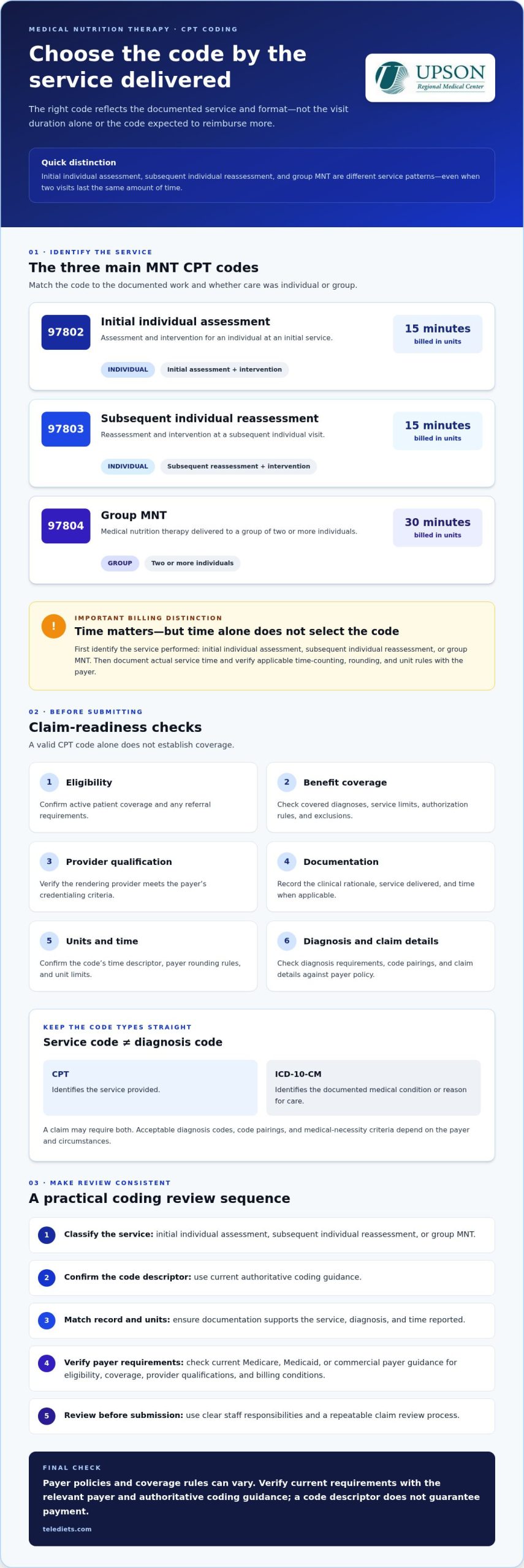
In brief, CPT 97802 generally describes an initial individual MNT assessment and intervention, 97803 a subsequent individual reassessment and intervention, and 97804 group MNT. These CPT codes for medical nutrition distinguish the service and format, but do not guarantee payment.
What services do CPT 97802, 97803, and 97804 generally describe?
Under the current descriptors, 97802 and 97803 are individual, face-to-face services billed in 15-minute units. Code 97804 describes MNT for a group of two or more and is billed in 30-minute units. The main distinctions are the work performed and whether the service is individual or group.
- 97802: Initial individual assessment and intervention.
- 97803: Individual reassessment and intervention at a subsequent visit.
- 97804: Group MNT for two or more individuals.
Before billing, confirm current descriptors, time-counting rules, and coverage with authoritative coding materials and the relevant payer. Don’t select a code simply because it appears on a claim form.
How do CPT codes differ from diagnosis codes?
A CPT code identifies the service provided. An ICD-10-CM diagnosis code identifies a documented medical condition or reason for care. A claim may require both, but acceptable diagnosis codes, code pairings, and medical-necessity criteria depend on the payer and circumstances. Check the payer’s current policy and make sure the record supports both the service and the diagnosis submitted.
How to Choose the Right Medical Nutrition CPT Code
Choose a code based on the service provided and the work documented, not on which code may reimburse more. Start by identifying whether the encounter was an initial individual assessment, a subsequent individual reassessment, or group MNT. Then confirm the current descriptor, applicable time rules, and payer policy. The Academy of Nutrition and Dietetics CPT codes resource can help orient your review, but it does not replace official coding guidance or payer requirements.
| Code | Service pattern | Time descriptor | Verify with payer |
|---|---|---|---|
| 97802 | Initial individual assessment and intervention | 15-minute increments | Eligibility, frequency, and unit rules |
| 97803 | Subsequent individual reassessment and intervention | 15-minute increments | Follow-up criteria and unit rules |
| 97804 | Group MNT | 30-minute increments | Group coverage and billing conditions |
When does the distinction between initial and follow-up matter?
The distinction reflects whether the documented work is an initial assessment or a subsequent reassessment and intervention. A patient who is new to your practice does not automatically qualify for 97802. Review the service history and the payer’s rules for frequency, provider, and service eligibility. The record should support the code selected.
How should providers think about units and service time?
Time conventions are code-specific. HHS-listed examples describe 97802 and 97803 in 15-minute increments and 97804 in 30-minute increments, but these descriptors do not guarantee that every payer uses the same billing rules. Record the actual service time, then check applicable rounding rules, unit limits, and documentation requirements before submitting the claim. A consistent workflow for CPT codes for medical nutrition makes these checks easier to repeat without replacing professional judgment or current payer verification.
What Should Providers Verify Before Billing MNT Codes?
A selected code is only one part of a claim. A valid CPT code alone does not establish coverage. Before submitting CPT codes for medical nutrition, use this claim-readiness checklist and confirm each requirement with current payer sources:
- Eligibility: Confirm the patient’s active coverage and any referral requirements.
- Benefit coverage: Check covered diagnoses, service limits, authorization rules, and exclusions.
- Provider qualification: Verify that the rendering provider meets the payer’s credentialing criteria.
- Documentation: Record the clinical rationale, service delivered, and time when applicable.
- Code: Match the documented work to the current code descriptor.
- Units: Validate time calculations, unit limits, and payer-specific billing conventions.
- Claim details: Check diagnosis pairing, referral information, place of service, and any required modifiers.
How do Medicare, Medicaid, and commercial payer rules differ?
Medicare MNT coverage has specific eligibility and referral criteria. Verify the applicable diagnosis, referral, and covered service limits against current Medicare guidance. Medicaid policies vary by state, so check the state program’s current rules rather than assuming there is a national standard. Commercial plans can differ by insurer and benefit design; confirm coverage and authorization directly with the plan. For telehealth, separately verify current coverage, place-of-service, and modifier requirements.
What documentation supports an MNT claim?
Keep the record aligned with the code and payer policy. Document the service performed, clinical rationale, relevant referral details, and time when required. Clear records support claim review, but do not guarantee reimbursement.
Assign staff responsibility for checking payer policies and official coding guidance before submission. Provider workflow tools, including insurance billing and CPT coding tools, can help organize these checks while leaving final decisions to current payer rules and professional judgment.
Build a Consistent CPT Coding Workflow for Medical Nutrition
A repeatable workflow helps your team carry documentation through to claim review without treating code selection as a shortcut. For each encounter, follow the same sequence:
- Document: Record the service delivered, clinical rationale, and time where applicable.
- Select: Match the documented work to the current code descriptor.
- Verify: Check coverage, provider requirements, units, and claim details against the payer’s current policy.
- Submit and review: Submit the claim, then examine denials, corrections, and recurring discrepancies for process gaps.
Assign clear ownership at each step. The clinician should document the service and clinical rationale. Designated billing staff can verify code descriptors and payer rules before submission. Keep an internal reference that identifies its source and review date, and revisit it when official coding guidance or payer policies change. Templates can prompt staff to check required details, but should not automatically determine which code applies.
How can practices reduce avoidable coding inconsistencies?
Use the same review sequence across providers and audit a sample of claims regularly. Track denial reasons and corrections to identify unclear handoffs, outdated references, or documentation gaps. Then update the workflow and train the relevant staff. This supports more consistent review, but cannot guarantee payment or replace payer confirmation.
Where can nutrition software support MNT billing workflows?
Software with integrated CPT tools can organize billing steps and keep coding tasks within provider workflows. TeleDIETS offers insurance billing and CPT coding tools for healthcare professionals. These tools support administration, but do not replace clinical judgment, current code guidance, or verification of payer-specific rules.
Make Your MNT Billing Workflow More Consistent
Choosing among CPT codes for medical nutrition starts with the service delivered: an initial individual assessment, a subsequent individual visit, or group MNT. The code is only one part of claim readiness. Confirm current descriptors and units, verify coverage and provider requirements with the payer, and ensure the documentation supports the service billed.
A consistent process helps your team carry those checks from clinical documentation through code selection, claim submission, and review. Clear staff responsibilities and periodic checks of current payer guidance make the workflow easier to maintain, while keeping coding decisions grounded in professional judgment.
TeleDIETS supports medical nutrition therapy workflows with insurance billing and CPT coding tools for healthcare professionals, along with telemedicine integration. These tools can support your billing process, but do not replace payer confirmation. Explore clinical nutrition software to see whether it fits your practice workflow.
Frequently Asked Questions
What CPT codes are commonly used for medical nutrition therapy?
The commonly used MNT codes are 97802 for an initial individual assessment and intervention, 97803 for subsequent individual reassessment and intervention, and 97804 for group MNT. In specific circumstances involving a documented change in diagnosis, condition, or treatment regimen, HCPCS G0270 or G0271 may apply. Check current code descriptors and payer policy before billing, since code availability does not establish coverage.
What is the difference between CPT 97802 and 97803?
CPT 97802 generally describes an initial individual MNT assessment and intervention, while 97803 describes a subsequent individual reassessment and intervention. Both are described in 15-minute increments, but the code should reflect the service delivered and documented, not simply whether a patient is new to your practice. Confirm current coding guidance, payer frequency rules, and documentation requirements before submitting a claim.
Is CPT 97804 used for group medical nutrition therapy?
Yes. CPT 97804 generally describes MNT delivered to a group of two or more individuals and is described in 30-minute increments. The group format distinguishes it from 97802 and 97803, which describe individual services. Before billing, verify that the payer covers group MNT and check its rules for time, units, provider qualifications, and claim details. Coverage may vary by plan.
Can medical nutrition therapy be billed through telehealth?
MNT may be billable through telehealth when the payer’s current coverage and billing conditions allow it. Medicare’s MNT telehealth coverage is extended through December 31, 2027; Medicare guidance specifies place-of-service code 02 for telehealth outside the patient’s home and 10 for services in the home. Verify current payer requirements, including applicable modifiers and documentation, before submitting a telehealth claim.
Does Medicare cover medical nutrition therapy for every patient?
No. Medicare Part B MNT coverage is limited to eligible beneficiaries with diabetes, non-dialysis chronic kidney disease, or a kidney transplant within the previous 36 months, and a physician referral is required. Coverage also has annual hour limits, with additional hours potentially available after a new referral documenting a change in condition. Confirm current Medicare eligibility, referral, and service requirements before billing.
Leave a Reply