
A vendor’s “HIPAA compliant” claim is a starting point, not proof. Choosing HIPAA compliant dietitian software means looking beyond a reassuring label to understand what safeguards the vendor documents, how patient data is handled, and whether the platform supports your clinical work. Before sharing sensitive information or changing established workflows, ask for clear answers about the product and services you would use.
This guide offers a practical framework for comparing vendors without treating marketing language as evidence. You’ll learn what privacy, security, and contract details to verify, and how to assess clinical functionality and workflow fit. Provider-focused tools such as TeleDIETS include nutrition protocols informed by lab results and diagnoses, insurance billing and CPT coding tools, and a telemedicine plugin. Those capabilities may support clinical workflows, but they don’t establish a vendor’s security posture. Evaluate both areas separately before deciding.
Key Takeaways
- Treat “HIPAA compliant dietitian software” as a search phrase, not proof of a regulator-issued software certification.
- Ask vendors for product-specific documentation on how patient data is accessed, stored, transmitted, retained, and deleted.
- Assess clinical capabilities separately from privacy evidence, including whether protocols support clinician-led work with diagnoses and lab results.
- Use a staged review to define needs, request evidence, test workflows, and record open questions with input from relevant stakeholders.
What HIPAA-compliant dietitian software means when you are evaluating vendors
“HIPAA compliant” is a buyer’s search phrase, not, by itself, proof that a product holds a regulator-issued certification. The Health Information Technology for Economic and Clinical Health (HITECH) Act established a framework for testing and certifying health information technology, but that doesn’t mean every dietitian platform carries a universal HIPAA software certification.
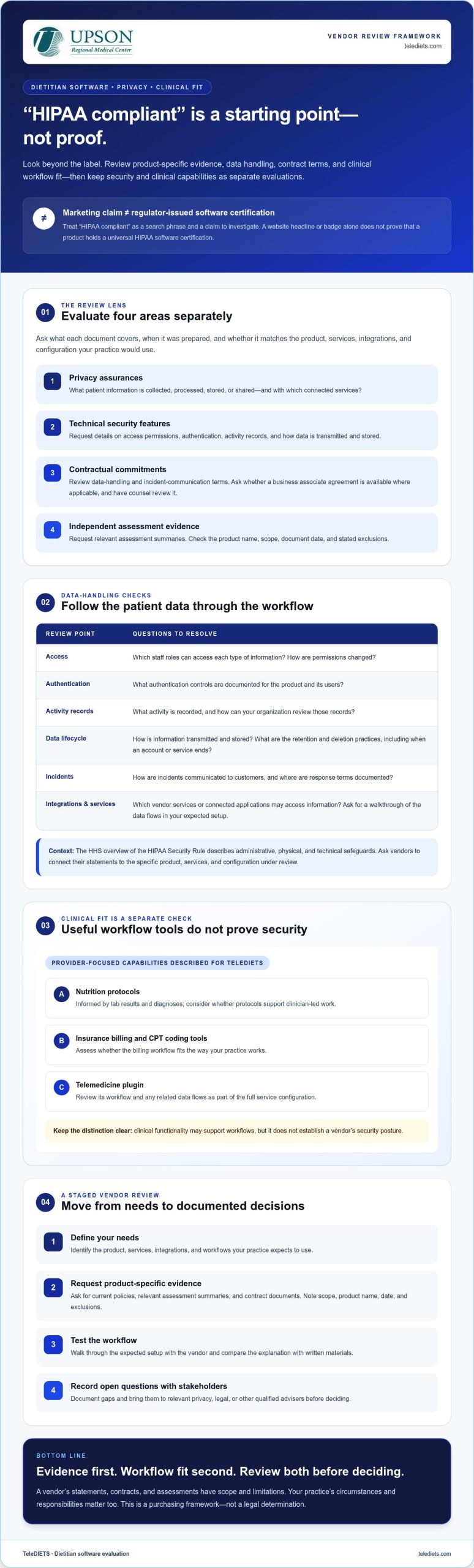
A vendor’s marketing label is a claim to investigate; product-specific documentation is evidence you can evaluate. Separate four areas in your review: privacy assurances, technical security features, contractual commitments, and independent assessment evidence. A website statement may not explain which product or services it covers. A contract or assessment also has a defined scope and limitations. Ask what each document applies to, when it was prepared, and whether it reflects the service and configuration your practice would use.
Does HIPAA-compliant software mean the product is certified?
Don’t infer certification from a website headline, generic badge, or broad statement about a company. Ask the vendor to explain the exact terminology it uses and provide current, product-specific documentation. Check that the product, integrations, and services described match what you are considering. Your practice’s circumstances can affect which obligations apply, so confirm relevant terminology and requirements with qualified privacy or legal advisers rather than relying on a vendor’s marketing.
Why dietitian practices should assess the whole relationship
Software is one part of a broader data-handling relationship. Consider what information enters the platform, which vendor services or integrations may access it, how staff use accounts, and what happens when a workflow changes or the service ends. Vendor safeguards and your organization’s practices are connected, but neither replaces the other. For example, a telemedicine workflow, billing tool, or connected application may create separate data flows to review. Ask the vendor to walk through those flows using the configuration you expect to use.
Use this distinction when assessing HIPAA compliant dietitian software: evaluate the vendor’s stated safeguards and contractual terms alongside your own workflows and organizational responsibilities. This is a purchasing framework, not a legal determination. Record unresolved questions and bring them to the appropriate advisers before deciding.
Which privacy and security evidence should dietitian software vendors provide?
Move from general assurances to evidence you can review. The HHS overview of the HIPAA Security Rule provides context for administrative, physical, and technical safeguards. Ask vendors to connect their statements to the specific product, services, and configuration your practice would use. If an answer refers to a company-wide policy, clarify how it applies to the software and workflows under consideration.
Security claims deserve product-specific evidence, not assumptions based on a badge or broad marketing statement. For HIPAA compliant dietitian software, request current policies, relevant assessment summaries, and contract documents. As you review them, note the document date, scope, product name, and any stated exclusions. A vendor’s willingness to provide materials is useful, but your organization’s qualified advisers should assess what those materials mean for your situation.
What to ask about protected health information
Ask the vendor to describe what patient information the platform collects, processes, stores, and shares with connected services. Request documentation on role-based permissions, authentication, activity records, and how data is transmitted and stored. Clarify retention and deletion practices, including what happens to information when an account or service ends. If the explanation is unclear, ask for a workflow walkthrough and compare it with the written materials.
- Which staff roles can access each type of information, and how are permissions changed?
- What activity is recorded, and how can your organization review those records?
- How are incidents communicated to customers, and where are response terms documented?
Review documents with the right advisers
Ask whether a business associate agreement is available where applicable, and have counsel review its terms. Request relevant security assessment summaries and contract documents that describe data handling and incident communication. Check whether the documents cover the product and services in your proposed setup, including any integrations you plan to use. If the vendor can’t answer a question or the documentation is unclear, record the gap and bring it to your organization’s privacy or legal adviser. This supports a careful review without turning a buyer checklist into a legal interpretation.
How to compare dietitian software for clinical fit and workflow
Keep clinical utility and privacy evidence in separate columns of your evaluation. A useful feature doesn’t prove safeguards, and security documentation alone doesn’t show that a platform supports your care workflows. For a risk-focused review, the American Medical Association’s overview of HIPAA security rule and risk analysis can provide additional context. Your organization’s advisers should interpret how it applies to your situation.
Which clinical and administrative capabilities matter?
Test representative medical nutrition therapy workflows. Can clinicians review and apply protocols informed by diagnoses and lab results? Do billing and CPT tools fit your existing processes? Does telemedicine fit how your team delivers care? Can staff complete common tasks without unnecessary workarounds? TeleDIETS, for example, offers nutrition protocols informed by lab results and diagnoses, insurance billing and CPT coding tools, and a telemedicine plugin. Assess these as workflow capabilities, not as evidence of security safeguards.
How should a clinic weigh features against evidence?
Score privacy documentation, clinical utility, usability, integration, and implementation needs as distinct criteria. For each item, record the evidence reviewed, who assessed it, and what remains unresolved. During a demonstration, use a consistent set of provider tasks across vendors so your team can compare like with like. This matrix can help focus the discussion:
Criterion | Evidence to request | Internal owner | Unresolved questions
Privacy | Product-specific safeguards and relevant assessments | Privacy or technology lead | What evidence is missing?
Clinical fit | Demonstration of protocols and clinician review | Clinical lead | Does it match care workflows?
Administration | Billing, CPT, and telemedicine workflow demonstration | Operations lead | Are workarounds needed?
Integration and implementation | Compatibility details and implementation requirements | Technology and operations leads | What dependencies remain?
Don’t treat a high feature score as a reason to overlook unanswered security questions. Resolve material concerns with the relevant stakeholders before deciding whether HIPAA compliant dietitian software fits your practice. Review TeleDIETS provider tools as one option for clinical workflow fit.
A practical vendor review before adopting dietitian software
A structured review helps your team move from vendor claims to a decision grounded in evidence and day-to-day fit. Define requirements first, then request documentation, test representative workflows, and record open questions. Include clinical, operational, privacy, and technology stakeholders so the review reflects how the practice will use the platform. A shared evaluation record can make it easier to track which questions have been answered and who owns the remaining follow-up.
Keep the stages distinct: a successful workflow demonstration doesn’t resolve security concerns, and complete documentation doesn’t prove the software suits your clinical processes. Before any pilot, get organizational approval for the test environment and data to be used. Don’t enter patient information until your organization has approved the platform and the relevant workflows.
What should a software evaluation pilot test?
Use approved test data to walk through common provider tasks, such as reviewing a protocol, completing a billing workflow, or testing a telemedicine connection. Check usability, permissions, and relevant integrations against your requirements. Ask participants to note friction, unexpected data flows, and questions the vendor hasn’t answered. Compare what happens in the demonstration with the vendor’s written description, assign an owner to each follow-up item, then review the findings with the appropriate stakeholders.
When should TeleDIETS enter the shortlist?
Consider whether TeleDIETS’ provider-focused medical nutrition therapy capabilities match your documented needs. Its protocols are informed by lab results and diagnoses, and it offers insurance billing and CPT coding tools plus a telemedicine plugin. These features may merit evaluation for clinical and administrative fit, but they don’t establish the platform’s privacy or security posture.
Before handling protected health information, request and review current product-specific security documentation and contractual terms, including whether a business associate agreement is available and under what conditions. Confirm open questions with your organization’s privacy or legal adviser. This evidence-led process helps you assess HIPAA compliant dietitian software without allowing a feature demonstration to stand in for a complete review. See TeleDIETS’ clinical nutrition platform.
Make Your Next Software Decision With Confidence
Choosing HIPAA compliant dietitian software calls for more than a reassuring label. Request product-specific privacy, security, and contractual evidence, then assess clinical functionality and workflow fit on their own merits. A structured review with clinical, operational, privacy, and technology stakeholders can help surface gaps before adoption.
TeleDIETS offers medical nutrition therapy software for healthcare professionals, including nutrition protocols informed by diagnoses and lab results, insurance billing and CPT coding tools, and a telemedicine plugin. These capabilities may align with your practice needs, but they don’t confirm security safeguards or contractual terms. Verify current documentation and review open questions with your organization’s qualified advisers before handling protected health information.
To assess whether its provider-focused tools fit your workflows, explore TeleDIETS’ clinical nutrition platform.
Frequently Asked Questions
Is all dietitian software marketed as HIPAA compliant actually compliant?
No. A vendor’s marketing description or badge doesn’t establish that HIPAA compliant dietitian software is appropriate for your practice’s handling of protected health information, or that your organization has met its own obligations. Request current, product-specific documentation and clarify which services and vendor roles it covers. Have your privacy or legal adviser review the arrangement before entering PHI. Evaluate verifiable evidence, not headline claims.
What should dietitians ask software vendors about patient-data handling?
Ask the vendor to explain what information the platform collects, processes, stores, and shares with connected services. Request documentation on access permissions, authentication, retention, deletion, and incident communication. Clarify which contract terms apply, including whether a business associate agreement is available where applicable. These questions help structure your review, but your organization’s privacy or legal adviser should assess the documentation and arrangement.
Does using HIPAA-compliant software automatically make a dietitian practice compliant?
No. Software is one part of a broader organizational environment that includes staff practices, data access, integrations, processes, and contracts. A vendor’s statements don’t establish that your practice has met its own obligations. Before using a platform with protected health information, ask qualified internal or external advisers to review the full arrangement alongside your organization’s policies and workflows. Don’t rely on a software label alone.
Can dietitian software support telehealth and clinical nutrition workflows securely?
It may support those workflows, but clinical features and security evidence need separate evaluation. Review how information moves through connected services and integrations, and ask how user permissions and data handling are documented. TeleDIETS provides medical nutrition therapy software and a telemedicine plugin; the available information doesn’t establish specific safeguards or contractual terms. Verify current, product-specific evidence with the vendor before deciding whether it fits your organization’s requirements.
Leave a Reply