
What if your clinic could turn patient lab data into an evidence-based nutrition prescription in seconds, without adding manual work? For high-volume teams, building plans one patient at a time can take hours. Connecting recommendations to lab results and sorting out CPT coding can add further steps. Clinical-grade nutrition intervention software can help organize these workflows while keeping provider review at the center.
If your goal is to deliver consistent Medical Nutrition Therapy (MNT) without increasing administrative work, the right tools can make a difference. This guide explains how software can support lab-informed prescriptions, organize insurance billing and CPT coding workflows, and help clinicians use nutrition protocols for patients taking GLP-1 medications. It also covers practical ways to assess a platform, including its planning capabilities, billing tools, and telemedicine fit, so you can choose an approach that works for your practice.
Key Takeaways
- See how nutrition intervention software can move clinical meal planning beyond static templates toward data-informed MNT prescriptions.
- Learn how lab data and clinical diagnoses can guide nutrition plans while leaving room for clinician review of individual needs.
- Explore how telemedicine workflows and CPT coding tools can reduce administrative friction around delivering and billing for nutrition services.
- Use practical criteria to assess clinical-grade tools, including planning capabilities, workflow fit, privacy safeguards, and billing features.
The Evolution of Nutrition Intervention Software in Clinical Practice
Medical Nutrition Therapy applies nutrition interventions to help manage health conditions through individualized, evidence-informed care. MNT software connects clinical information with nutrition planning by helping clinicians turn diagnoses and lab data into structured prescription drafts.
Earlier workflows often relied on static PDF meal plans and manual edits. Clinical-grade nutrition intervention software can use clinical diagnoses and lab data to help generate plans for providers to review and tailor. That brings nutrition support closer to routine chronic disease management, where recommendations need to reflect each patient’s clinical context.
For a foundational explanation of how nutritional content is assessed and how software can support that work, see Nutrition analysis software.
From Manual Planning to Automated Prescription
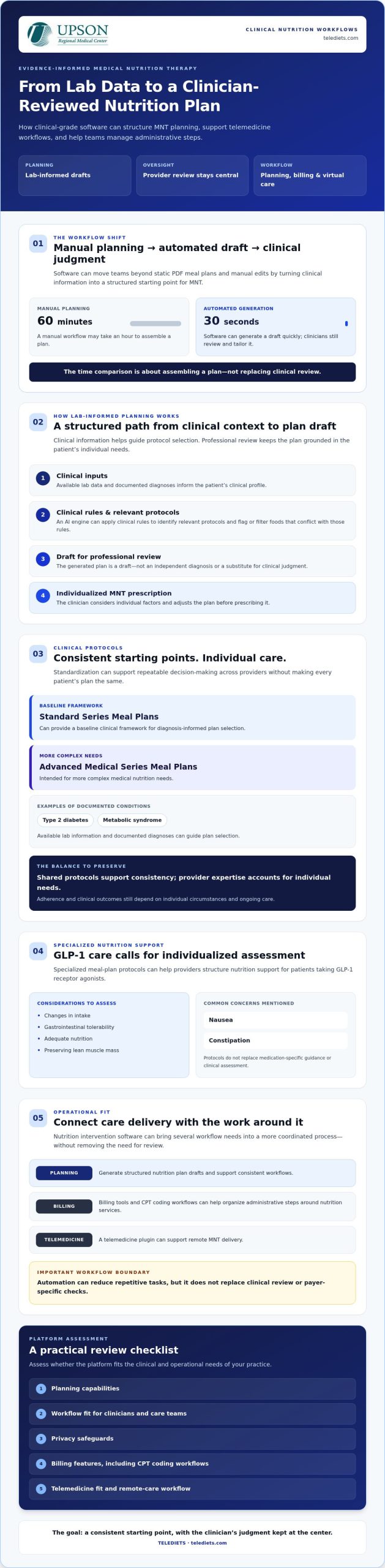
A manual planning workflow may take 60 minutes, while automated generation can create a draft in 30 seconds. For a high-volume team, that difference can reduce time spent assembling plans and leave more room for clinical review. Evidence-based protocols can also make recommendations more consistent across providers. They support repeatable decision-making, but clinicians remain responsible for reviewing each prescription and deciding whether it fits the patient.
The Clinical Impact of Standardized MNT
Structured nutrition workflows can make MNT a more practical part of chronic disease care. A shared protocol helps a medical group align how teams translate clinical information into nutrition interventions, rather than relying on separate templates and individual processes. Clear, relevant plans may also make recommendations easier for patients to understand and follow. Adherence and clinical outcomes still depend on individual circumstances and ongoing care.
Standardization does not mean giving every patient the same plan. It gives providers a consistent starting point, with room to apply their expertise and account for individual needs. For medical groups, that balance can support more coordinated care as nutrition services grow across teams.
Translating Lab Data into Precision Medical Nutrition Therapy
Lab-based nutrition prescription software helps clinicians connect a patient’s clinical profile with an appropriate nutrition plan. An AI engine can take lab data and documented diagnoses as inputs, then apply clinical rules to identify relevant protocols and flag or filter foods that conflict with those rules. The output is a draft for professional review, not an independent diagnosis or a substitute for clinical judgment.
In a high-volume telemedicine practice, automated customization can make consistent nutrition support more practical. Clinicians can review the generated plan, consider individual factors, and make adjustments before prescribing it. This workflow is especially relevant to chronic conditions where nutrition care needs to align with the broader treatment plan.
Diagnosis-Based Meal Planning Logic
For a patient with a diagnosis such as Type 2 diabetes or metabolic syndrome, a system can use the documented condition and available lab information to guide plan selection. Standard Series Meal Plans can provide a baseline clinical framework, while Advanced Medical Series Meal Plans are intended for more complex medical nutrition needs. These protocols give teams a consistent starting point without treating every patient as interchangeable.
Specialized Protocols for GLP-1 Support
Patients taking GLP-1 receptor agonists may need nutrition support that accounts for changes in intake and gastrointestinal tolerability. Supporting adequate nutrition and preserving lean muscle mass can be important considerations for clinicians to assess within an individualized care plan. Specialized GLP-1 meal plan protocols can help providers structure that support and consider common concerns such as nausea or constipation. They do not replace medication-specific guidance or clinical assessment.
For practices evaluating clinical meal planning options, review available meal plan protocols as one part of assessing how a platform could fit your care workflow.
Optimizing Clinical Workflows and Insurance Reimbursement
Adding MNT to an established clinic workflow can raise a practical question: will it create more work than it saves? Nutrition intervention software can reduce repetitive tasks by bringing plan generation, billing tools, and virtual care into a more coordinated process. A telemedicine plugin can also support remote MNT delivery, so practices can offer care without requiring every visit to take place in person.
Automation can help teams follow consistent workflows, but it does not replace clinical review or payer-specific checks. Providers still need to confirm that documentation reflects the services delivered and supports the patient’s care.
Navigating MNT Billing with CPT Codes
CPT codes 97802 and 97803 are used for initial and follow-up MNT assessments, respectively. Integrated insurance billing and CPT coding tools can help staff organize coding and documentation tasks alongside clinical workflows. Records should clearly describe the service provided and support medical necessity. Before submitting claims, verify current payer requirements, coding guidance, and reimbursement details, since coverage and payment can vary.
Seamless Telemedicine Integration
A dedicated telemedicine plugin can connect remote nutrition visits with a practice’s service delivery workflow. For provider networks working across locations, a shared virtual-care approach can help teams coordinate how they deliver MNT. Standardized plans and automated administrative steps may help clinics expand capacity, though staffing needs depend on each organization’s operations.
To assess whether an integrated approach fits your billing and virtual-care workflows, explore TeleDIETS clinical nutrition tools.
Selecting the Right Nutrition Intervention Software for Your Practice
Choose a platform designed for clinical Medical Nutrition Therapy, not simply an app that tracks food or offers general meal suggestions. Consumer tools may support everyday food logging. Clinical-grade software should help providers connect lab data and diagnoses with structured nutrition protocols, while leaving professional review in charge of the final prescription.
Compare options against your actual care process. For each platform, check what information it uses to generate a plan, how clinicians review and adjust the result, and whether billing and virtual-care features fit your existing workflow. Key considerations include:
- Clinical relevance: Does it support lab-informed planning and evidence-based protocols for medical needs? Can providers review and tailor generated plans?
- Privacy and security: Ask vendors about safeguards for protected health information and whether a Business Associate Agreement is available. Consult your organization’s privacy or legal advisers about your obligations.
- Billing workflow: Can integrated insurance billing and CPT coding tools help organize claims-related tasks? Confirm which steps remain manual.
- Virtual care: Will the telemedicine features fit how your providers deliver MNT and coordinate remote visits?
Essential Features for Healthcare Providers
An AI-powered engine can support scale by helping generate a clinical plan from diagnoses and lab data, while leaving providers responsible for review and clinical decisions. Evidence-based protocols should be central to the workflow. For practices managing more complex medical nutrition needs, assess whether Advanced Medical Series Meal Plans offer the level of protocol support you need alongside Standard Series Meal Plans and specialized GLP-1 Meal Plan Protocols.
TeleDIETS brings together an AI engine for healthcare professional use, lab-based prescription capabilities, insurance billing and CPT coding tools, and a telemedicine plugin. For providers comparing clinical nutrition platforms, these features bring planning and practice workflows into one clinical SaaS offering.
Implementation and Next Steps
Before adopting a clinical nutrition SaaS platform, map your current process: how clinicians review patient data, prepare MNT plans, conduct remote visits, and handle billing. Then compare each step with the software’s capabilities. Ask how the platform uses lab data and diagnoses, where providers review or edit a draft, and how billing and telemedicine features fit your team’s workflow. Providers ready to explore a subscription can visit the clinical software checkout.
Build a More Scalable MNT Workflow
Clinical nutrition care is moving beyond static plans toward workflows that connect patient data, evidence-based protocols, and provider review. The right nutrition intervention software can help clinicians turn lab results and diagnoses into draft prescriptions while supporting more consistent Medical Nutrition Therapy across teams.
As you evaluate options, look for tools that fit both clinical and operational needs. A lab-based AI prescription engine can reduce repetitive plan-building work, while insurance billing and CPT coding tools can help organize documentation and claims workflows. Specialized GLP-1 clinical protocols can also support providers caring for patients using these medications, with clinical judgment guiding each plan.
TeleDIETS brings these capabilities together with a telemedicine plugin to support remote MNT delivery. Explore how its clinical nutrition software could fit your practice and help your team scale care: Explore TeleDIETS clinical nutrition software.
A thoughtful implementation can help your team spend less time on manual processes and more time delivering coordinated, evidence-informed care.
Frequently Asked Questions
What is nutrition intervention software for healthcare providers?
Nutrition intervention software helps healthcare providers deliver Medical Nutrition Therapy through structured clinical tools. Depending on the platform, clinicians can use diagnoses and lab data to generate evidence-based nutrition plan drafts, review and tailor prescriptions, and support related billing or telemedicine workflows. It differs from a consumer food-tracking app because it is designed to assist professional care, not simply record an individual’s eating habits.
How does medical nutrition therapy software integrate with lab results?
Medical nutrition therapy software can use lab results and documented diagnoses as inputs when generating a nutrition plan draft. The clinician reviews the available information, considers the patient’s broader clinical context, and decides whether to modify or use the suggested protocol. When comparing platforms, check how they receive or record lab data, what information the engine uses, and which review steps remain with the provider.
Can I bill insurance for nutrition therapy provided through software?
Potentially, but using software does not guarantee that a service is covered or reimbursed. Coverage depends on payer policies, provider eligibility, documentation, and claim requirements. CPT 97802 is commonly used for an initial MNT assessment, while 97803 is used for reassessment. Billing and coding tools can help organize this workflow, but confirm current coding guidance and coverage with each payer before submitting claims.
Are there specific meal plan protocols for patients on GLP-1 medications?
Yes, clinical platforms may include specialized GLP-1 meal plan protocols for providers to consider as part of individualized nutrition care. These can help structure support around nutritional adequacy, lean muscle maintenance, and common gastrointestinal concerns. Protocols do not replace clinical assessment or medication guidance. Providers should review each plan in context and make decisions appropriate to the patient’s needs and care team.
Is nutrition intervention software HIPAA compliant?
Do not assume that software is suitable for protected health information based on a “HIPAA compliant” label alone. If a vendor handles protected health information on behalf of a covered healthcare organization, assess the vendor’s safeguards and whether it will sign a Business Associate Agreement. Review the platform with your organization’s privacy or legal advisers, who can assess your specific obligations and processes.
Leave a Reply