
Generic meal planning tools are an outright clinical liability when managing chronic kidney disease. As a clinician, you already know that manually calculating bio-available phosphorus, potassium, sodium, and protein targets devours hours of precious chart time. Worse, standard nutrient databases regularly overlook clinical kidney restrictions, leaving patients with unpalatable, static handouts that undermine dietary adherence. Implementing dedicated renal diet planning software for clinicians isn’t just an operational convenience; it’s an essential safeguard for complex care.
You shouldn’t have to compromise between clinical precision and practice productivity. Discover the critical clinical features, lab-integration standards, and reimbursement capabilities required to select enterprise renal nutrition software that protects your patients and empowers your team. In this comprehensive 2026 guide, we examine how automated electrolyte guardrails, seamless EHR interoperability, and built-in CPT coding for medical nutrition therapy can safely streamline your daily workflow while elevating long-term clinical outcomes.
Key Takeaways
- Identify the essential safety guardrails and micronutrient algorithms required when evaluating enterprise renal diet planning software for clinicians.
- Learn how automated clinical protocols translate shifting eGFR, phosphorus, and potassium labs directly into precise nutrition interventions within seconds.
- Discover how integrated CPT coding tools and telemedicine plugins eliminate charting bottlenecks while securing full medical nutrition therapy reimbursement.
- Evaluate core software licensing criteria and practice ROI models to confidently choose a scalable platform for your nephrology care team.
Core Evaluation Criteria for Clinical Renal Nutrition Software
Enterprise software selection begins with clinical validity, diagnostic adaptability, and multi-user administration. Modern nephrology practices require granular access controls, rapid record export options, and certified cloud infrastructure to safeguard protected health information across distributed care teams. Role-based permissions allow registered dietitians, nephrologists, and clinical coordinators to collaborate efficiently without duplicating chart documentation. Within complex metabolic care, clinical nutrition demands purpose-built renal diet planning software for clinicians that operates far beyond the scope of generic wellness trackers.
Automated Micro and Macronutrient Guardrails Across CKD Stages
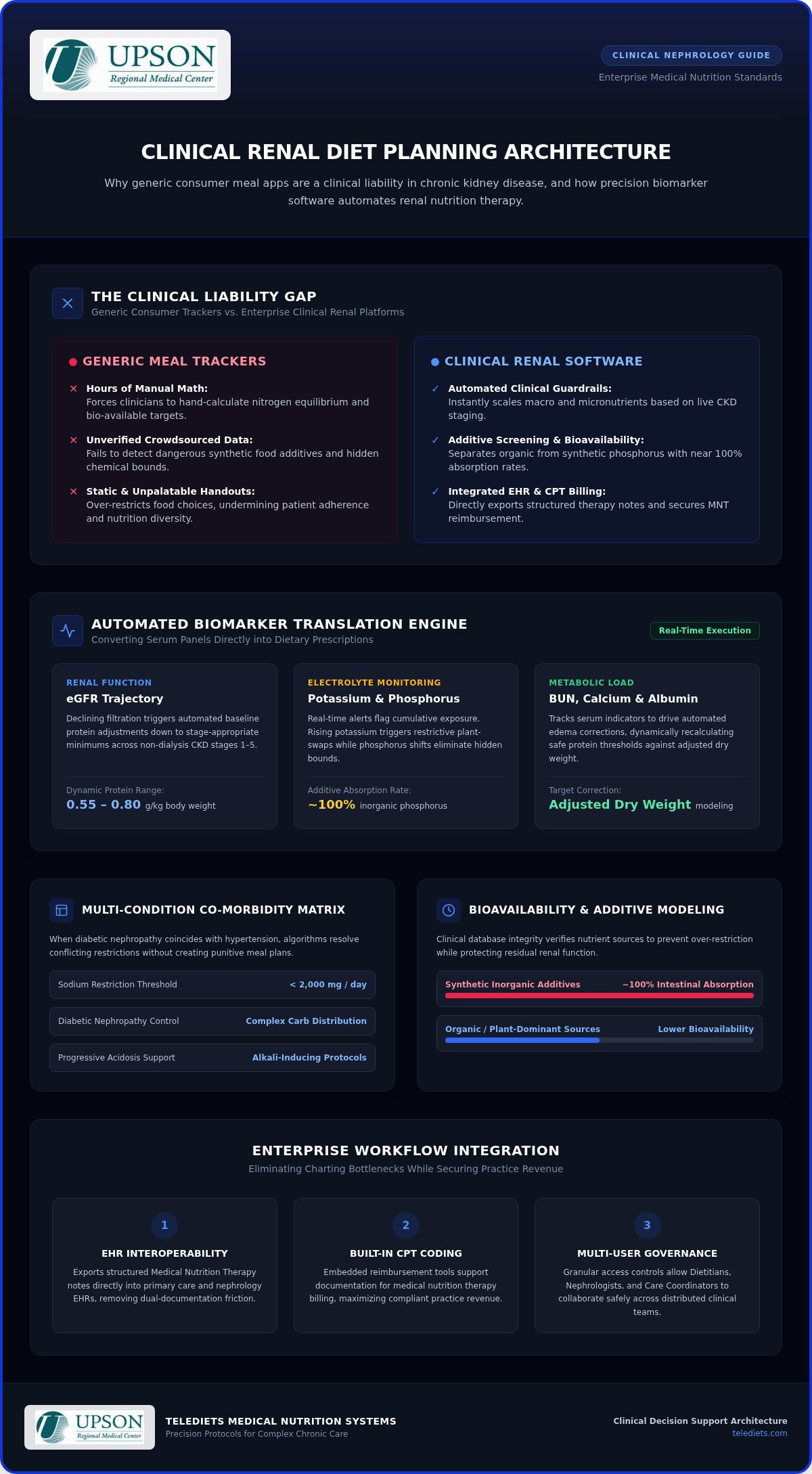
Non-dialysis CKD stages 1 through 5 demand contrasting metabolic targets. An enterprise platform must automatically calculate individualized protein targets between 0.55 and 0.80 g/kg of body weight, dynamically scaling recommendations as glomerular filtration changes. Built-in clinical guardrails must actively flag dangerous micronutrient thresholds. Real-time alerts warn providers about cumulative electrolyte exposure, preventing acute hyperkalemia, hyperphosphatemia, and fluid overload before a plan ever reaches the patient.
Database Clinical Integrity and Food Additive Screening
Crowdsourced databases are a clinical liability in nephrology. High-performing renal diet planning software for clinicians utilizes verified food libraries capable of detecting inorganic phosphorus additives embedded in processed food labels. Because synthetic additives have an intestinal absorption rate near 100%, software algorithms must differentiate between organic and inorganic sources. Precise bioavailability modeling for plant-dominant versus animal-dominant protein ensures patients receive safe, diverse nutritional therapy. This algorithmic precision prevents over-restriction, keeping meals appetizing while protecting residual renal function.
Translating Patient Biomarkers into Automated Dietary Protocols
Modern clinical architecture translates raw blood chemistry panels directly into actionable nutrition plans within seconds. Rather than spending half an hour hand-calculating nitrogen equilibrium, specialized platforms ingest laboratory biomarkers to program precision meals instantly. Automated clinical software converts complex lab inputs into tailored medical nutrition prescriptions by matching serum indicators to restrictive therapeutic algorithms. Adopting robust renal diet planning software for clinicians ensures these calculations remain dynamic, updating menu designs the moment fresh blood panels post.
Biomarker Input Architecture: eGFR, Electrolytes, and BUN
Precision software maps clinical parameters across several interdependent metrics:
- Glomerular Filtration: Declining eGFR automatically ratchets baseline protein targets down to stage-appropriate minimums.
- Serum Electrolytes: Elevated potassium triggers restrictive plant-swaps, while rising phosphorus eliminates hidden chemical bounds.
- Metabolic Byproducts: BUN, serum calcium, and albumin drive automated edema corrections, recalculating protein against adjusted dry weight.
Co-Morbidity Balancing in Complex Renal Populations
Renal pathology rarely occurs in isolation. When diabetic nephropathy coincides with hypertension, clinicians face conflicting priorities: moderating glycemic impact while restricting potassium and sodium. Manual meal planning quickly leads to patient non-compliance due to overly bland, punitive choices. Sophisticated platforms resolve this by deploying Advanced Medical Series protocols that harmonize sodium limits below 2,000 mg daily with complex carbohydrate distribution and alkali-inducing foods for progressive acidosis. To deploy these multi-condition workflows in your practice, explore how TeleDIETS streamlines medical nutrition protocols for complex chronic care.
Workflow Integration: EHR Connectivity, Telemedicine, and CPT Billing
Clinical efficacy means little if charting administrative burdens overwhelm your daily schedule. For nephrology practices and specialized dietitians, documentation friction during encounters directly restricts patient volume. Dedicated renal diet planning software for clinicians eliminates this bottleneck by exporting structured nutritional therapy notes directly into major primary care and nephrology EHRs. Instead of navigating separate, disconnected software systems, clinicians manage dietary protocols within their existing electronic health record interface.
Capturing Revenue with Automated CPT Coding for MNT
Securing appropriate reimbursement for Medical Nutrition Therapy demands exact time tracking and documentation rigor. Integrated billing engines automate coding for common renal encounters:
- CPT 97802: Documents the initial assessment, tracking 15-minute face-to-face units with built-in audit compliance.
- CPT 97803: Streamlines follow-up reassessment charting, verifying qualifying time increments as clinical interventions evolve.
- CPT 97804: Captures documentation requirements for group medical nutrition therapy encounters and major condition changes.
Remote Delivery via Telehealth Portals and Patient Communication
Virtual encounters are now a foundational care model for chronic disease management. Incorporating a purpose-built telemedicine plugin allows clinicians to conduct secure consultations, distribute dynamic dietary plans, and monitor between-visit patient compliance asynchronously. Digital meal plan delivery replaces obsolete, static handouts with interactive guidance that drives real-world adherence. Connecting clinical charting directly to compliant billing ensures your practice scales without sacrificing documentation quality. To eliminate administrative hurdles and modernize your virtual workflow, schedule a consultation with TeleDIETS today.
Selecting the Right Renal Platform: Enterprise Decision Matrix
Selecting the right technology stack requires balancing clinical liability against operational efficiency. When comparing consumer tracking apps, basic EHR diet templates, and dedicated clinical SaaS, the differences in diagnostic safety are stark. Generic templates lack dynamic stage-specific mineral algorithms, while purpose-built renal diet planning software for clinicians delivers audited nutrient modeling and measurable return on investment through accelerated chart completion.
Clinical-Grade SaaS vs. Consumer Tracking Apps: Core Differences
Consumer trackers rely heavily on unverified, crowdsourced entries. In chronic kidney disease management, relying on inaccurate micronutrient data introduces severe clinical risk, especially when bioavailable phosphorus additives go unflagged. Professional clinical platforms eliminate this liability through peer-reviewed biochemical databases and automated safety warnings. Practices seeking to equip their teams with verified medical nutrition therapy capabilities can transition smoothly through professional clinical software licensing.
Implementation Strategy for High-Volume Nephrology Practices
Deploying specialized software across a multidisciplinary care team follows a structured clinical pathway:
- Staff Onboarding: Integrate physicians, nurse practitioners, and registered dietitians into standardized, role-based access tiers.
- Quality Checkpoints: Establish automated review triggers ensuring generated meal protocols align with nephrology directives before chart sign-off.
- Outcome Tracking: Benchmark practice performance by tracking saved clinician charting hours alongside longitudinal serum biomarker stability.
Adopting dedicated renal diet planning software for clinicians transforms fragmented dietary workflows into a standardized, high-yield clinical asset that protects patient outcomes.
Transform Your Practice with Precision Renal Care
Delivering exceptional chronic kidney disease care requires clinical technology that matches the biochemical complexity of your patients. Moving away from manual calculations to automated, lab-driven guardrails actively prevents electrolyte complications while recovering hours of documentation time each week. Seamless EHR connectivity and integrated CPT coding tools ensure your practice captures full insurance reimbursement for every medical nutrition therapy consultation, transforming clinical nutrition into a financially viable, scalable service line.
Built upon enterprise clinical software infrastructure developed by Lifestyles Technologies, modern platforms generate diagnosis-aligned, lab-adjusted meal protocols within seconds. Selecting dedicated renal diet planning software for clinicians empowers your multidisciplinary care team to deliver responsive, evidence-based nutritional therapy without administrative exhaustion. You don’t have to choose between clinical safety and daily productivity. Ready to modernize your workflow and expand your patient reach? Deploy professional clinical software to empower your practice and elevate patient outcomes today.
Frequently Asked Questions
How does renal diet planning software adjust for different stages of chronic kidney disease?
Dedicated renal diet planning software for clinicians dynamically adjusts nutrient targets based on the patient’s specific CKD stage and eGFR benchmarks. For non-dialysis stages 1 through 5, the software dials protein allowances between 0.55 and 0.80 g/kg body weight while restricting daily sodium. As renal filtration declines or laboratory alerts trigger, the platform recalibrates potassium, phosphorus, and fluid allowances, generating revised meal plans without manual provider recalculations.
Can renal nutrition software integrate directly with existing clinic EHR and telemedicine platforms?
Yes, enterprise clinical platforms integrate smoothly into existing electronic health records and virtual workflows. Providers can embed a specialized telemedicine plugin directly into their current portal, enabling secure video encounters and asynchronous dietary tracking. Chart notes, lab-tailored meal protocols, and compliance records export cleanly back into primary care and nephrology EHRs, eliminating double-entry and keeping the clinical team aligned across every encounter.
What specific CPT codes can clinics bill when utilizing clinical medical nutrition software?
Clinics bill CPT codes 97802, 97803, and 97804 for qualified medical nutrition therapy services. CPT 97802 covers initial assessments in 15-minute increments, while CPT 97803 reimburses follow-up visits. CPT 97804 covers group encounters and condition reassessments. Dedicated software features integrated billing tools that track encounter duration and documentation compliance, ensuring claims meet CMS time requirements and telehealth modifiers without administrative friction.
How do clinical-grade nutrition platforms handle hidden inorganic phosphorus in foods?
Clinical platforms screen ingredient profiles against curated biochemical food libraries to isolate synthetic phosphorus additives. Because inorganic phosphorus additives absorb at nearly 100% in the gut, standard nutrient tables underestimate toxicity. Advanced software detects chemical preservatives like phosphoric acid and polyphosphates, automatically substituting them with additive-free alternatives. This algorithm ensures patients avoid toxic mineral accumulation while preserving dietary variety and palatability.
Can renal diet planning software manage patients with concurrent diabetes and kidney disease?
Yes, specialized renal diet planning software for clinicians utilizes multi-condition protocols to balance overlapping metabolic restrictions. When managing diabetic nephropathy, the system simultaneously calculates glycemic index, carbohydrate distribution, and strict electrolyte guardrails. Deploying Advanced Medical Series meal plans allows clinicians to prevent hyperkalemia and fluid retention without compromising blood glucose control, offering patients safe, nutritious menus tailored to both diagnoses.
Leave a Reply