
Which tools can carry nutrition care from assessment through follow-up without creating another disconnected workflow? When lab findings, individualized plans, clinical documentation, and billing live in separate systems, even thoughtful care planning can add administrative work. The right clinical nutrition care delivery tools can help connect these steps while keeping clinical decisions in the hands of qualified professionals.
A useful solution needs to do more than generate a plan. It should fit your care model, support personalization, and help coordinate follow-up and practice tasks. This guide explains the core functions to look for and offers practical criteria for assessing clinical fit, workflow integration, and administrative needs.
You’ll also see how nutrition planning, telemedicine, and insurance billing and CPT coding tools can work together. TeleDIETS brings personalized dietary protocols, specialized meal plan options, billing and coding tools, and a telemedicine plugin into a provider-focused offering. Use this guide to identify where your current process breaks down and choose a practical next step for supporting nutrition services in your setting.
Key Takeaways
- Distinguish provider-led clinical nutrition care delivery tools from consumer diet apps and meal delivery services.
- Check whether a tool can use relevant patient information to support individualized plan preparation and fit your follow-up workflow.
- Evaluate clinical fit, usability, and integration against your team’s workflow needs and intended nutrition service model.
- Consider how TeleDIETS combines specialized meal plan protocols with billing, coding, and telemedicine workflow tools.
What Are Clinical Nutrition Care Delivery Tools?
Clinical nutrition care delivery tools are digital and operational resources that help healthcare professionals organize provider-led nutrition services. Depending on their features, they may support assessment, individualized care planning, communication, follow-up, and administrative tasks. They are not consumer meal delivery services or general-purpose diet apps. For a high-level overview of the field, see Clinical nutrition.
The goal is to connect parts of care that can otherwise become fragmented. Technology can help prepare or organize information, but qualified professionals remain responsible for interpreting it, making clinical decisions, and building a relationship with the patient.
Which parts of nutrition care can tools support?
A tool may support the path from reviewing relevant clinical information to communicating a plan and arranging follow-up. Its functions generally fall into two groups:
- Clinician-facing: Organizing patient information, supporting plan preparation, documenting care, and assisting with workflow tasks such as billing or coding.
- Patient-facing: Providing access to care plans or supporting communication and follow-up, depending on the platform’s features.
These functions should work together in a way that suits the provider’s care model. A feature is useful when it supports the team’s process without obscuring clinical oversight.
How do clinical tools differ from consumer nutrition apps?
Clinical tools are designed around provider-directed medical nutrition therapy. They may help a care team use relevant diagnoses or lab information when preparing an individualized plan, then document and communicate that plan as part of ongoing care. The provider reviews and applies the information using professional judgment.
Consumer nutrition apps and meal delivery services serve different purposes. They are not substitutes for clinical workflows that connect assessment, care planning, provider-patient communication, and follow-up. When evaluating a tool, consider whether it supports your intended patient population and service model, rather than simply offering nutrition-related features.
How Clinical Nutrition Tools Connect Plans, Follow-Up, and Practice Workflows
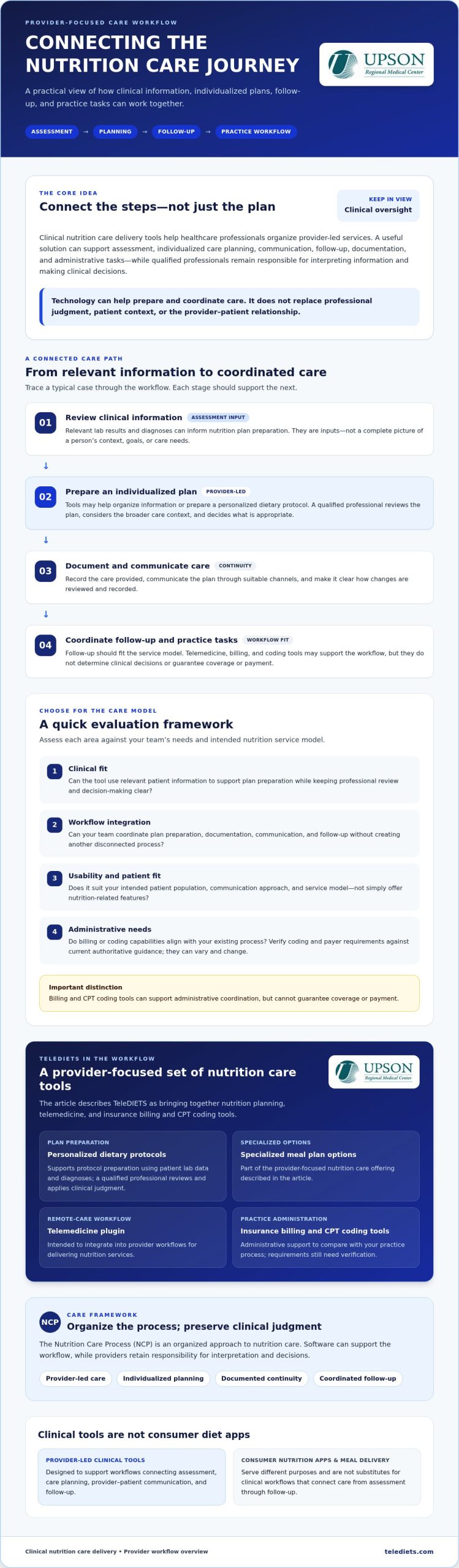
Useful clinical nutrition care delivery tools help teams move from clinical information to plan preparation and follow-up without treating each step as a separate task. This aligns with the Nutrition Care Process (NCP), a framework that guides dietitians through an organized approach to nutrition care. Software can support the workflow, while providers retain responsibility for clinical interpretation and decisions.
From clinical information to an individualized nutrition plan
Relevant lab results and diagnoses can inform nutrition plan preparation. For example, TeleDIETS supports generating personalized dietary protocols using patient lab data and diagnoses. These inputs are a starting point, not a substitute for reviewing the person’s broader context, goals, and care needs. The qualified professional must assess whether a prepared plan is appropriate and make clinical decisions accordingly.
Documentation and follow-up remain important after a plan is prepared. Providers need to record care in a way that supports continuity, communicate the plan through suitable channels, and determine how future contact fits their service model. When assessing a tool, trace a typical case through each step. Note where information is entered, who reviews the plan, and how the team records and communicates changes. A tool should make these steps easier to coordinate, not imply that automated preparation alone completes care.
Where telemedicine and billing tools fit
A telemedicine plugin may connect nutrition services with a provider’s remote-care workflow. Consider how it fits alongside plan communication and follow-up, and whether it supports the way your team delivers care. TeleDIETS includes a telemedicine plugin intended to integrate into provider workflows.
Billing and CPT coding tools can support administrative coordination, but they cannot guarantee coverage or payment. Coding and payer requirements may vary and can change, so verify them against current authoritative guidance before relying on them. TeleDIETS also offers insurance billing and CPT coding tools as part of its provider-focused nutrition care offering. Comparing these capabilities with your existing process can help clarify whether they meet your practice’s needs.
How to Evaluate Clinical Nutrition Care Delivery Tools
Evaluate clinical nutrition care delivery tools against the work your team needs to do, not just a feature list. The Nutrition Care Process offers a useful reference for considering how a tool supports organized nutrition care. Use this sequence to structure your review:
- Define workflow needs. Map how your team handles assessment, plan preparation, communication, follow-up, and documentation. Identify handoffs, repeated data entry, or points where follow-up can lose continuity. These are the specific problems a tool should help address.
- Assess clinical fit. Check whether it supports your intended patient population and nutrition service model. Clarify which data inputs it uses, how providers review plans, and what controls they have to revise or reject a prepared plan.
- Test usability. Ask the staff who will use the system to walk through common tasks. Can they review and update a plan, communicate it appropriately, and coordinate follow-up? Make sure the workflow keeps clinician review distinct from automated preparation.
- Review integration. Confirm how the tool fits existing systems and responsibilities, including data-sharing needs, staff training, and governance review.
Questions to ask before adopting a tool
Ask whether the platform supports each step in your care pathway and makes team responsibilities clear. Find out what information informs plan preparation, who reviews the output, and how changes are recorded and communicated. Ask staff to describe what happens when a plan needs revision or when a follow-up task is due. A tool should support professional oversight, not make autonomous clinical decisions on the provider’s behalf.
How to assess workflow fit before implementation
Walk through a typical care process with clinical, administrative, and technology stakeholders. Note where information is entered more than once, where handoffs occur, and where follow-up can lose continuity. Verify integration requirements and training needs before implementation, and agree on how the team will oversee use.
Review billing support separately from reimbursement decisions. Coding tools may assist administrative workflows, but they do not establish coverage or guarantee payment. Confirm coding accuracy and applicable payer requirements using current authoritative guidance. To review how provider workflow tools can fit nutrition services, visit TeleDIETS.
How TeleDIETS Supports Provider-Led Nutrition Care Delivery
TeleDIETS brings together several provider-focused functions: personalized dietary protocols based on patient lab data and diagnoses, specialized meal plan protocols, insurance billing and CPT coding tools, and a telemedicine plugin. As one example of clinical nutrition care delivery tools, it can support plan preparation and practice workflows while qualified professionals retain responsibility for reviewing information and making clinical decisions.
Match platform capabilities to your practice needs
Consider whether the available capabilities align with your patient population and service model. TeleDIETS offers Standard Series and Advanced Medical Series Meal Plans, as well as GLP-1 Meal Plan Protocols. These are provider-facing resources, not patient-specific recommendations. Clinicians determine whether and how a protocol fits their professional approach to care.
Assess each function against the workflow criteria discussed earlier. Do diagnosis- and lab-informed plans support your planning process? Can the telemedicine plugin fit the way your practice delivers remote care? Would the insurance billing and CPT coding tools assist with administrative tasks? Confirm current capabilities and availability directly, and review workflow or integration requirements rather than assuming they will match your existing systems.
Billing and coding features may help organize administrative work, but they do not guarantee payer coverage or reimbursement. Review coding accuracy and payer requirements using current authoritative guidance, and keep clinical review distinct from administrative processing.
Take a practical next step
Start by comparing the platform’s functions with the needs you identified: plan preparation, remote-care workflows, and billing support. Then consider whether the available features fit your team’s responsibilities and processes. A focused review can help you decide whether TeleDIETS merits further consideration without assuming it is the right fit for every practice.
Review the available clinical software access options to assess whether they align with your care model and workflow.
Move Toward a More Connected Nutrition Workflow
Effective clinical nutrition care delivery tools should support a connected care pathway, fit your team’s service model, and leave clinical decisions with qualified professionals. A practical evaluation starts with workflow needs, then considers clinical fit, usability, and integration. Billing and CPT coding features can help with administrative tasks, but they do not guarantee coverage or payment.
TeleDIETS brings together personalized nutrition plans based on lab results and clinical diagnoses, specialized meal plan protocols, insurance billing and CPT coding tools, and a telemedicine plugin. Consider whether these capabilities align with how your practice prepares plans, supports remote care, and coordinates administrative work.
With clear requirements and thoughtful review, your team can move toward nutrition services that are easier to coordinate while keeping provider judgment at the center of care. Explore TeleDIETS clinical nutrition tools to see whether the platform fits your setting.
Frequently Asked Questions
How can software support medical nutrition therapy in a clinic?
Software can help a clinic organize nutrition planning and related workflow tasks. Depending on the platform, this may include preparing individualized protocols from relevant clinical information, supporting remote care through telemedicine features, and assisting with billing or CPT coding processes. Providers should assess which steps a specific tool supports, how it fits team responsibilities, and whether clinical review remains part of the process.
Can clinical nutrition software create plans from lab results?
Yes, some clinical nutrition software can use lab results as inputs when preparing personalized dietary protocols. TeleDIETS, for example, supports plans informed by patient lab data and clinical diagnoses. These outputs are intended to support provider-led care, not make independent clinical decisions. A qualified professional should review relevant information, consider patient context, and determine whether a prepared plan is appropriate.
What should providers look for when evaluating nutrition care tools?
Start by checking whether a tool fits your intended patient population and nutrition service model. Review what information it uses, how providers can assess and revise plans, and whether communication and follow-up fit your workflow. Test usability with the staff who will use it, and confirm integration and training needs. Evaluate billing features separately from coding accuracy, payer requirements, and reimbursement decisions.
Do clinical nutrition care tools replace a dietitian or physician?
No. These tools can support tasks such as organizing information, preparing plans, or coordinating administrative workflows, but they do not replace the expertise and judgment of a dietitian, physician, or other qualified professional. Providers remain responsible for interpreting clinical information, deciding what care is appropriate, and maintaining the provider-patient relationship. Technology should assist the care process, not act as an autonomous clinician.
Leave a Reply