
What if the best code isn’t the one that seems to fit the appointment, but the one supported by the service you actually delivered? If you’ve paused over a code, questioned whether your note supports a claim, or found payer instructions that don’t match, you’re not alone. This medical nutrition therapy coding guide starts with a practical principle: code the documented service, then verify it against current payer rules.
Use the steps below to review an MNT claim: identify the service, check the applicable code definition, confirm the record supports the service, and verify diagnosis, practitioner, and payer requirements. Medicare guidance can be a useful reference, but it does not replace checking the current rules for each payer. A consistent process can help teams catch missing or mismatched details before submission. Integrated billing and CPT coding tools can support that process within an MNT workflow, while professional judgment and payer verification remain essential.
Key Takeaways
- This medical nutrition therapy coding guide separates code selection from diagnosis coding, coverage decisions, and claim payment.
- Use the service delivered, setting, and format to guide code review, then confirm current code descriptors before billing.
- Check that the record supports the service, time, practitioner, and clinical rationale, and verify diagnosis and medical-necessity requirements with the payer.
- A repeatable review workflow and integrated billing tools can make coding checks easier to manage without replacing professional judgment or payer verification.
What Medical Nutrition Therapy Coding Covers, and What It Does Not
MNT coding translates the nutrition service delivered into claim codes under applicable coding guidance and payer rules. Accurate coding means the selected codes and claim details reflect the documented service. It does not, by itself, establish coverage, guarantee reimbursement, or mean that a payer will approve the claim.
MNT is part of Clinical nutrition, which applies nutrition care in the context of health conditions. For billing, keep four steps distinct: select the CPT code that represents the service, report diagnosis information supported by the record, check the payer’s coverage rules, and submit the claim for adjudication. A correctly coded claim may still be denied for reasons unrelated to code selection.
This medical nutrition therapy coding guide is educational, not a substitute for current code-set guidance, payer instructions, or professional judgment. Use it to organize your review, then verify requirements for the specific claim.
Which coding references should a practice check?
Use the applicable AMA CPT materials to review code definitions, CMS guidance for relevant Medicare requirements, and the specific payer’s policies for coverage and billing instructions. These sources serve different purposes; one cannot replace another. Check that each reference applies to the payer and date of service before relying on it.
Why one coding answer may not fit every claim
Begin with the service documented, then consider its context. The format and setting, practitioner circumstances, diagnosis information, and payer rules may all affect review. Medicare guidance can inform a Medicare claim, for example, but should not be assumed to govern a commercial plan or a state Medicaid program. Confirm the requirements for the particular payer and claim instead of relying on a universal code or coverage assumption.
How to Choose an MNT Code Based on the Service Delivered
Start with the service documented, not with a code chosen in expectation of a particular payment. Separating code selection from coverage review helps make the process consistent while leaving coverage and reimbursement decisions to the applicable payer.
- Identify the service: Determine whether the encounter involved an initial assessment, follow-up or reassessment, or group service. Use the note to establish what took place, rather than relying on the appointment label alone.
- Confirm the setting and format: Record whether the service was individual or group, and whether it was in person or delivered by telehealth.
- Check current code guidance: Compare the documented service with current CPT materials. CPT 97802, 97803, and 97804 are examples to investigate for different MNT service types, not codes to assign by label alone.
- Review payer rules: Check coverage, practitioner, referral, and claim requirements for the payer and service date. For Medicare, consult relevant guidance, such as Medicare MNT Coverage Requirements.
Verify code-set updates and payer policy for the date of service. A coding reference or workflow tool can help organize the review, but it cannot replace professional judgment or payer verification.
How do assessment, follow-up, and group services affect code review?
These service distinctions help frame the review, but they do not replace the current CPT descriptors. Check whether the documented service aligns with the applicable code definition, including requirements for service type and time. For code-specific detail, consult dedicated CPT 97802 and CPT 97803 guides alongside authoritative, current CPT materials.
What should change when the format or setting changes?
Repeat the relevant checks when a service shifts between individual and group, or between in-person and telehealth formats. A format alone does not determine code use or coverage. Verify how the payer handles the setting, which claim details it requires, and whether telehealth rules apply to that service date.
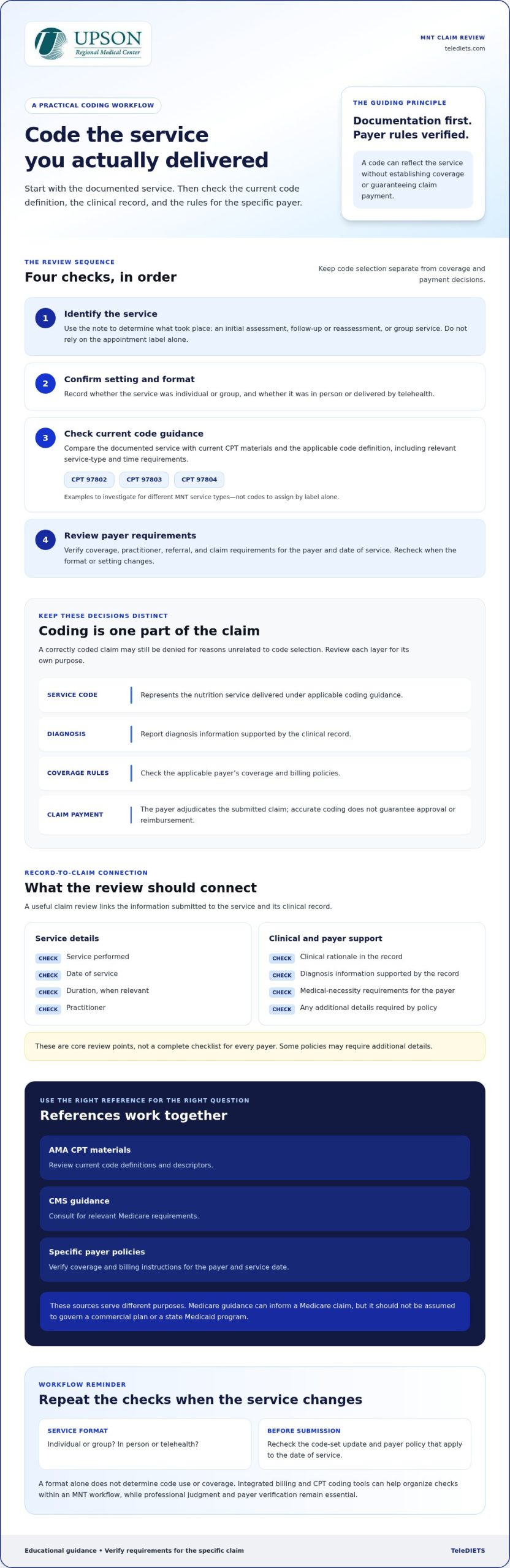
What MNT Documentation and Claim Checks Help Support Accurate Coding?
A useful claim review connects the clinical record to the information submitted. Document the service performed, date, duration when relevant, practitioner, and clinical rationale. Diagnosis and medical-necessity information should be supported by the clinical record and assessed against the payer’s applicable requirements. These are core review points, not a complete checklist for every payer; some policies may call for additional details.
Complete records, accurate code selection, and payer-specific review work together to support a well-substantiated MNT claim. Before submission, compare the claim fields with the clinical record rather than relying on memory or copying a prior claim. A useful medical nutrition therapy coding guide can structure this review, but it cannot guarantee approval. For additional coding context, consult the MNT Coding and Billing Guide from AAPC and check current authoritative guidance.
Which record details should a billing team reconcile?
Review the service note, selected code, diagnosis information, practitioner details, and claim data together. Ask whether the claim reflects the documented service and whether identifying details align across the records. Treat these as general review practices, not a universal payer checklist. Confirm whether the relevant plan or program specifies additional documentation or claim fields, or consider working with a revenue cycle partner like Meridian RCM to support ongoing accounts receivable and claim management.
How should a practice handle a denial or unclear policy?
Start with the remittance or denial reason, then check the coding guidance and policy that applied on the service date. Identify whether the issue concerns coding, documentation, eligibility, or coverage before correcting or resubmitting the claim. If the answer remains unclear, consult qualified billing or compliance resources, or contact the payer. Integrated billing and CPT coding tools can support routine checks, alongside professional review. Explore MNT billing and coding tools to see how workflow support may fit into your practice.
How to Build MNT Coding Checks Into a Clinical Workflow
A repeatable sequence makes coding review part of the workflow rather than a last-minute claim check. Assign clear responsibilities so the clinical record and billing review connect, and define who resolves questions before a claim is submitted.
- Complete the clinical note: The practitioner records the service delivered and its relevant clinical rationale.
- Review the code: A designated team member compares the documented service with current code guidance.
- Check payer requirements: Confirm applicable coverage and claim instructions for the payer and date of service.
- Reconcile and submit: Compare the claim with the record, resolve discrepancies, and document who completed the review.
Keep reference materials current and make responsibility clear when guidance changes. A practical medical nutrition therapy coding guide can support a consistent review sequence, but the team still needs to verify current requirements and apply professional judgment.
Where can software support MNT billing work?
TeleDIETS provides provider-facing MNT software with integrated insurance billing and CPT coding tools. The platform also supports clinicians in generating personalized dietary protocols based on patient lab data and diagnoses. Used within an established workflow, these tools can keep coding checks connected to administrative tasks. They do not replace human review or confirm coverage, so practices should verify current product features rather than assume the software automates every payer’s rules.
What should a practice verify before adopting a workflow tool?
Map your existing documentation, coding review, payer checks, and claim responsibilities before assessing a tool. In a product walkthrough, ask how the current functions fit those steps, what information staff must still verify, and where human review remains necessary. Confirm that the workflow meets your practice’s needs before making changes. The goal is a reliable process, not a promise of payment or compliance.
Make MNT Coding a Consistent Part of Care
A reliable coding process starts with the service documented, then checks the code against current guidance and the payer’s rules. Keep the clinical record and claim details aligned, and treat code selection, coverage review, and payment decisions as separate steps. This medical nutrition therapy coding guide offers a repeatable framework, but current code definitions and payer policies still need to be verified for each claim.
Clear review responsibilities and current references can help your team apply that process consistently. Provider-facing tools can also bring billing and CPT coding checks into existing MNT workflows, while leaving final decisions to qualified reviewers.
TeleDIETS offers provider-facing MNT software with integrated insurance billing and CPT coding tools, plus clinical nutrition plans designed for healthcare provider workflows. Explore TeleDIETS MNT billing and coding tools to see how workflow support could fit your practice.
Frequently Asked Questions
What CPT codes are commonly associated with medical nutrition therapy?
CPT 97802, 97803, and 97804 are commonly discussed in connection with MNT services. Check current authoritative CPT materials for their descriptors and appropriate use, then match the code to the service documented. A code’s existence does not establish coverage or payment. Before submitting a claim, verify the payer’s requirements for the service date.
How do I know whether to use CPT 97802 or 97803?
Does Medicare cover medical nutrition therapy for every patient?
No. Medicare Part B coverage is not universal. Current Medicare guidance identifies diabetes, chronic renal disease, and a kidney transplant within the previous 36 months as qualifying conditions, and requires a physician referral and services by an eligible Registered Dietitian or Registered Dietitian Nutritionist. Verify current CMS requirements for the claim. Commercial and Medicaid policies may differ, so check the relevant payer’s rules.
What documentation should support an MNT claim?
The record should accurately reflect the service delivered and meet applicable coding and payer requirements. As a general review, reconcile the service note, date, practitioner, diagnosis information, and submitted claim details. These items are not a universal checklist because payer documentation rules can vary. Confirm the current policy for the specific claim, and seek qualified billing or compliance guidance if a requirement is unclear.
Can MNT services delivered by telehealth be billed using the same coding rules?
Not necessarily. Telehealth requirements can vary by payer and may involve coverage, place-of-service, or other claim details. Medicare’s current MNT telehealth coverage is extended through December 31, 2027; its guidance identifies POS 02 for telehealth outside the patient’s home and POS 10 for services in the home. Verify current Medicare or other payer instructions for the service date and delivery format before billing.
Leave a Reply