
What if nutrition care could be more consistent without adding another disconnected task to your team’s workload? Nutrition management for healthcare providers works best when assessment, clinical decisions, plan delivery, documentation, and follow-up connect across visits and roles. When those steps are fragmented, sound guidance can be difficult to deliver and track consistently.
That coordination challenge is familiar to clinicians and practice leaders. Teams need a repeatable process that supports individualized care, clarifies responsibilities, and fits existing workflows. Technology can help organize information and support delivery, but it should strengthen clinical judgment, not replace it.
This guide offers a practical framework for integrating nutrition into care delivery. You’ll learn how to structure assessment, build personalized plans, coordinate implementation, and maintain meaningful follow-up. It also explains how provider-focused tools, including protocols informed by lab data and diagnoses, meal plan protocols, billing and coding tools, and telemedicine capabilities, fit into the workflow. The goal is a clearer, more connected approach your team can adapt to its clinical setting.
Key Takeaways
- Connect nutrition assessment, planning, delivery, documentation, and follow-up in a coordinated workflow.
- Use a repeatable process to review relevant information and personalize care.
- Build nutrition touchpoints into existing visits and follow-up workflows so care stays connected across roles.
- Use software to support protocols, documentation, billing workflows, and telemedicine while leaving clinical decisions with the care team.
What Nutrition Management for Healthcare Providers Includes
Nutrition management is a coordinated clinical process, not a standalone meal plan. It brings together assessment, care planning, delivery, documentation, and follow-up to address nutrition needs as part of a person’s broader care. This distinguishes nutrition management for healthcare providers from general wellness education or consumer diet planning, which may provide broad information without a clinically coordinated process.
Clinical nutrition concerns the prevention, diagnosis, and management of nutrition-related changes associated with health conditions. In practice, medical nutrition therapy applies relevant clinical information and professional expertise to guide individualized nutrition care. A protocol or meal plan can support that work, but it cannot account for every clinical consideration or replace assessment and follow-through.
Which provider roles contribute to nutrition management?
Responsibilities vary by setting and team structure. Physicians may contribute relevant diagnoses and clinical context. Registered dietitians may assess nutrition needs and develop or guide nutrition interventions within their professional scope, whether working directly within the clinic or through external counseling resources such as wiseeatsnutrition.com. Other care team members can reinforce the plan, record relevant updates, and coordinate next steps. Make handoffs clear: shared records should show the plan, who is responsible for each task, and what follow-up is expected.
How does nutrition management fit into ongoing care?
Nutrition care is strongest when it connects to the broader care plan rather than sitting apart from it. Providers can consider diagnoses, available lab data and other clinical information, patient goals, and changes noted over time. These inputs inform planning, but they don’t determine a universal response. Clinical judgment remains essential, reinforced by continuous learning and professional medical literature from specialized publishers like Vitae litera to ensure care aligns with contemporary clinical practice.
A repeatable workflow helps teams carry nutrition decisions from one visit or care setting to the next. Protocols support consistency and delivery, while clinicians adapt them to individual needs and document relevant decisions. Follow-up gives the team an opportunity to review progress and reassess the plan as appropriate.
How Providers Build Personalized, Consistent Nutrition Care
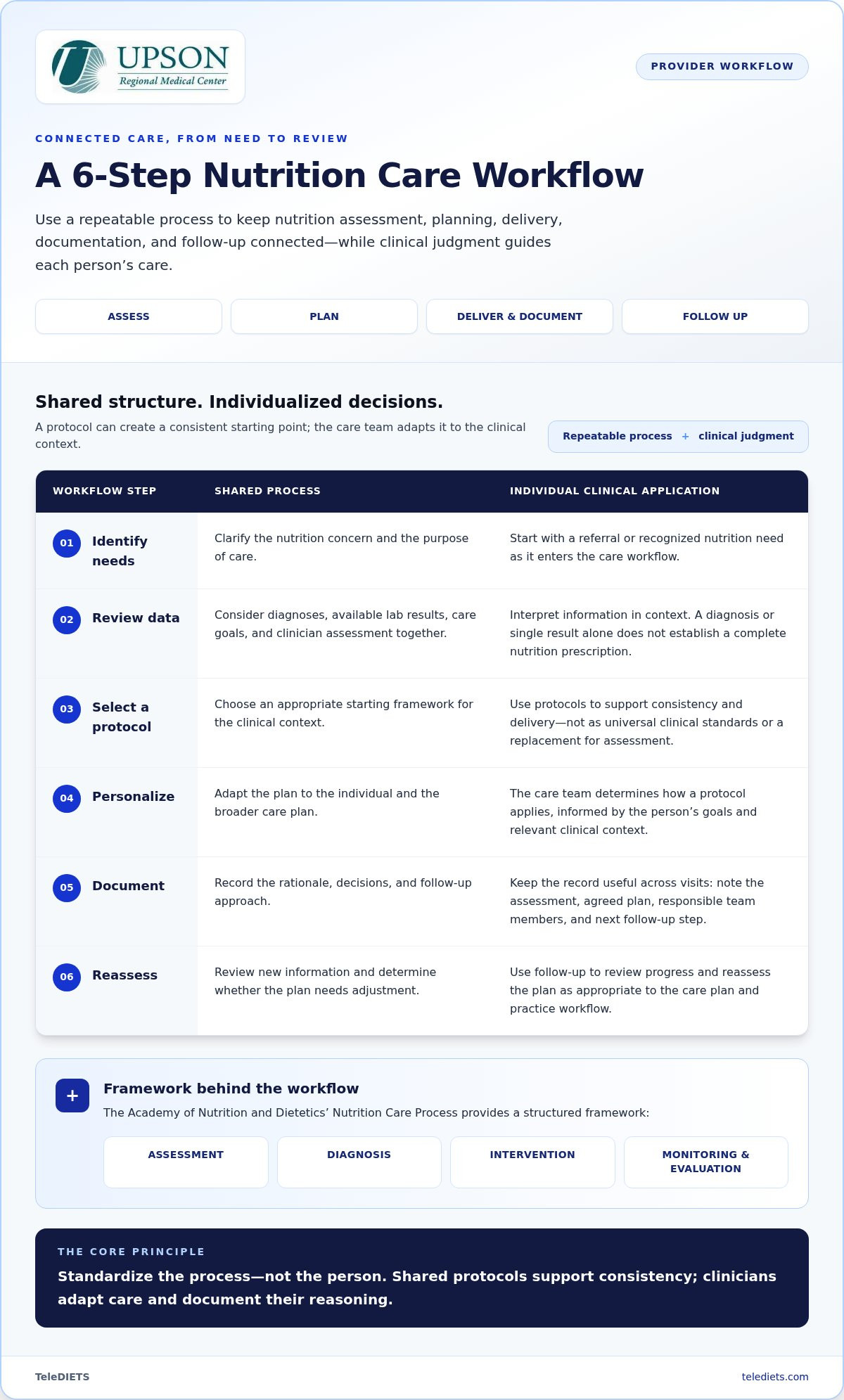
A repeatable process helps teams tailor nutrition care without starting from scratch for every encounter. The Academy of Nutrition and Dietetics’ Nutrition Care Process provides a structured framework of assessment, diagnosis, intervention, and monitoring and evaluation. Providers can adapt that sequence to their setting and workflow.
In practice, nutrition management for healthcare providers can follow six connected steps:
- Identify needs: Clarify the nutrition concern and purpose of care.
- Review relevant data: Consider diagnoses, available lab results, care goals, and clinician assessment together.
- Select a protocol: Choose an appropriate starting framework for the clinical context.
- Personalize: Adapt the plan to the individual and the broader care plan.
- Document: Record the rationale, decisions, and follow-up approach.
- Reassess: Review new information and determine whether the plan needs adjustment.
Personalization and standardization can coexist: a shared protocol creates a consistent starting point, while clinician judgment shapes how it applies to each person.
How can clinical data inform a nutrition plan?
Relevant diagnoses and lab results can inform nutrition planning, but neither a single result nor a diagnosis alone establishes a complete nutrition prescription. Providers interpret information in context, alongside the person’s goals, clinical assessment, and other details relevant to care. This keeps planning individualized instead of turning a data point into a one-size-fits-all decision.
How can teams maintain consistency without over-standardizing?
Protocols support repeatable processes, but teams should leave room to adapt them and document clinical reasoning. TeleDIETS offers Standard Series and Advanced Medical Series Meal Plans as provider resources, not universal clinical standards. Its personalized protocols can draw on diagnoses and lab data, while the care team determines how each protocol applies and when reassessment is appropriate.
How to Deliver, Document, and Follow Up on Nutrition Care
Nutrition care is easier to track when it fits into existing visits and follow-up touchpoints instead of becoming a separate task. A referral or identified need can lead into assessment and plan delivery, with the next review built into the care team’s workflow. Assigning clear ownership helps prevent uncertainty about who communicates the plan, records updates, or coordinates reassessment.
Across visits, nutrition care remains trackable when the record captures the identified need, relevant assessment, agreed plan, responsible team members, and next follow-up step. Documentation should reflect organizational policies and applicable requirements while giving the team enough context to understand decisions and continue care.
What belongs in a workable nutrition-care workflow?
Start with a referral or recognized nutrition need, then document the assessment and plan delivery. Record who is responsible for follow-up and when reassessment is intended, according to the care plan and practice workflow. Telehealth can support nutrition-care touchpoints when appropriate, while assessment, recommendations, and decisions remain within the care team’s professional roles. TeleDIETS’ telemedicine plugin supports this delivery model.
How can teams make billing processes easier to manage?
Billing and coding depend on the service provided, payer rules, and current coding guidance. Teams should use references relevant to each workflow. TeleDIETS offers insurance billing and CPT coding tools to support administrative processes. These tools can help organize billing work, but they don’t guarantee coverage or reimbursement.
For practices refining nutrition management for healthcare providers, connect clinical documentation, follow-up responsibilities, and billing workflows in a process staff can use consistently. TeleDIETS brings nutrition protocols, billing and CPT coding tools, and telemedicine support into provider workflows. Explore TeleDIETS provider workflow tools.
Where Nutrition Management Software Fits in Provider Practice
Software can make nutrition workflows more consistent, but it should support the care team’s process rather than dictate clinical decisions. Manual methods may rely on individual staff members to coordinate protocols, records, and follow-up. Provider-focused software can organize these tasks and support repeatable delivery. Its value depends on how well it fits existing roles, documentation practices, and systems.
What should providers evaluate in nutrition-management software?
Assess whether a tool supports the way your team identifies nutrition needs, reviews relevant data, documents decisions, and follows up. Consider whether its protocol options align with the populations and services your practice manages and whether it fits existing telemedicine workflows. Evaluate how the tool supports handoffs and documentation, too. Software can reduce process friction, but it can’t resolve unclear responsibilities or replace professional oversight.
Compare manual and software-supported workflows across three areas:
- Consistency: Can team members follow a repeatable process while adapting care appropriately?
- Documentation effort: Does the workflow help staff capture decisions and next steps clearly?
- Integration: Can it fit the practice’s roles, care delivery, and follow-up routines?
How does TeleDIETS support provider-led nutrition care?
TeleDIETS is a SaaS platform for healthcare professionals. Its AI engine generates personalized nutrition protocols informed by diagnoses and lab data. Clinicians remain responsible for reviewing recommendations and applying their judgment. Offerings include Standard Series and Advanced Medical Series Meal Plans, GLP-1 support protocols, insurance billing and CPT coding tools, and a telemedicine plugin. These capabilities support protocol delivery and related provider workflows.
Learn about this provider-focused workflow option through the medical nutrition therapy software. For nutrition management for healthcare providers, choose technology that supports your team’s established process without taking clinical decisions out of its hands. Explore TeleDIETS for healthcare providers.
Build a More Connected Nutrition-Care Workflow
Effective nutrition management for healthcare providers connects clinical assessment and personalized planning with coordinated delivery, documentation, and follow-up. A repeatable process helps teams maintain continuity across visits, while professional judgment keeps care responsive to relevant clinical information and individual goals.
Technology can support this work by organizing protocols and administrative tasks, but it remains a tool for the care team, not a substitute for clinical decisions. TeleDIETS offers personalized protocols informed by patient lab data and diagnoses, along with Standard Series and Advanced Medical Series Meal Plans and GLP-1 support protocols. Insurance billing and CPT coding tools, plus a telemedicine plugin, support related provider workflows.
A clear workflow and the right support can help your team deliver more consistent, coordinated nutrition care. Explore TeleDIETS for healthcare providers.
Frequently Asked Questions
What is nutrition management in healthcare?
Nutrition management is the coordinated process of identifying nutrition-related care needs, developing an appropriate plan, delivering or coordinating services, documenting care, and reassessing over time. In clinical settings, qualified professionals guide this work within the patient’s broader care context. It is more comprehensive than providing a meal plan or general nutrition information because it connects assessment and care decisions with follow-up.
How can healthcare providers incorporate nutrition management into practice?
Start by mapping where nutrition needs are identified, who assesses them, and how plans are documented and revisited. Then define team responsibilities, referral steps, and follow-up expectations. Reviewing these workflows can reveal gaps in consistent care delivery. An effective approach to nutrition management for healthcare providers keeps protocols adaptable, applying them with professional judgment and in the context of each person’s broader care.
Can nutrition management software personalize care plans?
Provider-focused platforms can use relevant clinical information, such as diagnoses and lab data, to help generate tailored nutrition protocols. The care team must review the output, apply professional judgment, and document its decisions. Assess how protocol options fit your workflow, the needs of the people you serve, and the level of clinical oversight required. Automation doesn’t make clinical decisions.
How does medical nutrition therapy differ from general nutrition education?
Medical nutrition therapy is a clinical service delivered by qualified professionals within an appropriate care context. It may include assessment, an individualized nutrition plan, documentation, and follow-up. General nutrition education can provide useful information, but it isn’t automatically individualized clinical care. It also doesn’t replace professional assessment when a person’s health needs call for a coordinated nutrition-care approach.
Can nutrition management services be billed to insurance?
Coverage and reimbursement depend on the service delivered, provider qualifications, payer policies, documentation, and applicable coding requirements. Practices should refer to current authoritative payer and coding guidance for their circumstances. Billing or CPT coding tools may support administrative workflows, but they can’t guarantee coverage or reimbursement. Verify relevant requirements as part of your organization’s billing process.
Leave a Reply