
What if nutrition tracking captured less information but made the next clinical action clearer? For clinics, patient nutrition tracking can become fragmented across visits, forms, and messages, leaving clinicians without a consistent view of change between appointments. When every new data point adds documentation, the process can feel more burdensome than useful.
A manageable approach starts with a small set of relevant measures and a clear plan for reviewing them. This guide explains how to choose actionable nutrition data, establish a repeatable follow-up loop, and connect findings to individualized medical nutrition therapy (MNT). It also covers how structured nutrition protocols and MNT software can support planning within a clinical workflow, without treating data capture as an end in itself.
The goal is practical: make nutrition information easier to review, clarify what warrants follow-up, and support care that reflects each patient’s clinical context.
Key Takeaways
- Start patient nutrition tracking for clinics with a care question so each measure has a clear purpose.
- Distinguish patient-reported information from clinical findings to guide consistent review.
- Set a repeatable workflow for collecting information, assigning review responsibilities, and documenting next steps.
- Use relevant findings to inform individualized MNT and nutrition protocols aligned with clinical context.
Patient nutrition tracking for clinics starts with a clear care question
Collect information when it can inform care or follow-up. A clinic doesn’t need a longer record for its own sake. It needs relevant details that help the care team understand what has changed and decide what to review next. Start by identifying what you need to learn, then select information that can help answer that question.
Patient nutrition tracking for clinics is the structured review of relevant patient-reported and clinical information over time to inform nutrition care and follow-up. It extends beyond a one-time assessment, which captures a point-in-time picture. It isn’t simply meal logging: recording food without a clinical purpose can create data without clarifying what action to take. General wellness monitoring can also collect more information than an MNT plan requires. For context, Medical Nutrition Therapy describes the clinical process that gives nutrition information a care-oriented purpose.
What should clinics aim to learn from tracking?
Link each measure to a clinical question, care goal, or planned follow-up. If the purpose is to understand progress toward a nutrition goal, ask what information would help the clinician review that progress at the next contact. The answer should reflect the individual’s care plan and circumstances, not a standard checklist applied to everyone. If a measure won’t inform a decision or conversation, reconsider whether it belongs in the tracking process.
Which information may be relevant to MNT follow-up?
Clinicians may select patient-reported information such as intake patterns, barriers to following the care plan, and progress toward agreed goals. The relevant details depend on the person’s needs and the question being reviewed. For specialized clinical focus areas like reproductive health, practices such as ah! fertility nutrition illustrate how tracking specific nutritional and lifestyle factors supports individualized outcomes. Keep reported information distinct from clinical findings, including diagnoses and lab results. When clinically appropriate, those findings can inform nutrition planning and individualized protocols. Tracking provides context for review; it doesn’t replace assessment or clinician judgment.
Choose nutrition tracking measures that lead to meaningful clinical review
A useful set of measures is focused, interpretable, and practical for both the patient and the clinic. Choose information that serves the care goal, then consider whether your team can collect and review it consistently. The right set varies by patient; a universal checklist may capture details that don’t answer the clinical question.
Match measures to care goals
Depending on the care plan, relevant patient-reported measures might include eating patterns, progress toward an agreed goal, or barriers that make the plan difficult to follow. Select only information that can shape a review or next step. Diagnoses and available lab results may also provide clinical context for nutrition planning and individualized protocols, when appropriate. The Nutrition Care Process (NCP) offers a structured framework for connecting nutrition assessment with care planning.
Keep patient-reported information distinct from clinical findings. A patient’s entry describes their report; a diagnosis or lab result is clinical information that requires interpretation in context. Neither should be treated as a conclusion on its own. An isolated entry may prompt a follow-up question, but it isn’t a diagnosis.
Make the information interpretable
Set a review period that fits the care question and the clinic’s follow-up cadence. A brief check-in may suit a goal reviewed at the next appointment, while other information may be collected closer to a planned clinical review. Choose a format patients can complete and staff can incorporate into the established workflow. Define who reviews submissions and how relevant findings reach the clinician responsible for follow-up.
More tracking data doesn’t automatically mean better care. Useful data is information the team can interpret and connect to an appropriate next step. This keeps patient nutrition tracking for clinics focused on care rather than collection. Before adding a measure, ask: Will it help the team understand progress, identify a barrier, or guide a planned review? If not, leave it out or clarify its purpose.
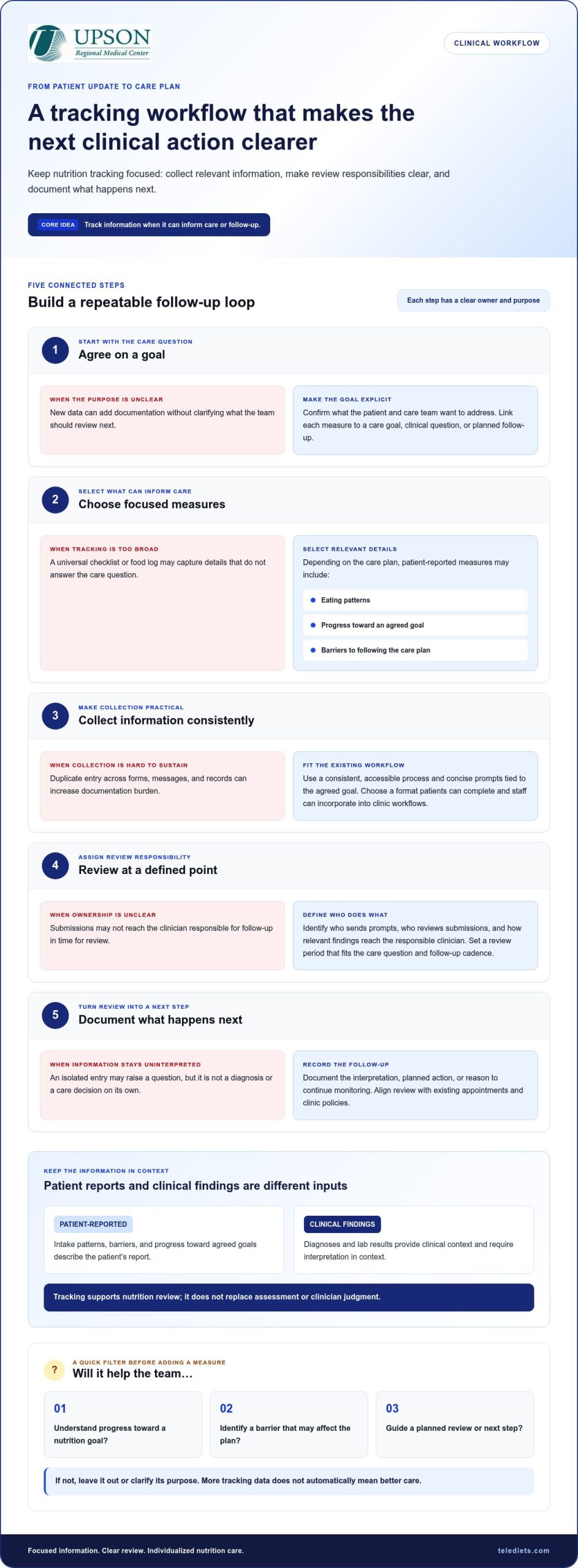
Build a patient nutrition tracking workflow clinics can sustain
A reliable workflow makes clear what happens after information is collected. Keep the steps visible, assign ownership, and align review with existing appointments and clinic policies.
- Agree on a goal: Confirm what the patient and care team want to address.
- Select measures: Choose only information that supports that goal and can be reviewed.
- Collect information: Use a consistent, accessible process that fits the clinic’s existing communication channels.
- Review: Assign a clinician or designated team member to review submissions at a defined point in the care cycle.
- Document next steps: Record the interpretation, planned action, or reason to continue monitoring.
Set responsibilities within existing clinic policies: identify who sends prompts, who reviews the information, and how concerns are escalated to the appropriate clinician. Choose a cadence that matches the care plan and appointment schedule. For example, review a check-in before a planned follow-up rather than creating a separate review cycle by default. For clinics using telemedicine, an integrated telemedicine workflow can help maintain continuity between appointments.
Keep tracking manageable between visits
Reduce documentation burden by avoiding duplicate entry across forms, messages, and records. Use concise prompts tied to the agreed goal instead of asking patients for extensive open-ended reports. A focused check-in can invite a brief update on progress or a barrier, giving the care team relevant context without asking for information it won’t use. Patient nutrition tracking for clinics is more sustainable when collection fits into familiar workflows. Similarly, for veterinary teams looking to optimize clinical efficiency, Helpful.vet offers workflow tools and benchmarks to streamline daily practice management.
Turn review into a documented next step
After review, note the clinical interpretation, any agreed adjustment, or why continued monitoring is appropriate. That record helps the next team member understand what was considered and what should happen next. A consistent review loop supports continuity by connecting patient updates, clinical interpretation, and documented follow-up.
TeleDIETS medical nutrition therapy software supports structured nutrition planning within clinical workflows.
Connect patient nutrition tracking with individualized MNT and next steps
Tracked information supports clinical review; it doesn’t replace individualized assessment or clinician judgment. Its value comes from connecting relevant updates with the patient’s clinical context, then deciding what action fits the care plan. A practical sequence is to review patient-reported information, consider relevant diagnoses and lab results, interpret the findings, and determine whether nutrition planning or follow-up should change.
This sequence helps keep tracking from becoming a separate data-collection task. In a disconnected process, updates may sit in different forms or communication channels, require duplicate entry, and leave follow-up unclear. An integrated clinical workflow can make information easier to review alongside care planning, reduce avoidable repetition, and make the next action visible. Integration doesn’t eliminate clinical interpretation; it helps connect information to follow-up.
Where nutrition software fits in the care loop
Provider-focused MNT software can support planning after clinical review. TeleDIETS provides nutrition protocols tailored to clinical diagnoses and lab results, helping clinicians translate relevant context into a structured nutrition-planning resource. Its insurance billing and CPT coding tools support nutrition-service workflows and facilitate reimbursement. These tools support the care process, not replace professional assessment.
Evaluate a clinic’s next step
Before changing tools or processes, map how nutrition information is captured, who reviews it, where interpretation is documented, and how follow-up is assigned. Look for gaps such as repeated data entry, updates that don’t reach the responsible clinician, or findings without a recorded next step. Then identify one point in the workflow where clearer ownership or a more connected planning process could help.
Clinics considering structured support for nutrition planning can explore TeleDIETS medical nutrition therapy software.
Make your tracking process work for care
Effective patient nutrition tracking for clinics doesn’t depend on collecting more information. It depends on choosing measures that answer a care question, setting a review rhythm the team can sustain, and documenting what happens next. Keeping patient-reported updates distinct from clinical findings also helps clinicians interpret information in context rather than treating an isolated entry as a conclusion.
Connect clinical review to individualized MNT. Relevant diagnoses and lab results can inform nutrition protocols, while clear follow-up responsibilities help keep the process connected across appointments. The right workflow should support clinical judgment and fit the way your team delivers care.
TeleDIETS provides provider-focused medical nutrition therapy software with protocols tailored to clinical diagnoses and lab results, insurance billing and CPT coding tools for nutrition-service workflows, and a telemedicine plugin designed for provider workflow integration. Explore TeleDIETS medical nutrition therapy software to see how its platform supports structured nutrition planning in your practice. Start with one clear care question, then build a process your team can maintain.
Frequently Asked Questions
What is patient nutrition tracking for clinics?
Patient nutrition tracking for clinics is a structured process for collecting and reviewing relevant nutrition information over time to support clinical care. Each measure should connect to a care question, with a designated reviewer and a documented next step. It’s more than food logging: collected information provides context for follow-up, but it doesn’t replace individualized assessment or clinician judgment.
What should a clinic track for medical nutrition therapy?
Track information that fits the patient’s clinical context and care goals. Depending on the plan, this may include patient-reported eating patterns, barriers to following recommendations, progress toward agreed goals, and relevant clinical findings. Select a focused set and determine how each item will inform review, planning, or follow-up. Avoid collecting information simply because it’s available if it won’t support care.
How often should clinics review patient nutrition data?
Set review frequency according to the care plan, the type of information collected, and the clinic’s follow-up model. For example, information intended to guide an upcoming appointment can be reviewed as part of that appointment’s preparation. Tell patients and staff when submissions will be reviewed, and define what happens if information is missing or raises a concern. Don’t imply real-time monitoring unless the workflow supports it.
Can nutrition tracking improve follow-up between clinic visits?
A consistent tracking process can help clinicians identify updates to discuss and support continuity between appointments. Its usefulness depends on whether patients can provide relevant information, the designated team member reviews it, and clinicians can act on findings. Tracking alone doesn’t establish a clinical outcome or replace a scheduled assessment. Treat updates as context for follow-up, not as a substitute for clinical review.
How can clinics reduce the administrative burden of nutrition tracking?
Start with a small set of measures tied to care goals, use concise prompts, and avoid duplicate entry by patients or staff. Assign review responsibilities and choose a cadence that fits the clinic’s workflow. Periodically ask whether each measure informs a clinical decision or follow-up. If information adds documentation work without supporting care, reconsider collecting it. A focused process is easier to maintain and interpret.
Leave a Reply