
What determines whether CPT 97802 fits an encounter? It is not simply whether a visit is called “initial.” The code describes an initial individual medical nutrition therapy (MNT) assessment and intervention, billed in 15-minute increments. Related codes describe follow-up individual care or group services, so the service delivered and documented matters.
For clinicians and billing teams, code selection is one part of a larger review. The encounter note, provider and patient information, time recorded, and payer requirements all affect claim preparation. This guide explains the general purpose of 97802, how it differs from CPT 97803 and 97804, and what to review before adding it to a billing workflow.
Coverage and claim requirements can vary, so use current authoritative coding guidance and the applicable payer policy. Structured nutrition protocols and billing tools, including those within TeleDIETS, can help organize provider workflows while keeping clinical judgment central.
Key Takeaways
- Understand the general MNT service context for 97802 and why a code alone doesn’t guarantee coverage or payment.
- Distinguish 97802 from 97803 and 97804 by reviewing the service type and applicable unit language.
- Use a pre-billing checklist to connect the documented service, provider and patient context, date, and time.
- Build a consistent workflow that checks current code guidance and payer policies while keeping clinical decisions with clinicians.
What Does CPT 97802 Mean for Medical Nutrition Therapy?
CPT 97802 identifies an initial, individual medical nutrition therapy (MNT) assessment and intervention. In the 2026 CPT reference, its descriptor is “Medical nutrition therapy; initial assessment and intervention, individual, face-to-face with patient, each 15 minutes.” The “each 15 minutes” language defines the time unit. Follow-up individual care and group MNT have different code contexts.
CPT codes identify healthcare services for reporting and billing. A code does not, by itself, establish that a service is covered or guarantee payment. Coverage and claim requirements depend on the payer’s current policies and the circumstances of the service.
What service does the code generally describe?
The code generally represents an initial individual MNT encounter that includes assessment and intervention with the patient. It is not a catchall for nutrition-related visits. When reviewing an encounter, distinguish the service actually provided from follow-up individual care or a group session, then compare that context with the current descriptor.
Why does the code matter in an MNT workflow?
Consistent code review helps connect the MNT service delivered with the encounter record and the claim prepared for submission. The broader Current Procedural Terminology (CPT) system provides a standardized way to identify services, but the code alone does not resolve coverage or payment questions.
For each encounter, the clinical record should accurately describe the service provided and support the coding review. Billing teams can then compare the documented service with current professional coding references and the applicable payer’s policies. Keep the steps distinct: the clinician documents care and makes clinical decisions, while coding and billing professionals use authoritative, up-to-date references to review code application and claim requirements. For practices seeking external operational support for revenue cycle management, Tausch Medical provides specialized billing services to help streamline claim submission. This is a provider-facing coding overview, not patient-specific clinical guidance or individualized billing advice.
How Does CPT 97802 Differ from CPT 97803 and 97804?
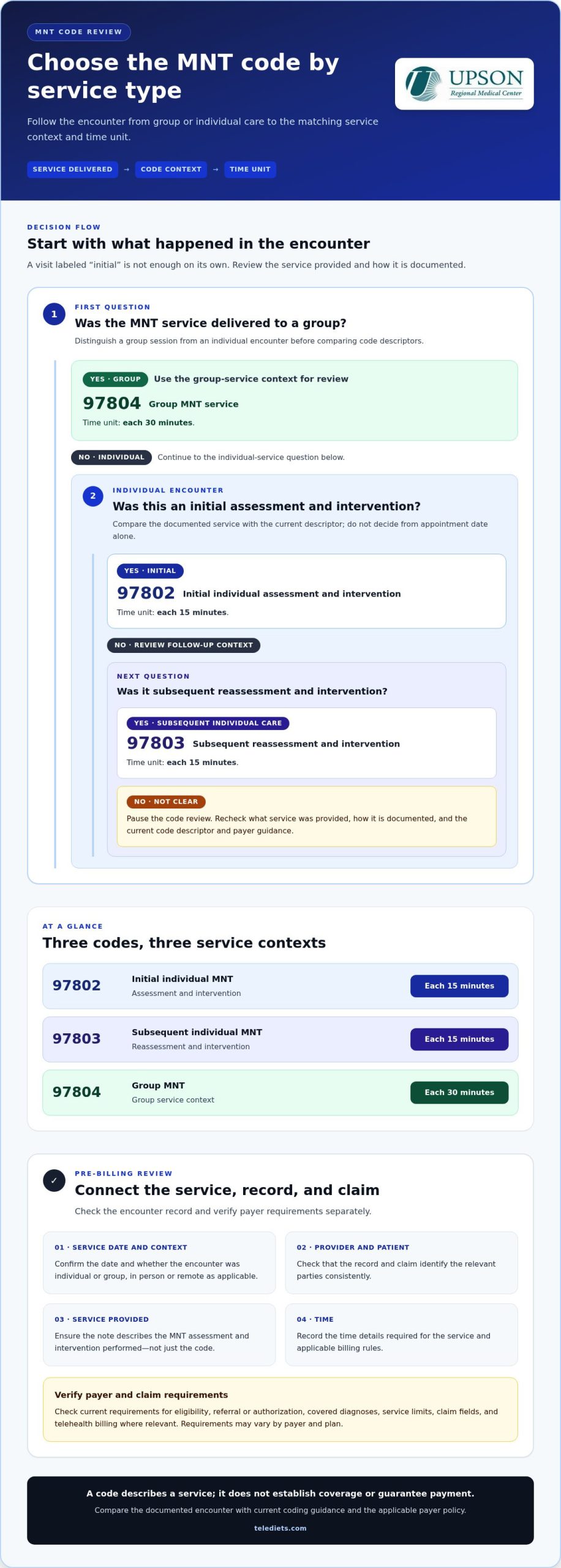
The main distinction is the type of MNT service: an initial individual encounter, a subsequent individual encounter, or a group service. Use the table to orient a code review, then confirm the current descriptor and unit language for the service being reported. This is a general overview, not a coding determination for a specific claim.
| Code | General MNT service context | Time unit |
|---|---|---|
| 97802 | Initial assessment and intervention for an individual | Each 15 minutes |
| 97803 | Subsequent reassessment and intervention for an individual | Each 15 minutes |
| 97804 | Group MNT service | Each 30 minutes |
General distinction: 97802 describes initial individual MNT, 97803 describes subsequent individual MNT, and 97804 describes group MNT. The group code has a different time unit. Treat these descriptions as a starting point for review, not as a coding decision for an individual claim.
The CMS guidelines for MNT distinguish initial, subsequent, and group services in Medicare guidance. For a claim decision, compare the actual service and encounter circumstances with current CPT descriptors and the applicable payer guidance. Payer policies may affect code selection and billing requirements.
How is an initial MNT service different from follow-up care?
An initial individual encounter generally involves the first assessment and intervention in the MNT service context. Follow-up care focuses on reassessing and intervening after that initial service. A later appointment date alone does not settle the coding question. Review what happened during the encounter, how it is documented, and how the current descriptors and payer guidance apply to the situation.
When does group MNT require a different code review?
A group session has a different service context from an individual encounter. Review the group code’s descriptor and time unit rather than assuming an individual code applies. Coverage, provider eligibility, and reimbursement also depend on the relevant payer’s rules, not the code alone. TeleDIETS’ insurance billing and CPT coding tools support organized provider workflows alongside current references and professional judgment.
What Documentation and Billing Details Should Providers Review?
A focused pre-billing review connects the service delivered to the encounter record and the claim. It cannot guarantee coverage or payment. Review the clinical documentation and payer claim rules as related but separate parts of the process.
What should the encounter record make clear?
Before submitting a claim for 97802, check that the record accurately identifies:
- Service date and context: Confirm the date and whether the encounter was individual or group, in person or remote as applicable.
- Provider and patient information: Check that the record and claim identify the relevant parties consistently.
- Service provided: Ensure the note describes the MNT assessment and intervention performed, rather than relying on the code alone.
- Time: Record the time details required for the service and applicable billing rules.
Use the note to show what care was delivered, and use current coding references and payer guidance to determine the documentation and time-reporting requirements that apply. The AAPC coding guidelines offer additional discussion of MNT coding and time-based billing.
Which payer and claim details need separate verification?
Review the applicable payer’s current requirements for eligibility, referral or authorization, covered diagnoses, service limits, claim fields, and telehealth billing where relevant. Medicare and commercial plans may apply different policies, and requirements can vary by plan. Do not treat a general code description as proof of coverage or assume one payer’s rule applies to another. Use current authoritative guidance and the specific payer policy for the service date.
To organize provider billing workflows, explore insurance billing and CPT coding tools. These tools can support MNT billing tasks, while clinicians retain responsibility for clinical decisions and billing teams apply current rules.
How Can a Clinic Build CPT 97802 into an MNT Workflow?
A repeatable workflow links the service delivered, the clinical record, and claim review without treating any one step as a substitute for professional judgment. Organize the process into five stages:
- Confirm the service context: Identify the type of MNT encounter and who received the service.
- Document care: Complete the clinical record to reflect the assessment and intervention provided, along with relevant encounter details.
- Review the code: Compare the documented service with current CPT guidance before coding.
- Check payer rules: Verify applicable coverage, documentation, and claim-submission policies for the plan and service date.
- Submit and monitor: Send the claim through the practice’s process and track its status for follow-up.
Where can software support the workflow?
Structured software can bring nutrition protocols, clinical inputs, and billing tasks into a more organized provider workflow. TeleDIETS supports nutrition protocols informed by patient lab results and diagnoses, along with insurance billing and CPT coding tools. These capabilities can help reduce reliance on fragmented manual processes, but they do not replace clinical judgment, current coding references, or payer-specific review. Use software to support the workflow, not to determine whether a claim will be covered or paid.
What should a practice do before submitting a claim?
Make the final review a defined handoff. The clinician is responsible for clinical decisions and an accurate record of care; billing professionals apply current coding guidance and payer rules. Before submission, compare the claim with current CPT guidance, the applicable payer policy, and the practice’s documentation procedures. A consistent checkpoint helps the team spot missing or mismatched information while accounting for payer-specific requirements. For healthcare facilities navigating administrative workloads and staffing pressures, workflow insights and tools from FrontRunnerHC, Inc. can help teams streamline patient data and reimbursement processes.
For clinics organizing MNT protocols and billing tasks, Explore clinical nutrition workflow software to see how it can support provider workflows.
Make MNT Billing a More Consistent Part of Care
Accurate MNT billing starts by matching the documented service to the appropriate code. 97802 generally applies to an initial individual assessment and intervention, while related codes represent other service contexts. A clear encounter record supports code review, but it does not establish coverage or payment on its own.
Build a repeatable process: document the care provided, review current coding references, and check the applicable payer’s requirements before submitting a claim. Keep clinical decisions with clinicians and apply payer-specific billing rules through the practice’s established review process.
Structured tools can help bring nutrition protocols and billing tasks into a more organized workflow. TeleDIETS supports protocols informed by lab results and clinical diagnoses, alongside insurance billing and CPT coding tools for healthcare workflows. Explore clinical nutrition workflow software to see how it can support your team’s process.
Frequently Asked Questions
What is CPT 97802?
CPT 97802 generally identifies an initial individual medical nutrition therapy (MNT) assessment and intervention. Confirm the exact descriptor and time-unit language in the current 2026 CPT reference before applying it. The code describes a service; it does not establish coverage or guarantee payment. The encounter record must support the service reported, and the payer’s current rules also affect claim requirements.
Is CPT 97802 for an initial nutrition assessment?
Generally, yes. The code is associated with an initial individual MNT assessment and intervention, subject to the current CPT descriptor. “Initial” is not a universal rule for every clinical or payer scenario. Code selection should reflect the documented service and be reviewed against current coding guidance and the coverage policy that applies to the claim.
How is CPT 97802 different from CPT 97803?
In general, 97802 represents an initial individual MNT service, while 97803 represents subsequent individual MNT reassessment and intervention. Confirm both descriptors and their time-unit language in a current CPT reference. This distinction alone does not determine which code applies to a particular encounter. Review the documented service, authoritative coding guidance, and the payer’s applicable policy.
Can CPT 97802 be billed for a telehealth MNT visit?
Telehealth billing depends on current code guidance and the applicable payer’s policies, so remote MNT is not automatically covered under this code. Before billing, verify the payer’s requirements for eligible practitioners, service conditions, documentation, and claim details, including any applicable telehealth reporting instructions. Use current authoritative payer materials because policies may change and can differ across plans.
Does CPT 97802 guarantee insurance coverage for MNT?
No. A CPT code identifies a service, but it does not guarantee that an insurance plan covers that service or will reimburse a claim. Coverage may depend on the patient’s plan, provider eligibility, service conditions, and supporting documentation. Confirm current payer-specific requirements before scheduling or submitting a claim, and use the relevant plan policy rather than relying only on general coding summaries.
Leave a Reply