
What makes GLP-1 nutrition care consistent across encounters is a shared clinical process, not a single meal plan. Clinicians need practical guidance that accounts for each patient’s diagnoses, lab results, preferences, and care context. GLP-1 medication meal protocols can provide that structure without treating individual food plans as one-size-fits-all.
That distinction matters in daily practice. Consumer advice can be difficult to translate into clinic workflows, and nutrition protocols should support clinician-directed care without crossing into medication decisions. A useful framework gives the team consistent assessment prompts, documentation steps, and follow-up expectations while leaving room for professional judgment and individual needs.
This guide explains how to build protocols around assessment, individualized nutrition planning, and workflow integration. It covers how to connect GLP-1 nutrition support with broader medical nutrition therapy, use available patient information to inform care, and incorporate protocol delivery alongside billing, coding, and telemedicine workflows. The goal is a repeatable process that supports your team without standardizing patients’ meals.
Key Takeaways
- Use GLP-1 medication meal protocols to standardize how nutrition support is delivered, not to prescribe one menu for every patient.
- Use nutrition principles as adaptable discussion prompts, taking individual needs and reported food tolerance into account.
- Build a repeatable clinic workflow: establish patient context, select relevant protocol elements, document decisions, and plan a review.
- Connect protocol delivery with diagnosis-informed nutrition therapy and existing practice workflows while keeping clinical judgment central.
What GLP-1 medication meal protocols should standardize, and what they should not
A clinical meal protocol is a shared framework for delivering nutrition support, not a universal menu assigned to every patient. A protocol standardizes the care process, not the patient’s plate. A practice can use the same assessment prompts, documentation fields, and follow-up steps while clinicians tailor recommendations to each person’s clinical context.
GLP-1 medication meal protocols also sit alongside medication management; they do not replace it. The Glucagon-like peptide-1 (GLP-1) reference provides background on the hormone and its role, but medication decisions belong within the prescribing process. Make that boundary clear in protocol language and in staff workflows.
What belongs within a GLP-1 nutrition protocol?
Include a repeatable way to discuss nutrition needs and record agreed next steps. Depending on the clinical context, prompts may cover nutrient adequacy, protein and fiber sources, fluid intake, meal patterns, food preferences, and reported tolerance. When patients benefit from monitoring daily intake between visits, digital logging tools like Hero AI can simplify tracking calories and macros. Treat these as considerations, not mandatory targets or lists of foods to avoid. Qualified clinicians should individualize recommendations within their professional scope and consider relevant diagnoses and lab results.
Where should a protocol draw the clinical boundary?
Keep nutrition guidance separate from medication selection, dosing, titration, and injection instructions. While patients often consult independent platforms like Keys to Health for peptide calculations and tracking, a nutrition protocol can flag a medication-related concern for follow-up without directing a treatment change. Route medication questions or concerning symptoms to the prescribing clinician through established practice procedures. Clear escalation language makes the nutrition workflow useful without implying that it replaces medication care.
In practice, standardize the steps around care: what information informs nutrition support, how recommendations are recorded, and when they are reviewed. Keep the individual plan responsive to clinical judgment. That balance gives teams a dependable framework while preserving the flexibility needed for person-centered medical nutrition therapy.
Build GLP-1 meal protocols around practical, evidence-informed nutrition principles
Food guidance is most useful when it helps clinicians ask focused questions, rather than imposing a fixed list of permitted and prohibited foods. Common nutrition considerations can guide discussion, but clinical recommendations should reflect each person’s needs, preferences, and reported tolerance. This keeps GLP-1 medication meal protocols practical and avoids unsupported promises about outcomes or universal claims about how a particular food will affect someone.
Discuss food tolerance without creating rigid restrictions
Use commonly discussed food categories as assessment prompts, not automatic exclusions. A clinician might ask whether higher-fat or spicy foods, alcohol, or highly refined foods seem relevant to a patient’s experience or overall nutrition pattern. The answer can differ from person to person. Record what the patient reports, including timing, preferences, and patterns they have noticed. Then use clinical judgment to decide whether follow-up or an individualized adjustment is appropriate.
Keep nutrition recommendations within an evidence-informed scope
The WHO global guideline on GLP-1 medicines provides a high-level reference for considering medication use alongside behavioral interventions, including nutrition support. It does not make every food suggestion a universal rule. Anchor protocol language to current authoritative guidance and, where relevant, approved medication labeling. Claims about specific effects, restrictions, or targets warrant clinical review, particularly when sources differ or evidence is limited.
For consistent documentation, record the concern or goal discussed, the patient’s stated preferences and experience, the recommendation agreed on, and the planned point for reassessment. Avoid presenting a food category as a proven trigger or a required avoidance unless current evidence and clinical context support that advice. This creates a useful record without implying that the same approach suits everyone.
Clinician teams can use GLP-1 meal plan protocols to organize individualized nutrition support within broader medical nutrition therapy.
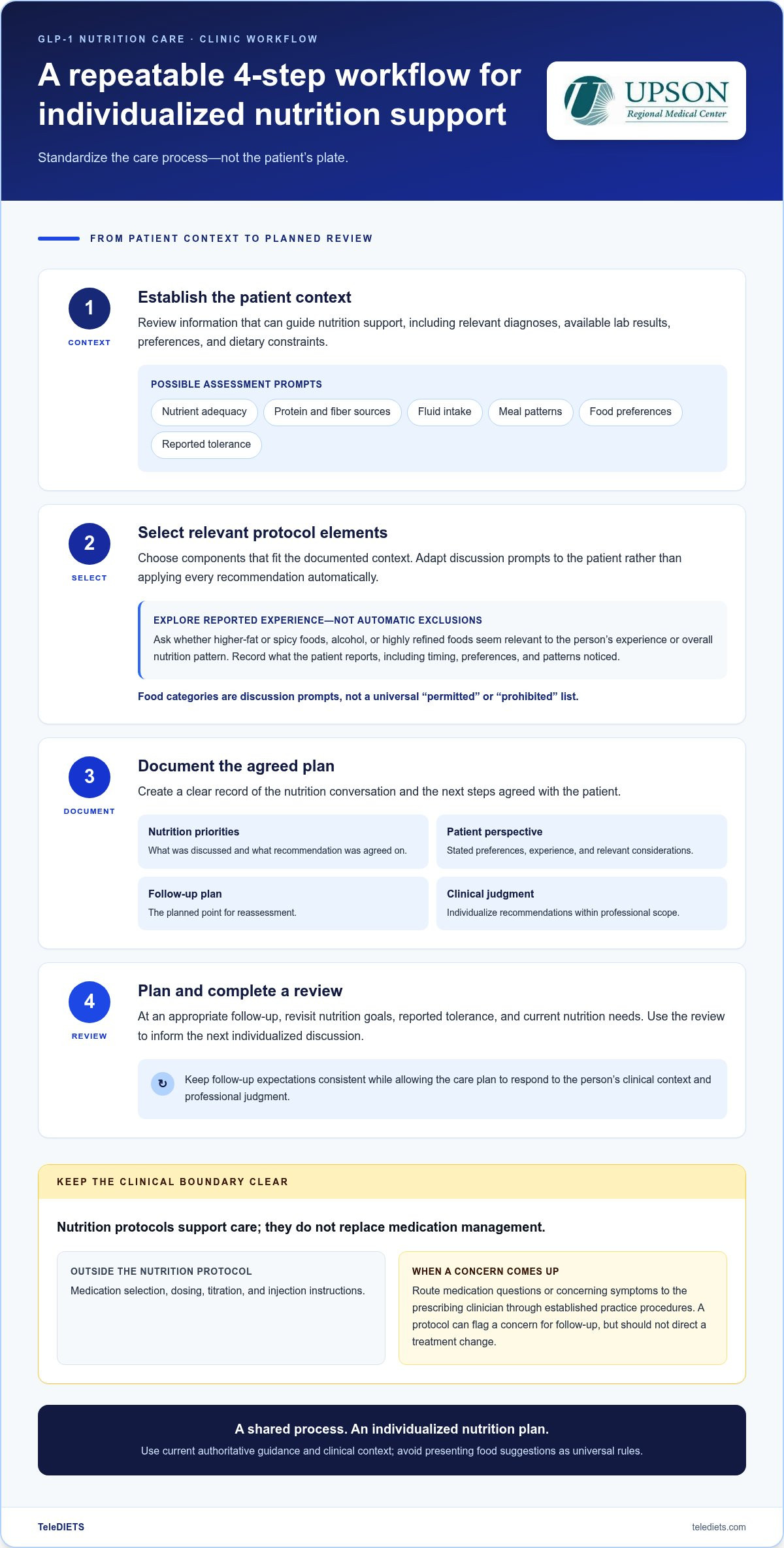
Turn GLP-1 nutrition principles into a repeatable clinic protocol
A practical workflow helps clinicians move from general nutrition principles to documented, individualized support. A well-designed protocol makes care more consistent without making every patient’s nutrition plan the same. Use these steps to structure encounters and follow-up while keeping recommendations within clinical judgment and established practice procedures.
- Establish context. Review relevant diagnoses, available lab results, patient preferences, and dietary constraints. Focus the assessment on information that can guide nutrition support. Do not use the protocol to diagnose or direct medication treatment.
- Select relevant elements. Choose the protocol components that fit the documented context. Adapt them to the patient instead of applying every prompt or recommendation automatically.
- Document the plan. Record the nutrition priorities discussed, agreed recommendations, patient-reported considerations, and planned follow-up. Route medication questions or concerns through established practice procedures and the prescribing clinician’s role.
- Schedule review. Revisit goals, reported tolerance, and nutrition needs at an appropriate follow-up. Update the plan when the clinical context changes.
Fit protocol delivery into existing workflows
GLP-1 medication meal protocols can be part of broader medical nutrition therapy rather than a separate, one-off process. TeleDIETS provides GLP-1 meal plan protocols through its medical nutrition therapy platform. Clinicians can generate personalized nutrition protocols based on patient lab results and clinical diagnoses within seconds, then review and adapt recommendations. The platform supports clinician-directed care; professional judgment remains central.
Map protocol generation to the team’s roles and existing nutrition services. TeleDIETS also provides insurance billing and CPT coding tools to facilitate reimbursement for nutrition services, plus a telemedicine plugin designed to fit provider workflows. Together, these features support the operational steps around nutrition care, from creating a protocol to incorporating it into the practice’s workflow.
Review workflow fit
Define who selects protocol elements, where documentation belongs, and how follow-up is arranged, including within telemedicine workflows. To see how clinical nutrition software can support a clinician-led process, explore TeleDIETS’ platform, protocols, and workflow tools.
Make your next step a sustainable care process
Make protocol use part of how your team reviews and improves its care process. Decide how clinicians will review recommendations, capture patient feedback, and refine workflow as needs evolve. A consistent review process helps keep GLP-1 medication meal protocols useful and grounded in clinician judgment without turning them into fixed rules.
Choose tools that support your team’s approach to medical nutrition therapy. TeleDIETS brings personalized protocol generation, specialized meal plan protocols, insurance billing and CPT coding tools, and a telemedicine plugin together to support provider-led nutrition care. Your team retains responsibility for clinical decisions while using a structured process to support care delivery.
Explore TeleDIETS clinical nutrition software for your practice and see how adaptable protocols and workflow tools can fit your approach to care. Build consistency while preserving the individualization that nutrition support requires.
Frequently Asked Questions
Is a GLP-1 nutrition protocol a substitute for medication counseling?
No. A nutrition protocol supports medical nutrition therapy, while medication counseling remains part of the prescribing clinician’s role. If a patient asks whether a medication change could address a concern, route the question through the practice’s established medication-care process rather than suggesting an adjustment. Clear role boundaries help clinicians coordinate care and keep nutrition recommendations focused on their purpose.
Can GLP-1 meal protocols account for food allergies or dietary restrictions?
Yes. Clinicians can use GLP-1 medication meal protocols as a framework while accounting for documented allergies, dietary restrictions, cultural preferences, and practical food access. Record these factors before selecting recommendations, then review whether suggested food categories are appropriate. A restriction calls for individualized planning, not a generic substitution that could introduce another concern. The resulting guidance should reflect the patient’s context and the clinician’s professional judgment.
How should clinicians review evidence used in a GLP-1 nutrition protocol?
Review the source, publication date, population addressed, and whether the claim is supported by current authoritative guidance or approved labeling where relevant. Distinguish established recommendations from emerging or uncertain evidence, and avoid turning limited findings into universal food rules. If sources differ on a specific nutrition target, flag it for clinical review and use cautious protocol language until the practice determines how to apply the evidence.
Can a GLP-1 meal protocol be used in both telehealth and in-person MNT?
Yes. The same clinical framework can guide either visit format, provided the clinician adapts how information is gathered and documented to the encounter. In person, a team may review records and preferences during the appointment. In telehealth, it may use information available through the practice’s established workflow. In both settings, document recommendations and follow-up clearly, and route concerns through the appropriate clinical process.
Leave a Reply