
Physician guided nutrition software can help turn relevant clinical information into a starting point for medical nutrition therapy, without asking software to make clinical decisions. For clinicians balancing limited time with complex patient needs, the right tool can organize protocol preparation around lab results and diagnoses, leaving the care team to assess relevance and decide what belongs in the care plan.
Speed alone is not enough. A useful workflow makes it clear what information shapes a proposed protocol, who reviews it, and how the team records its decisions. Software can help prepare and organize a protocol, while clinicians consider the patient’s clinical context and determine whether and how to use it.
This guide explains how physician-guided nutrition software can support provider-led nutrition workflows in 2026. It covers practical ways to assess clinical relevance and workflow fit, the role of clinician oversight, and how tailored meal plans, billing and CPT coding tools, and telemedicine integration can support nutrition care. The aim is to help practices introduce structured protocols without giving up professional judgment.
Key Takeaways
- Use physician guided nutrition software to organize protocol preparation, while keeping clinical assessment and decisions with the care team.
- Use a consistent workflow: review relevant clinical information, select a protocol, assess its fit, and personalize it as needed.
- Evaluate whether the software uses relevant diagnoses and lab results and fits your clinical and telemedicine workflows.
- TeleDIETS combines tailored protocols with billing and CPT coding tools and a telemedicine plugin for provider-led care.
What Physician-Guided Nutrition Software Does for Clinical Care
Clinical nutrition planning involves more than selecting foods or tracking intake. Healthcare professionals may need to consider diagnoses, lab results, and the goals of medical nutrition therapy when preparing a plan for review and adaptation. Medical Nutrition Therapy refers to nutrition care used to manage health conditions. Physician guided nutrition software can support this work by organizing structured protocols around clinical information.
Physician-guided nutrition software prepares protocols tailored to clinical information, while qualified clinicians review recommendations and retain responsibility for care decisions. That distinction matters: the software supports a professional workflow. It is not a consumer tracking app or an autonomous medical decision-maker.
How physician guidance differs from automated recommendations
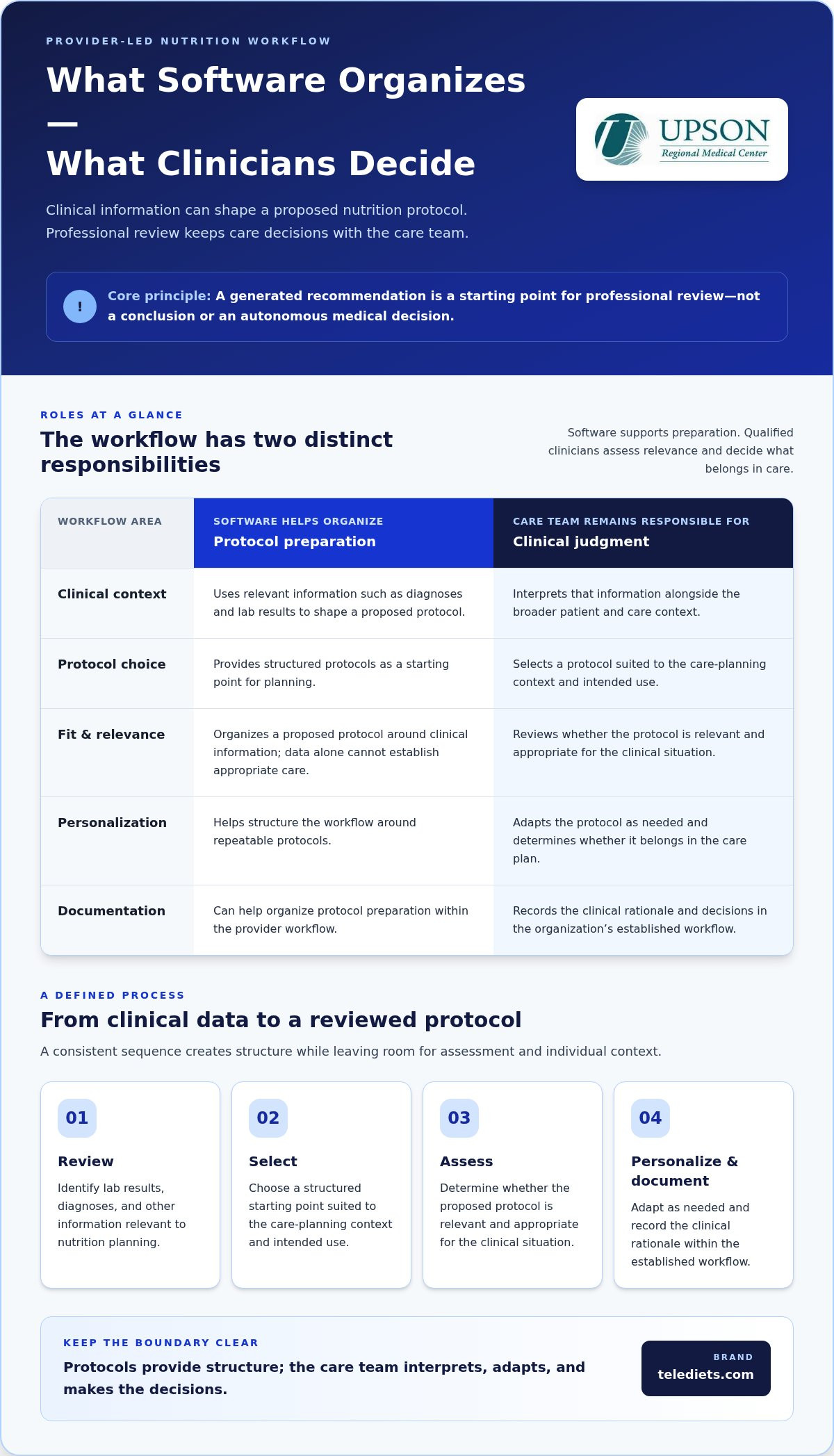
Software may use information such as a diagnosis or lab results to shape a proposed protocol. The clinician reviews it alongside the broader care context, considers whether it is appropriate, and personalizes it as needed. A generated recommendation is a starting point for professional review, not a conclusion.
Consumer tracking apps generally focus on recording food or activity. Clinical nutrition software supports healthcare professionals with care planning. It does not independently diagnose a condition or prescribe treatment. Clinical judgment remains with the provider, who decides whether a proposed protocol belongs in the care plan.
Which clinical settings may consider these tools
Physicians, clinics, and healthcare organizations delivering medical nutrition therapy can use software to support a consistent care process. It is especially relevant when teams work with clinical information and repeatable protocols, while still reviewing each care decision in context.
Telemedicine platforms delivering nutrition care can also use protocol preparation within provider workflows. Assess whether the tool supports the organization’s process for reviewing information, personalizing plans, and documenting decisions. The goal is to make those steps easier to manage, not to remove clinician involvement.
How Clinical Data Becomes a Nutrition Protocol
Turning clinical information into a usable nutrition plan takes more than matching a diagnosis to a template. A defined process helps a care team use protocols consistently while making room for professional assessment and individual context.
- Review relevant information. Identify the lab results, clinical diagnoses, and other information relevant to nutrition planning.
- Select a protocol. Choose a structured starting point that fits the care-planning context and intended use.
- Assess its fit. Review whether the proposed protocol is relevant and appropriate for the clinical situation.
- Personalize and document. Adapt the protocol as needed and record the clinical rationale within the organization’s established workflow.
Data-informed personalization uses clinical information to guide protocol selection; it does not make software an autonomous diagnostician or treatment decision-maker. Physician guided nutrition software can organize this sequence, but data alone cannot establish what care is appropriate.
Using lab results and diagnoses as clinical context
Lab results and diagnoses can help inform which nutrition protocol a clinician considers. They provide context for professional review, not automatic instructions or universal thresholds. The care team interprets the information alongside its clinical assessment, then decides whether a protocol is relevant and what adjustments may be appropriate. This keeps data useful without treating it as a complete picture.
Where clinician review belongs in the process
Review belongs before a protocol is used in care. Clinicians assess its relevance and appropriateness, consider how it fits the care plan, and ensure that decisions and personalization are documented. Repeatable protocols provide structure, but remain starting points for qualified professionals to adapt to the care context. Responsibility stays with the care team.
TeleDIETS offers protocols tailored using lab results and clinical diagnoses. Explore how TeleDIETS nutrition protocols support provider-led planning, with review and decisions remaining with clinicians.
How to Evaluate Physician-Guided Nutrition Software for Your Practice
Start with clinical fit, not a feature count. Physician guided nutrition software should help your team use relevant diagnoses and lab results to prepare protocols, review and adapt them before use, and understand what the software generates versus what clinicians decide.
Map the intended workflow before assessing tools. Identify who selects and reviews protocols, what documentation the process requires, and where nutrition planning fits into clinical or telemedicine workflows. Then walk through a typical case-planning process from the information reviewed to the final clinician decision. Focus on whether the steps work for your organization rather than assuming a particular EHR or system integration.
Questions for a clinical software evaluation
Use a practical checklist to assess how the tool supports your team’s work:
- Can providers review, adapt, and document a protocol before incorporating it into care?
- Do the available protocol types, such as Standard Series, Advanced Medical Series, or GLP-1 protocols, match the practice’s intended use?
- Are generated materials clear enough for providers to assess and use within their established process?
- Who is responsible for reviewing protocols, documenting decisions, and handling routine administrative steps?
Consider these questions together. A tool may support protocol generation but still be a poor workflow fit if review responsibilities or documentation steps are unclear. Assess the full process, from protocol selection through clinical review and follow-through.
How to assess evidence and appropriate use
Look for clear explanations of how protocols are structured and how clinical information informs tailoring. The software should make the role and limits of automation understandable, so providers can assess recommendations rather than treat them as automatic conclusions. Apply professional standards and organizational policies when deciding how the tool should be used.
Review billing capabilities separately from clinical features. Insurance billing and CPT coding tools can support administrative workflows, but they do not determine payer rules or guarantee coverage or payment. Keep the software’s workflow support distinct from reimbursement decisions.
Explore TeleDIETS for your practice to see how tailored protocols and clinical workflow tools can support provider-led nutrition care.
How TeleDIETS Supports Physician-Led Nutrition Workflows
Once you have defined clinical-fit criteria, compare platform capabilities with your care model. TeleDIETS is a provider-focused medical nutrition therapy platform that generates protocols tailored to lab results and clinical diagnoses. These inputs help shape a starting point. Clinicians review the proposed protocol, decide whether it fits, and personalize it for care.
For organizations evaluating physician guided nutrition software, protocol options and workflow tools matter alongside clinician oversight. TeleDIETS offers Standard Series Meal Plans, Advanced Medical Series Meal Plans, and GLP-1 Meal Plan Protocols. The right option depends on the practice’s intended use and provider-led process. No single protocol is assumed to suit every situation.
Match platform capabilities to your care model
Map each capability to an operational need. Protocols tailored from clinical information support provider review and planning. Insurance billing and CPT coding tools support administrative workflow, but do not guarantee coverage or payment. The telemedicine plugin supports provider workflows for remote care.
As part of your evaluation, identify who reviews generated materials, how the team documents decisions, and where billing or telemedicine steps fit into existing responsibilities. This helps decision-makers assess the platform as part of a broader care process, rather than judging it by a feature list alone.
A practical next step for clinic decision-makers
Review the medical nutrition software subscription against your practice’s protocol needs, staff roles, and workflow. Consider how clinicians will review and make decisions as the platform is introduced. A focused evaluation can help your team identify where structured protocol support fits and what operational steps belong in your internal process.
Explore TeleDIETS to see how its provider-focused tools support physician-led nutrition workflows.
Bring Nutrition Planning Into Your Next Practice Review
Make your next step a focused workflow decision. Identify where nutrition protocol planning creates friction, who will oversee software-supported planning, and what your team needs to learn before expanding its use. Define the scope of an initial evaluation and how the team will assess day-to-day fit, with clinician review built into the process.
Keep the purpose of physician guided nutrition software in view: support consistent protocol preparation, not replace professional responsibility. Agree on practical evaluation criteria with the people who will use and oversee the process, such as whether review responsibilities are clear and whether the workflow supports documentation. Revisit those criteria as your team gains experience.
Explore TeleDIETS for provider-led nutrition care and see how its medical nutrition therapy platform, specialized meal plan protocols, billing and CPT coding tools, and telemedicine plugin support clinical workflows. Take the next step by reviewing how these capabilities align with your practice’s priorities.
Frequently Asked Questions
What is physician-guided nutrition software?
Physician guided nutrition software is a professional tool that helps healthcare teams organize medical nutrition therapy planning. It can use clinical information to support protocol preparation, while qualified providers interpret that information and decide how to use it. Unlike a consumer food log, its purpose is to assist care delivery within a clinical workflow, not to make independent diagnoses or treatment decisions.
Does nutrition software guarantee medical nutrition therapy reimbursement?
No. Software can support administrative tasks such as organizing billing information or CPT coding, but it cannot guarantee that a payer will cover a service or issue payment. Reimbursement depends on applicable payer rules and the circumstances of the claim. Practices should use software tools as workflow support and maintain their usual processes for checking requirements and reviewing claims.
Can a clinic use physician-guided nutrition software across multiple providers?
A clinic can use physician-guided nutrition software across a team when responsibilities and provider workflows are clearly defined. Before introducing a tool across multiple providers, decide who selects protocols, who reviews them, and how decisions are documented when care is shared. Clarify each provider’s role and intended use so software-supported planning remains consistent and clinical accountability stays clear.
What should a practice prepare before evaluating nutrition software?
Prepare a brief outline of your current nutrition-care process: who contributes, where planning fits, and what information the team uses. Identify the protocol types relevant to your services, the documentation your workflow requires, and any billing or telemedicine steps the tool needs to support. This gives decision-makers concrete criteria for assessing fit rather than relying on a feature list alone.
Does physician-guided nutrition software replace a registered dietitian?
No. Software can assist with organizing protocol information, but it does not replace a registered dietitian’s professional expertise or the contributions of other qualified clinicians. Clarify how dietitians and physicians participate in assessment, planning, and follow-up according to their roles and organizational policies. The technology should support collaboration, not remove the professionals responsible for nutrition care.
Leave a Reply