
Primary care providers used a diet goal-setting clinical decision support tool in 100 percent of appointments during the study, showing how nutrition guidance can fit into routine care. Clinical decision support tools for nutrition can help clinicians bring patient diet data into a structured workflow and connect dietary goals with other clinical information. They support professional judgment rather than replace it.
Integrating nutrition into a busy clinical workflow takes more than collecting diet information. Teams need a practical way to use that information when setting goals and planning care. This article explains how clinical decision support tools for nutrition can fit into clinical workflows, how patient diet data can inform their use, and what evidence says about their potential role in patient outcomes. It also outlines workflow considerations to help teams assess whether a tool supports their approach to care.
Key Takeaways
- Identify where nutrition guidance can fit into existing clinical workflows, from gathering diet information to setting goals.
- Learn which patient diet details can help clinicians make nutrition support more relevant to individual care needs.
- Understand the main types of nutrition decision support systems used in the United States and how their roles differ.
- Assess evidence for these tools by looking at study design, workflow use, and the patient outcomes being measured.
Clinical workflow compatibility
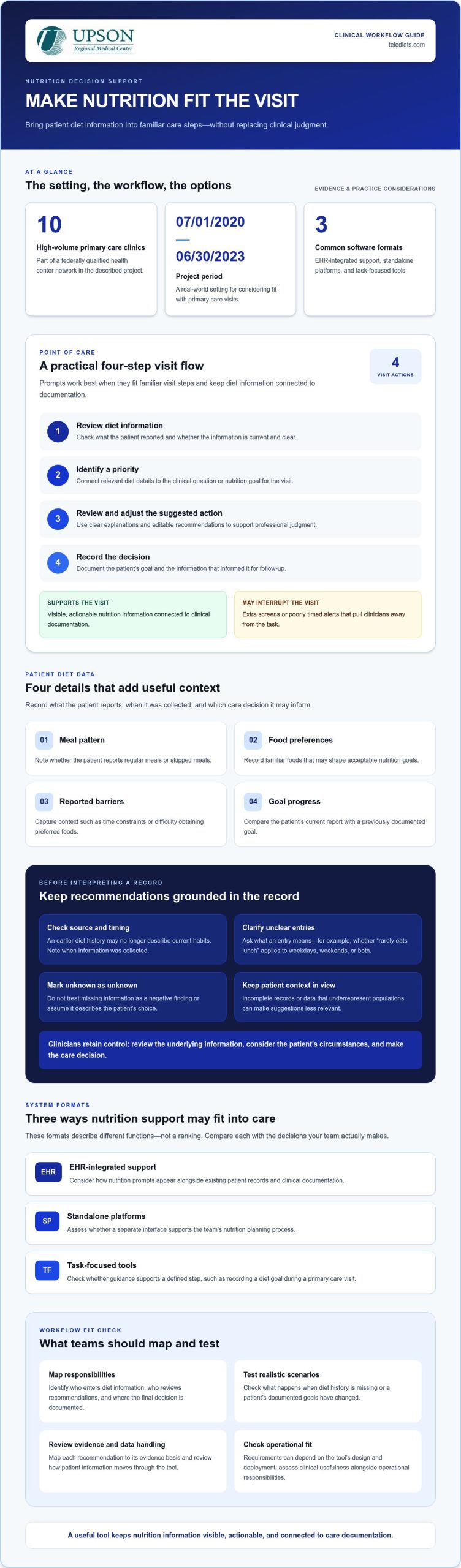
A nutrition decision tool works best at the point of care. In primary care, that may be intake, goal-setting, or follow-up documentation. A project running 07/01/2020 – 06/30/2023 involved 10 high-volume primary care clinics in a federally qualified health center network. This setting highlights a practical requirement: prompts should fit familiar visit steps. A clinician can review diet information, identify a priority, and record a goal without switching repeatedly between tasks.
How do nutrition decision support tools compare in features and usability? They vary in the patient data they use, the recommendations they present, and how they connect with clinical documentation. Compare them by walking through a realistic workflow: enter diet details, review a suggested action, adjust it, and record the decision. Clear explanations and editable recommendations make it easier to apply professional judgment. Extra screens or poorly timed alerts can interrupt a visit.
In the United States, clinical guidance informs nutrition recommendations, while applicable regulations shape how health information and software are handled. Practices should map each recommendation to its evidence basis and review how patient data move through the tool. Requirements can depend on the tool’s design and deployment. This distinction helps teams assess clinical usefulness alongside operational responsibilities.
What are the risks, limitations, and bias concerns of nutrition decision support tools? Incomplete diet records can produce suggestions that do not reflect a patient’s circumstances. Data that underrepresent particular populations may also make recommendations less relevant. A prompt can distract rather than help if it appears at the wrong stage of a visit. Clinicians should review the underlying information, consider patient context, and retain control over decisions.
Before adopting a tool, map its steps against a typical appointment. Identify who enters diet information, who reviews recommendations, and where the final decision is documented. Test scenarios such as a missing diet history or a patient whose documented goals have changed. These checks show whether the tool supports the team’s process or adds avoidable work. A useful workflow keeps nutrition information visible, actionable, and connected to clinical documentation.
Patient diet data
Patient diet data can turn a broad nutrition discussion into a focused clinical question. Record what the patient reports, when it was collected, and which care decision it may inform. For example, when reviewing a patient’s usual breakfast, a clinician can ask how it relates to an agreed nutrition goal. Keep reported eating patterns distinct from measured clinical findings.
Useful records can include meal patterns, food preferences, reported barriers, and nutrition goals. One patient may describe skipping breakfast because of a work schedule, while another may report limited access to familiar foods. These details give the clinician context for interpreting a recommendation. They also help distinguish missing information from a patient’s stated choice.
- Meal pattern: Note whether the patient reports regular meals or skipped meals.
- Food preferences: Record familiar foods that may shape acceptable nutrition goals.
- Reported barriers: Capture examples such as time constraints or difficulty obtaining preferred foods.
- Goal progress: Compare the patient’s current report with a previously documented goal.
Before using these details, check their source and timing. A diet history from an earlier visit may no longer describe current habits. Ask the patient to clarify unclear entries, such as whether “rarely eats lunch” means weekdays, weekends, or both. Mark unknown information as unknown rather than treating it as a negative finding. This keeps recommendations tied to what the record actually says.
Next, connect relevant diet information to the clinical question. If the visit concerns a nutrition goal, use the patient’s reported routine to identify a practical next step. If the record lacks context, gather it before interpreting the entry. Document the patient’s stated goal and the information supporting it. This creates a clear trail for follow-up and helps another clinician understand how the recommendation was reached.
Review data quality over time. Compare new reports with prior entries, note meaningful changes, and avoid assuming an old preference is still current. For example, a patient’s meal schedule may change after a shift change at work. Clear, dated notes help keep nutrition guidance grounded in the patient’s present circumstances.
Which nutrition clinical decision support systems are available in the United States?
In the United States, nutrition decision support comes in several software formats. An electronic health record (EHR) may include prompts within patient documentation. A standalone clinical platform may organize nutrition plans and recommendations separately. Some systems focus on a single workflow, such as identifying diet goals during primary care visits. The right category depends on where clinicians need nutrition guidance and what patient information they use.
Compare options by the task each system supports. An EHR-integrated tool can place prompts near existing records. A standalone platform may focus more directly on nutrition planning. A workflow-specific tool can guide a defined step, such as recording a diet goal. These categories describe different functions, not a ranking. Review whether the system supports the decisions your team actually makes.
- EHR-integrated support: Consider how nutrition prompts appear alongside clinical documentation.
- Standalone platforms: Assess whether a separate interface supports your nutrition planning process.
- Task-focused tools: Check whether guidance addresses a specific step, such as setting a diet goal.
For a practical comparison, trace one visit from start to finish. Identify where patient diet information enters, when a recommendation appears, and how the clinician records a decision. For example, a primary care workflow might capture a patient’s stated nutrition goal during the visit. A useful system makes that information available at the relevant decision point, rather than requiring staff to search separate records.
Next, assess how each option handles evidence and clinician control. Review whether recommendations explain their basis and allow clinicians to adapt them to patient context. Consider how changes to a recommendation appear in documentation. A tool that supports goal-setting serves a different purpose from one focused on storing diet data. Distinguishing these functions helps clinics match software to their care model, staffing, and existing EHR workflow.
Availability alone does not establish fit. Use a sample case to compare the system’s input fields, suggested actions, and documentation steps. Then identify which team members use each feature. This structured review can show whether a nutrition support system addresses a genuine workflow need or duplicates an existing process.
What evidence shows nutrition clinical decision support tools improve patient outcomes?
Researchers evaluated a diet goal-setting tool in a 3-month cluster randomized controlled trial. This design compares groups assigned different approaches, rather than relying only on clinician impressions. The evaluation focused on a practical question: can structured nutrition support be used during care? A trial’s design matters, but it does not establish which patient outcomes changed. Interpret findings by separating tool use, goal-setting, and health measures.
Look for outcomes that connect the tool’s actions to patient care. A clinician documenting a diet goal is a process measure; a patient’s progress toward that goal is a different outcome. Health measures may provide another level of evidence. Each answers a distinct question, so a study reporting more documented goals alone cannot prove improved health.
- Use: Did clinicians apply the tool during appointments?
- Care process: Did patients and clinicians set or revisit nutrition goals?
- Patient outcomes: Did measured health indicators or reported behaviors change?
In a cluster randomized trial, clinics or groups receive the intervention rather than assigning each patient individually. This approach can test a tool within real clinic routines. Review how researchers selected clinics, measured outcomes, and compared groups. Also examine follow-up duration and whether the reported results address patient outcomes or implementation. These details determine how closely the findings apply to another care setting.
Evidence should guide adoption without replacing clinical judgment. A tool may make nutrition goals more visible, but patient circumstances still shape whether those goals are practical. Compare trial measures with your intended use. If your aim is better documentation, assess documentation outcomes. If your aim is patient progress, look for patient-level measures. Keep these goals distinct.
When reviewing evidence for clinical decision support tools for nutrition, ask whether the study reports both implementation and patient outcomes. The 3-month evaluation provides a study design and timeframe, not a result to assume. Apply the same standard to future evaluations: identify what changed, how it was measured, and whether the finding addresses your clinical question. That disciplined reading helps teams judge evidence without overstating what a tool can achieve.
TeleDIETS: Standard Series Meal Plans
TeleDIETS gives healthcare professionals a practical next step when they need structured nutrition plans within clinical workflows. Its Standard Series Meal Plans support nutrition planning, while Advanced Medical Series Meal Plans address more specialized clinical needs. GLP-1 Meal Plan Protocols and Insurance Billing & CPT Coding Tools provide additional practice-focused options.
TeleDIETS enables clinicians to prescribe evidence-based nutritional plans tailored to lab results and clinical diagnoses. Its platform can connect patient information with a plan relevant to the clinician’s care process. Teams evaluating nutrition decision support can consider whether structured plans fit their workflow and patient population.
Explore TeleDIETS to support evidence-based nutrition planning in your practice. Contact TeleDIETS to learn more.
Make your next step practical
Choose one clinical workflow where nutrition support could become more consistent. Define the decision clinicians need to make, the patient information they need, and where that decision should appear in documentation. Then assess whether clinical decision support tools for nutrition support that workflow without obscuring professional judgment.
Bring clinical, operational, and technology perspectives into the discussion. A clinician can identify useful recommendations, while operations staff map the steps required to use them. Technology teams can assess how the tool fits existing systems. This shared review creates a practical basis for deciding what to implement and how to evaluate its use.
TeleDIETS offers nutrition planning options for healthcare professionals seeking structured support in clinical practice. Consider whether its offerings align with your workflow and the patient needs your team serves. Discuss your practice’s needs with TeleDIETS and take a thoughtful next step toward making nutrition guidance part of care.
Frequently Asked Questions
What are clinical decision support tools for nutrition?
Clinical decision support tools for nutrition are software features that help healthcare professionals apply nutrition information during care. They may organize relevant patient details, present evidence-based guidance, or support a nutrition-related decision. For example, a clinician could use a tool to connect a documented diagnosis with appropriate nutrition planning. The tool informs professional judgment; it does not replace assessment or individualized care.
How do nutrition decision support tools integrate with electronic health records?
Nutrition tools can connect with an electronic health record (EHR) through an interface or a workflow within the record. Depending on the system, clinicians may view relevant patient details, enter nutrition information, and document decisions in the same care environment. Before implementation, define which information should move between systems and where it should appear. This helps prevent duplicate entry and keeps documentation clear.
How do clinicians implement nutrition decision support tools in a healthcare setting?
Clinicians can start by defining the intended use, such as supporting nutrition planning during a specific appointment type. Next, identify the staff who will use the tool and the information they need. Configure the workflow, explain how to review recommendations, and provide practical training. After launch, gather staff feedback and assess whether the tool supports its intended task without adding unnecessary steps.
What patient data and inputs do nutrition decision support tools use?
Inputs may include patient-reported eating patterns, nutrition goals, relevant diagnoses, and clinical information such as lab results. The specific inputs depend on the tool’s purpose. For a useful review, note where each detail came from, when it was recorded, and whether it is complete. For example, distinguish a patient’s report from a value documented in the clinical record before interpreting either.
Leave a Reply