
There isn’t one diet that works for everyone with Crohn’s disease. A Crohn’s disease MNT platform can help healthcare professionals tailor nutrition plans to a person’s symptoms, nutritional needs, and food tolerance, with registered dietitian guidance. The goal is a practical plan that can adapt as needs change, not a rigid list of foods to avoid.
It’s understandable to look for a clear answer in approaches such as the Mediterranean or low FODMAP diet. But a diet’s usefulness depends on the individual and the plan’s purpose. This article explains how personalized medical nutrition therapy works, what factors inform an eating plan, and what to consider when assessing these approaches. It also covers how plans can account for changing symptoms while supporting adequate nutrition, helping care teams make dietary decisions with greater clarity and clinical support.
Key Takeaways
- Personalized eating plans account for symptom patterns, food tolerance, and nutritional needs rather than relying on a single Crohn’s disease diet.
- Medical nutrition therapy can help structure nutrition support and identify what to monitor as symptoms and needs change.
- Explore how Mediterranean and low FODMAP approaches differ, and what to consider before applying either to an individual plan.
- Learn which insurance and Medicare coverage details to clarify and how billing tools can support MNT workflows.
Personalized eating plans
No single diet works for everyone with Crohn’s disease or ulcerative colitis. A personalized plan considers symptoms, nutritional needs, food tolerance, and the person’s current disease phase. During periods without symptoms, eating plans generally include whole grains and a variety of fruits and vegetables. If symptoms change, the plan may need to change too.
A registered dietitian nutritionist can connect dietary choices with practical goals, such as maintaining adequate nutrition and identifying foods that coincide with symptoms. For example, a person might record meals and symptoms, then review patterns with a dietitian rather than removing several food groups at once. This can help identify an individual food sensitivity without applying a broad rule that may unnecessarily limit variety.
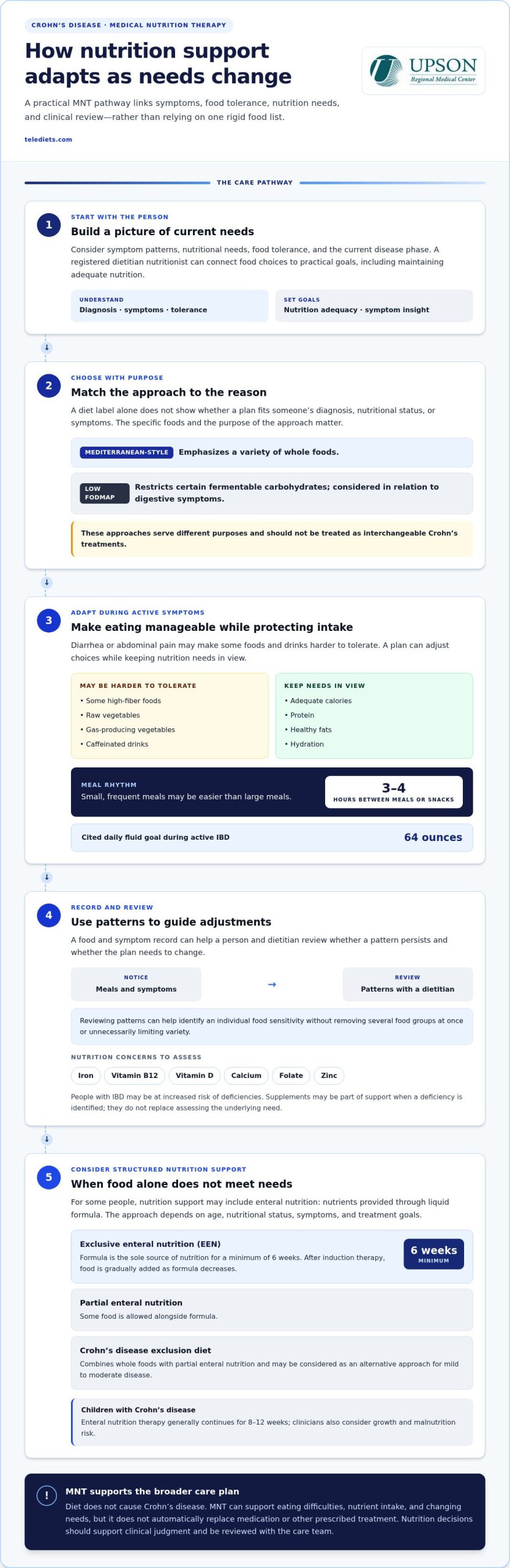
Mediterranean and low FODMAP approaches serve different purposes and shouldn’t be treated as interchangeable Crohn’s treatments. A Mediterranean-style pattern emphasizes a variety of whole foods, while a low FODMAP approach restricts certain fermentable carbohydrates and is typically considered in relation to digestive symptoms. Neither label alone shows whether a plan fits a person’s diagnosis, nutritional status, or current symptoms. The specific foods included and the reason for using the approach matter.
When comparing Crohn’s disease MNT platforms, assess dietitian credentials, personalization, and evidence. Check whether registered dietitian nutritionists are involved, plans reflect the person’s diagnosis and changing needs, and recommendations have an evidence-based rationale. A platform should explain how clinical information informs its plans instead of presenting one template as suitable for everyone.
Before using a Crohn’s disease MNT platform, ask practical questions to clarify how the plan will be used:
- Which registered nutrition professional supports or reviews the plan?
- How are symptoms, diagnosis, food tolerance, and nutritional concerns considered?
- What evidence supports the recommended dietary approach?
- How can the plan be adjusted if symptoms or eating patterns change?
These questions help patients and care teams assess whether a plan supports individualized care. A dietary approach can help organize choices, but it doesn’t replace prescribed treatment. Nutrition decisions should also account for concerns such as weight changes, possible nutrient gaps, and the role of supplements or enteral nutrition when food alone does not meet needs. A Crohn’s disease MNT platform is most useful when recommendations support clinical judgment and make personalization clear.
How can medical nutrition therapy help manage Crohn’s disease?
Medical nutrition therapy (MNT) uses dietary strategies to support a health condition or its symptoms. For Crohn’s disease, it can help address eating difficulties, nutrient intake, and changing needs during active symptoms. Diet doesn’t cause Crohn’s disease, but symptoms and digestive changes can affect what a person tolerates and absorbs. MNT complements the broader care plan; it doesn’t automatically replace medication or other treatment.
A practical plan considers both nutrition and symptom patterns. During active symptoms, diarrhea or abdominal pain may make some high-fiber foods, raw vegetables, gas-producing vegetables, or caffeinated drinks harder to tolerate. Small, frequent meals can be easier than large meals, and the general recommendation is to eat meals or snacks every 3 to 4 hours. Adequate calories, protein, and healthy fats remain important. Hydration matters too: during active IBD, the cited daily fluid goal is 64 ounces.
Monitoring helps identify concerns that may need attention. People with IBD may be at increased risk of deficiencies in iron, vitamin B12, vitamin D, calcium, folate, and zinc. A care plan can consider symptoms, food intake, and relevant clinical information when assessing nutrition needs. Supplements may be part of support when a deficiency is identified, but they aren’t a substitute for assessing the underlying need.
For some people, nutrition support involves enteral nutrition, which provides nutrients through liquid formula. Exclusive enteral nutrition (EEN) uses formula as the sole source of nutrition for a minimum of 6 weeks. After induction therapy, food is gradually added as formula decreases. Partial enteral nutrition allows some food alongside formula. The Crohn’s disease exclusion diet combines whole foods with partial enteral nutrition and may be considered as an alternative approach for mild to moderate disease.
These therapies require structured planning. EEN may involve choosing an appropriate formula, maintaining adequate intake, and planning food reintroduction with a dietitian and healthcare provider. In children with Crohn’s disease, enteral nutrition therapy generally continues for 8-12 weeks; clinicians also consider growth and malnutrition risk. Formula-based support is not the same as a general eating plan, so the care team weighs age, nutritional status, symptoms, and treatment goals.
MNT can also support ongoing review. A food and symptom record, for example, can help a dietitian assess whether a pattern persists and whether the plan needs adjustment. The aim is to protect nutritional adequacy while adapting food choices to the person’s clinical needs.
Does insurance or Medicare cover MNT for Crohn’s disease?
Coverage for medical nutrition therapy (MNT) depends on the benefit rules for the specific service. A Crohn’s disease diagnosis alone doesn’t determine whether a particular nutrition visit or program qualifies. Insurers may assess the clinical indication, provider credentials, network status, referral requirements, and billing details. Medicare decisions also depend on the applicable benefit criteria and how the service is provided and billed. A meal plan, dietitian visit, and nutrition software are different services, so coverage for one doesn’t establish coverage for another.
Start by identifying the service being considered. For example, a patient may receive MNT from a registered dietitian, while a clinic uses software to prepare or document nutrition plans. A benefit may apply to a professional service, but not necessarily to a digital platform or meal-plan resource. This distinction helps prevent assumptions based only on the terms “nutrition therapy” or the Crohn’s diagnosis.
Coverage review commonly turns on several practical details:
- Clinical indication: The record should explain why MNT relates to the patient’s Crohn’s care, such as nutrition concerns or difficulty meeting needs.
- Provider eligibility: The plan’s rules may specify which professional can furnish or bill for the service.
- Network and referral rules: Benefits can depend on network participation, prior authorization, or a required referral.
- Service and coding: The billed service and its documentation need to match the care delivered and the payer’s criteria.
- Patient cost-sharing: Deductibles, copayments, and coinsurance can affect what the patient pays even when a benefit applies.
For Medicare, distinguish coverage for a qualified nutrition service from coverage for tools a practice uses. Medicare’s benefit criteria, provider requirements, and billing rules determine whether a claim qualifies. A platform that supports meal planning or coding does not itself establish Medicare eligibility or payment. Clinics should align documentation with the service provided, the patient’s clinical rationale, and applicable billing requirements.
Before scheduling, patients can review their plan documents for nutrition benefits and ask targeted questions about the service, provider type, referral, authorization, and cost-sharing. For instance, asking whether the benefit applies to a dietitian appointment is more precise than asking whether “Crohn’s nutrition” is covered. Clinics can support clear billing workflows by matching documentation and codes to services delivered, rather than treating every nutrition resource as a reimbursable visit. This distinction helps patients understand their benefits and helps practices set accurate expectations without implying that every plan follows the same rules.
TeleDIETS: Standard Series Meal Plans
TeleDIETS offers healthcare professionals a practical way to organize nutrition care through its Standard Series Meal Plans. When Crohn’s care calls for a more clinically specialized approach, Advanced Medical Series Meal Plans offer another plan category. These offerings support professional workflows, but don’t replace individualized clinical judgment or determine insurance coverage for a specific service.
Providers can use the platform to prepare nutritional plans informed by clinical diagnoses and lab results. Its Insurance Billing & CPT Coding Tools support billing workflows, a useful consideration when coverage depends on the service and plan rules. The right offering depends on the clinician’s workflow and nutrition-planning needs.
To explore how TeleDIETS can fit your practice’s medical nutrition therapy workflow, contact TeleDIETS.
Make the next nutrition decision with clarity
For a care team, the next step is to turn clinical priorities into a nutrition workflow that can be reviewed and adapted over time. A Crohn’s disease MNT platform can support that process when its plans complement professional judgment and the person’s broader care plan. The practical question is how to make evidence-informed nutrition planning easier to apply in your setting.
TeleDIETS offers Standard Series Meal Plans, Advanced Medical Series Meal Plans, and GLP-1 Meal Plan Protocols for healthcare professionals building nutrition support into clinical workflows. These offerings serve different planning needs, so the right starting point depends on the care context and your practice’s goals.
If you’re considering how structured meal plans could fit your approach to Crohn’s nutrition, contact TeleDIETS about Crohn’s nutrition. A thoughtful workflow can help your team approach nutrition planning with greater consistency and confidence.
Frequently Asked Questions
How does the diet work?
A personalized diet uses a person’s symptoms, food tolerance, and nutritional needs to guide choices. A Crohn’s disease MNT platform can help a care team organize this information and review it as needs change. For example, clinicians can compare a symptom record with eating patterns before considering dietary adjustments. This supports informed discussion without treating food changes as a replacement for prescribed care.
What conditions is the diet used for?
Medical nutrition therapy can support nutrition care for Crohn’s disease and other conditions where dietary planning relates to a diagnosis or its symptoms. In inflammatory bowel disease, this can include Crohn’s disease and ulcerative colitis, although plans aren’t automatically interchangeable. A Crohn’s disease MNT platform can help clinicians structure condition-focused plans, while the diagnosis and clinical context guide the approach.
Why is it being recommended?
Nutrition planning is recommended because Crohn’s symptoms can affect eating, digestion, and nutrient absorption, while food responses vary between people. It can help the care team consider intake and potential nutrient concerns alongside the broader treatment plan. The purpose is to support nutritional needs and clinical decision-making, not to suggest that a specific diet cures Crohn’s disease or works the same way for everyone.
What is a Crohn’s disease MNT platform, and what features does it offer?
A Crohn’s disease MNT platform is clinical software that helps healthcare professionals organize nutrition planning around diagnoses and relevant clinical information. TeleDIETS is offered as a SaaS application or AI engine, with plans tailored to lab results and clinical diagnoses. Its offerings include Standard Series Meal Plans, Advanced Medical Series Meal Plans, Insurance Billing & CPT Coding Tools, and a Telemedicine Plugin.
How do Crohn’s disease MNT platforms compare on dietitian credentials, personalization, and evidence?
Compare whether registered dietitian nutritionists review plans, whether recommendations reflect the person’s diagnosis, symptoms, food tolerance, and changing nutritional needs, and whether the rationale is evidence-based. A platform should explain how clinical information informs recommendations rather than offering one template for everyone.
Leave a Reply