
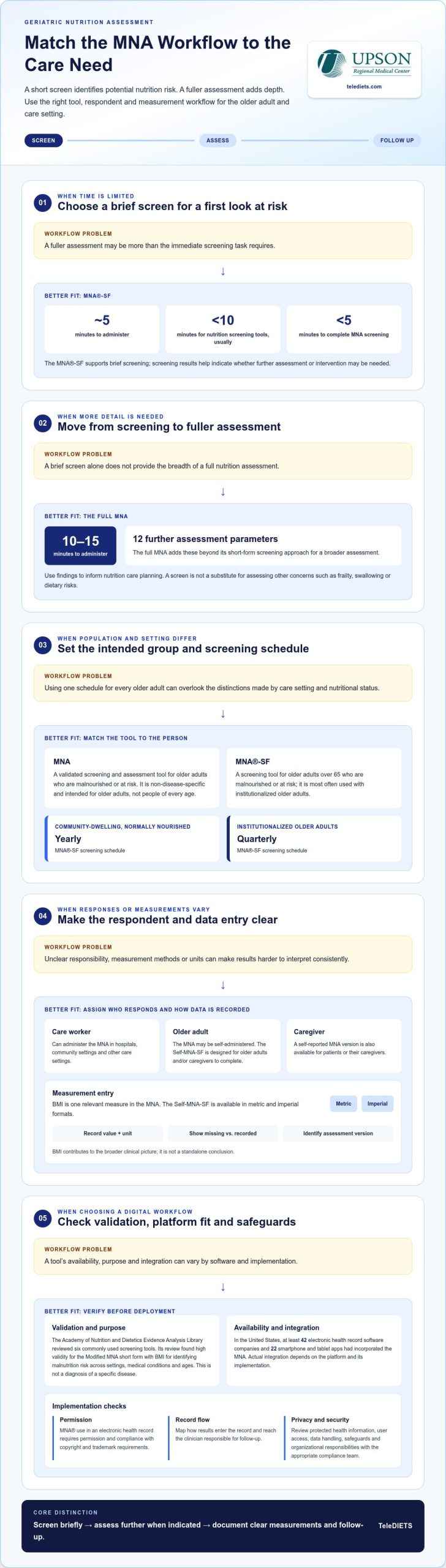
A shorter screen can save time, but it doesn’t replace knowing what the tool measures or who should complete it. The Mini Nutritional Assessment takes 10 – 15 min to administer, while the MNA®-SF takes about 5 minutes; nutrition screening tools usually take less than 10 minutes. For teams comparing geriatric nutrition assessment software, administration time is only one part of choosing a practical workflow.
A useful assessment must fit both the care setting and the older adult’s needs. This reference explains how the MNA and MNA®-SF differ, which anthropometric measurements they use, and who they are intended for. It also clarifies what screening results can tell you, helping distinguish a brief screen from a fuller assessment and understand where each belongs in nutrition care.
Key Takeaways
- Distinguish a brief nutrition screen from a fuller assessment so you can match the tool to the care task.
- Review which anthropometric measurements are included and how they contribute to the overall assessment.
- Choose an approach suited to the older adult’s setting and whether a care worker, the individual, or a caregiver will respond.
- Use assessment findings to inform nutrition care planning, then consider how clinical meal-plan resources and workflow tools fit your practice.
Administration time
Administration time is the minutes needed to complete a nutrition screen or assessment. The original Mini Nutritional Assessment (MNA) takes 10 – 15 minutes to administer. The MNA®-SF takes about 5 minutes, while nutrition screening tools usually take less than 10 minutes. Completing MNA screening takes less than 5 minutes.
Compare geriatric nutrition assessment software by tool, completion time, measurement fields, respondent options, and workflow fit. The MNA®-SF supports brief screening; the full MNA includes 12 further assessment parameters for a broader assessment.
For privacy and security, assess whether the workflow involves protected health information and identify applicable safeguards and responsibilities before deployment. Review user access, data handling, and organizational policies with the appropriate compliance team.
In the United States, MNA support appears in electronic health record platforms and smartphone or tablet apps. At least 42 electronic health record software companies had incorporated the MNA, and 22 smartphone and tablet apps had incorporated it.
Electronic health record workflows can include the MNA, but integration depends on the platform and its implementation. Map how results enter the record and reach the clinician responsible for follow-up.
The MNA and MNA®-SF are nutrition screening and assessment tools; which tool is available depends on the software and its permissions. The MNA® may be incorporated into an electronic health record only with permission and in compliance with copyright and trademark requirements.
The MNA evaluates malnutrition risk and supports decisions about whether further assessment or intervention is needed. Frailty, swallowing, and dietary risks require appropriate assessment fields, so don’t assume a nutrition screen measures every concern.
Choose and implement software by defining the population, selecting the screening tool, and mapping who completes it. Then review privacy responsibilities, fit the steps into clinical practice, and train users to record results and follow-up.
Anthropometric measurements
An anthropometric measurement is a body measurement used to inform nutrition assessment. In the Mini Nutritional Assessment (MNA), BMI is one relevant measure. A modified MNA short form with BMI showed high validity for identifying malnutrition risk across adults, care settings, medical conditions, and ages.
For older adults, software should make the measurement method and units clear to the person entering data. The Self-MNA-SF is available in metric and imperial formats. Consistent units help clinicians interpret entries and compare records over time; the chosen format should match the measurement source and assessment workflow.
A validated assessment tool has been evaluated for its intended use. The Academy of Nutrition and Dietetics Evidence Analysis Library reviewed six nutrition screening tools commonly used in health care settings. Its review found high validity for the Modified Mini-Nutritional Assessment short form with BMI across settings, medical conditions, and ages. This finding concerns identifying malnutrition risk, not diagnosing a specific disease.
Before choosing a digital workflow, review its measurement fields. Confirm that staff can distinguish a recorded value from a missing one, see which units apply, and identify the assessment version used. For example, if one record uses metric units and another uses imperial units, the software should display the unit clearly rather than leave clinicians to infer it.
- Record: capture the measurement and its unit together.
- Review: check that the selected MNA version matches the intended assessment.
- Interpret: consider BMI as part of the broader clinical picture, not as a standalone conclusion.
The full MNA contains 12 further assessment parameters beyond its short-form screening approach. Anthropometric information therefore contributes to, but does not replace, the wider assessment. For geriatric nutrition assessment software, clear measurement entry and unit display support more consistent documentation across a clinical setting.
The MNA® was reported to perform better than the Braden Scale and other measures in predicting pressure ulcer development. This comparison concerns prediction, not confirmation that an individual has a pressure ulcer. Consider it alongside the anthropometric record and broader assessment, while keeping the purpose of each measure clear. A risk estimate is not a diagnosis or a direct measurement of body size.
Intended population and respondents
Nutrition screening is a brief process for identifying people who may need further assessment. The Mini Nutritional Assessment (MNA) is a validated screening and assessment tool for older patients who are malnourished or at risk of malnutrition. It is intended for older adults, not people of every age or a population defined by one disease. The MNA is non-disease-specific and evaluates nutrition risk across clinical contexts.
The MNA® Short Form (MNA®-SF) is a screening tool for older adults over 65 years who are malnourished or at risk of malnutrition. It is most often used with institutionalized older adults. Normally nourished, community-dwelling older adults should complete the MNA®-SF yearly; institutionalized older adults should complete it quarterly. These schedules distinguish people by setting and nutritional status, not simply by age.
A respondent is the person who answers or supplies information for an assessment. Care workers can administer the MNA in hospitals, community settings, and other care settings, or it may be self-administered. The Self-MNA-SF is designed for older adults and/or caregivers to complete. A self-reported MNA version is also available for patients or their caregivers. These options help teams match the screening process to the respondent and care context.
When selecting software, identify the intended individuals and respondent before setting up a screening workflow. For example, a residential care workflow may involve a care worker recording responses, while a community-dwelling older adult may complete a self-report version. Keep the respondent’s role visible in the record so clinicians can interpret the information’s source. The MNA evaluates malnutrition risk in older patients and supports early nutritional intervention when needed. A positive screen signals a need for appropriate follow-up, not a stand-alone diagnosis. Use the selected MNA version consistently and record whether responses came from the individual, caregiver, or care worker.
The MNA is a non-disease-specific assessment developed for an older population, so its use is not limited to a particular diagnosis. The Mini Nutritional Assessment Short Form is most often used in institutionalized older adults, reflecting its typical care setting.
What is geriatric nutrition assessment software and who uses it?
Geriatric nutrition assessment software is a digital tool for recording and organizing nutrition screening or assessment information about older adults. It can support workflows built around tools such as the Mini Nutritional Assessment (MNA) and its short form. The software supports workflow, but does not replace clinical judgment or comprehensive assessment.
Users include healthcare professionals who screen older patients in hospitals, community settings, and other care settings. Care workers may administer the MNA, while registered dietitian nutritionists can conduct comprehensive nutrition assessments when screening identifies risk. Older adults and caregivers may also provide information through self-reported versions. The respondent’s role matters because it identifies who supplied the answers.
A digital workflow can help teams capture responses, preserve the selected assessment version, and make findings available for review. For example, staff can record whether the MNA®-SF was completed by a care worker or self-reported by an older adult. The software should make that distinction clear and link the result to the correct individual’s record.
Screening and assessment serve different purposes. The MNA helps identify older patients who are malnourished or at risk, while a comprehensive nutrition assessment provides a fuller evaluation. A screening result can guide next steps, including referral for further assessment. Software supports documentation, but a screening score alone does not establish the complete nutrition picture.
When evaluating geriatric nutrition assessment software, map the workflow before selecting features. Define the users, choose the appropriate screening tool, and determine how results reach the clinician responsible for review. This helps practices assess whether software supports every step, from capturing responses to documenting follow-up, while keeping the respondent and assessment version clear.
TeleDIETS: Standard Series Meal Plans
TeleDIETS supports healthcare professionals with medical nutrition therapy planning after assessment findings inform care. Its Standard Series Meal Plans provide one option for practices building nutrition care workflows. For more specialized clinical needs, TeleDIETS also offers Advanced Medical Series Meal Plans and GLP-1 Meal Plan Protocols. Insurance Billing & CPT Coding Tools support related practice administration.
TeleDIETS’ offerings complement nutrition screening; they don’t replace an assessment tool such as the MNA or determine a patient’s nutritional status. Consider them when your practice needs structured, evidence-based meal plans to support nutrition care after clinical review. The appropriate plan depends on the care goals and clinical context established by the healthcare professional.
To explore how TeleDIETS fits your practice’s nutrition workflow, contact TeleDIETS.
Turn Assessment Into a Practical Care Workflow
Connect assessment processes with the nutrition care your practice delivers. Before choosing geriatric nutrition assessment software, identify how screening results will inform professional review, care planning, and documentation. This workflow focus helps your team evaluate whether its tools support the work that follows an assessment, rather than treating data entry as the endpoint.
For nutrition planning, TeleDIETS offers Standard Series Meal Plans, Advanced Medical Series Meal Plans, and GLP-1 Meal Plan Protocols. These options can support different practice needs within medical nutrition therapy. Consider which type aligns with your clinical priorities and how it fits your existing care process.
If you’re ready to discuss how these offerings may fit your practice, contact TeleDIETS to discuss your needs. A clear next step can help your team move from assessment planning toward a nutrition workflow that serves its patients.
Frequently Asked Questions
What nutrition assessment features should software for older adults include?
Software for older-adult nutrition assessment should support a validated tool, accurate scoring, clear measurement units, respondent attribution, and follow-up documentation. For example, MNA®-SF scoring should distinguish 12-14 points as normal nutritional status, 8-11 points as risk of malnutrition, and 0-7 points as malnutrition. It should also preserve the selected instrument and version, and any electronic use of MNA® must respect permission, copyright, and trademark requirements.
What HIPAA, privacy, and security requirements apply to nutrition assessment software?
Before deployment, assess whether the workflow involves protected health information, then review applicable safeguards and responsibilities with the compliance team. Check user access, data handling, and organizational policies.
Which software platforms support geriatric nutrition assessment in the United States?
In the United States, the MNA is available through electronic health record platforms and smartphone or tablet apps. At least 42 EHR software companies and 22 apps had incorporated it.
How does the software assess malnutrition, frailty, swallowing, and dietary risks in older adults?
The MNA evaluates malnutrition risk and can help identify the need for further assessment or intervention. Frailty, swallowing, and dietary risks require appropriate assessment fields; don’t assume a nutrition screen measures them.
Leave a Reply