
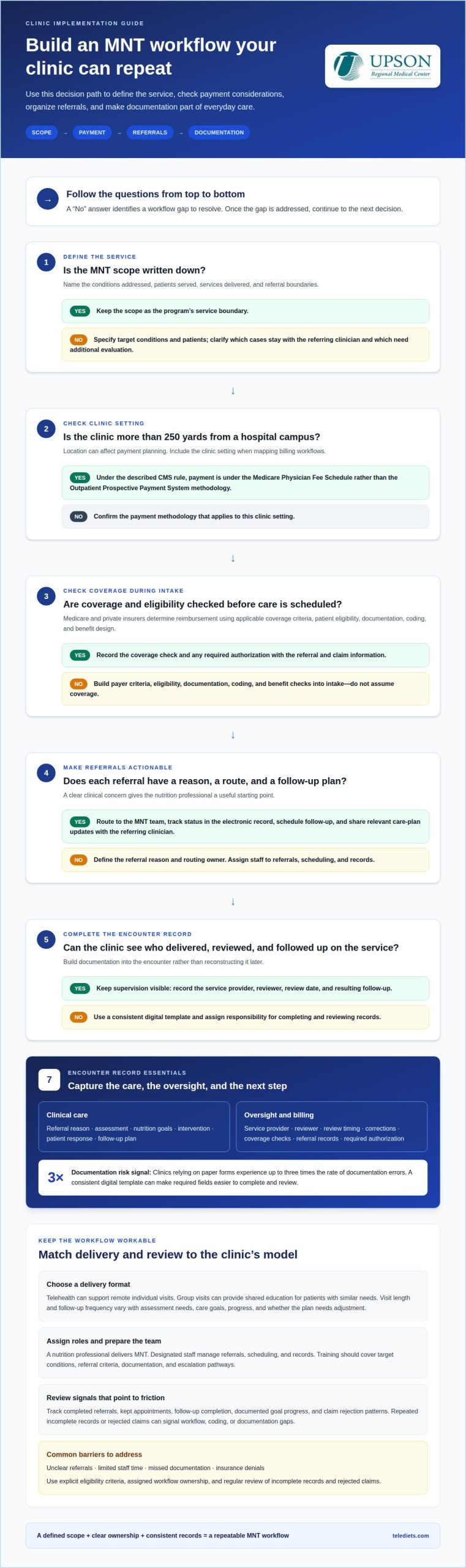
A busy clinic can make medical nutrition therapy (MNT) manageable by defining what it will address, which patients it will serve, and how supervision and documentation fit into everyday care. To understand how to implement MNT in a busy clinic, set those boundaries before building the workflow. The goal is a clear, repeatable process that supports clinical care without confusing staff responsibilities.
It’s reasonable to be cautious about adding another service to an already full schedule. MNT works best when its audience and scope are specific, responsibilities are clear, and documentation fits consistently into the clinic’s existing processes.
This guide covers practical steps for setting your MNT scope and target audience, organizing referrals and care delivery, and tracking supervision and compliance documentation. It also explains how structured meal plans and billing tools can support the workflow, helping you decide what belongs in your clinic’s model and what needs a clearer process before launch.
Key Takeaways
- Set a defined MNT scope around your clinic’s services, patient population, and referral pathway; Medicare payment rules can also differ for off-campus clinics more than 250 yards from a hospital campus, according to the Centers for Medicare & Medicaid Services.
- Build supervision and documentation into the workflow, with clear responsibility for recording services, oversight, and follow-up.
- Identify the patients and nutrition-related needs your MNT program is designed to support, then align care pathways with that focus.
- Make coverage and referral processes part of program design so staff can document key steps and keep care delivery organized.
1. Defining clinic scope and target audience
Start with a written scope that defines the conditions addressed, patients served, services delivered, and referral boundaries. For example, a primary care clinic might prioritize nutrition support for patients managing chronic disease. Define which cases remain with the referring clinician and which require additional evaluation. A clear scope turns a broad opportunity into a manageable service.
Location can affect payment planning. Under the described Medicare payment rule, off-campus clinics more than 250 yards from a hospital campus are paid under the Medicare Physician Fee Schedule rather than the Outpatient Prospective Payment System methodology, according to the Centers for Medicare & Medicaid Services. Include the clinic’s setting when mapping billing workflows.
MNT costs depend on visit format, staffing, and the clinic’s operating model. Medicare and private insurers determine reimbursement based on applicable coverage criteria, patient eligibility, documentation, coding, and benefit design. Build these checks into intake rather than assuming coverage.
For primary care staffing, assign a nutrition professional to deliver MNT and designate staff to manage referrals, scheduling, and records. Training should cover the clinic’s target conditions, referral criteria, documentation process, and escalation pathway. A concise workflow guide helps medical assistants and clinicians follow the same steps.
Integrate referrals into existing care by defining a referral reason, routing it to the MNT team, and scheduling follow-up before the patient leaves. Use the electronic record to track referral status and share relevant care-plan updates with the referring clinician.
Visit length and follow-up frequency will vary by patient. Set appointment time and follow-up cadence according to assessment needs, care goals, progress, and whether the plan needs adjustment.
Telehealth can support remote individual visits, while group visits can provide shared education for patients with similar needs. Common barriers include unclear referrals, limited staff time, missed documentation, and insurance denials. Address them with explicit eligibility criteria, assigned workflow ownership, and regular review of incomplete records and rejected claims.
2. Tracking supervision and compliance documentation
Build documentation into each MNT encounter rather than reconstructing it later. A complete record can capture the referral reason, assessment, nutrition goals, intervention, patient response, follow-up plan, and responsible clinician. Clinics relying on paper forms experience up to three times the rate of documentation errors. A consistent digital template can make required fields easier to complete and review.
Make supervision visible in the workflow. Record who delivered the service, who reviewed it, when the review occurred, and what follow-up resulted. If a supervisor requests a correction, retain the updated note and communicate the change to relevant care-team members. Clear ownership helps prevent unsigned, incomplete, or misrouted records from causing avoidable delays.
For privacy, use the clinic’s approved record system, limit access by staff role, and communicate patient information through approved channels. Billing documentation should support the service reported, with encounter details aligned to payer requirements and the code submitted. Track coverage checks, referral records, and any required authorization alongside the claim. The clinic’s privacy policies, payer contracts, and billing procedures determine the applicable requirements.
Track quality with measures that connect care delivery to patient progress. Useful indicators include completed referrals, kept appointments, follow-up completion, documented goal progress, and claim rejection patterns. Choose measures that match the program’s scope and review them regularly. A report showing many referrals but few completed visits may point to scheduling friction; repeated claim rejections may signal coding or documentation gaps.
Keep the review practical. A designated lead can sample records, identify recurring gaps, and share corrections during team meetings. Use findings to refine templates, staff training, and program workflows. This makes supervision an ongoing quality process, not a signature added after care is complete.
To keep the digital workflow dependable, assign responsibility for maintaining templates and test them against routine encounters. When staff identify a missing field or unclear instruction, route it for review and update the workflow consistently. This makes corrections part of everyday practice rather than isolated fixes.
3. What is medical nutrition therapy (MNT), and which patients benefit most?
Medical nutrition therapy is individualized nutrition care connected to a person’s clinical needs. A clinician uses relevant health information, such as lab results and diagnoses, to guide nutrition recommendations. The process can include assessing dietary patterns, identifying nutrition concerns, setting practical goals, and reviewing progress. For example, a care plan may address a patient’s documented nutrition needs alongside the treatment plan managed by the broader clinical team.
MNT is most relevant for patients whose diagnosed conditions or clinical findings make nutrition care part of ongoing management. People managing chronic disease may benefit when nutrition goals are tailored to their health information and reviewed over time. A referral should identify the clinical concern and purpose of nutrition support, giving the nutrition professional a clearer starting point than a general request for dietary advice.
For clinic teams considering how to implement MNT in a busy clinic, a defined patient profile helps keep referrals relevant. Use clinical need, program scope, and follow-up capacity as practical screening filters. Identify the diagnoses or care goals your clinic is prepared to support, then distinguish MNT referrals from general wellness education. Patients whose needs fall outside the program’s scope should follow the clinic’s established care pathway.
Individualization matters. Two patients with the same diagnosis may have different lab results, food patterns, priorities, or barriers to following a care plan. The assessment should connect recommendations to the person’s clinical context and realistic goals. Follow-up can show whether the plan remains appropriate or needs adjustment.
Defining how to implement MNT in a busy clinic also means describing the audience in operational terms: eligible referral reasons, intake information, and the professional responsible for care. This helps clinicians identify suitable patients and staff route referrals consistently. It keeps the program focused on evidence-based nutrition support for diagnosed needs, rather than unrelated diet advice.
4. What are the U.S. Medicare coverage and referral requirements for MNT?
Medicare coverage for MNT depends on the service, the patient’s circumstances, and applicable coverage criteria. Don’t assume every nutrition referral is covered. Before scheduling, identify the clinical reason for the referral and determine which Medicare coverage rules apply.
Build a coverage review into intake. Staff can record the referral reason, proposed service, patient information needed for review, and coverage-check result. Keep that result with the scheduling record so billing staff can see what was established before the visit. If a required detail is missing, route the referral through the clinic’s established process.
Referral documentation should make the clinical purpose clear. A referral tied to a documented diagnosis or care goal, for example, gives the MNT team useful assessment context. Record who initiated the referral, what information accompanied it, and any follow-up needed from the referring clinician. This supports continuity and makes the pathway easier to audit.
Medicare payment can also depend on clinic setting. Under the described Medicare payment rule, off-campus clinics more than 250 yards from a hospital campus are paid under the Medicare Physician Fee Schedule rather than the Outpatient Prospective Payment System methodology, according to the Centers for Medicare & Medicaid Services. Keep location-specific billing workflows distinct where that rule applies.
For private insurance, review the patient’s plan terms separately. Coverage criteria, referral processes, authorization steps, and claim requirements can differ by plan. A consistent intake checklist should capture the insurer, relevant benefit information, referral status, and documentation needed for billing. Don’t assume a Medicare workflow transfers unchanged to a commercial plan.
After each visit, reconcile the record. Confirm that the documented service matches the service billed, and track denials by reason. Patterns such as missing referral information or incomplete encounter notes can guide staff training and improve the clinic’s workflow without changing its clinical scope.
For off-campus clinics more than 250 yards from a hospital campus, Medicare pays under the Medicare Physician Fee Schedule rather than the Outpatient Prospective Payment System methodology. Private insurer reimbursement depends on the patient’s plan terms, coverage criteria, referral and authorization processes, and claim requirements.
TeleDIETS
TeleDIETS supports clinics ready to operationalize MNT with structured nutrition plans and workflow tools. Its platform enables healthcare professionals to prescribe evidence-based plans tailored to lab results and clinical diagnoses, helping connect your defined patient scope with consistent nutrition support.
Clinics managing chronic disease may use Advanced Medical Series Meal Plans, while GLP-1 Meal Plan Protocols address a specific nutrition-support pathway. Standard Series Meal Plans offer another plan option. Insurance Billing & CPT Coding Tools can support the administrative side of delivering and documenting MNT.
Consider TeleDIETS when your clinic has established its audience and referral process and needs tools to support plan delivery or billing workflows. Contact TeleDIETS to discuss how the platform can fit your clinic’s MNT approach.
Put Your MNT Workflow Into Practice
The next step is to turn your clinic’s MNT approach into a workflow staff can use consistently. Start with a clearly defined patient pathway, then observe where referrals, scheduling, documentation, and follow-up create friction. Use those observations to refine responsibilities and processes before expanding the program. This makes how to implement MNT in a busy clinic a practical operational decision, not just a planning exercise.
TeleDIETS can support healthcare professionals with evidence-based nutrition plans and tools for clinic workflows. If you’re ready to discuss how its platform may fit your practice’s needs, contact TeleDIETS to discuss MNT.
A focused starting point gives your team room to learn, adapt, and build a sustainable MNT service for the patients it is designed to serve.
Frequently Asked Questions
How can a busy clinic screen patients and identify those who need MNT?
Add a brief nutrition-screening prompt to an existing intake or rooming workflow, then route relevant findings for clinical review. For example, staff can flag a documented diagnosis, nutrition-related concern, or relevant lab result for the clinician to assess against the clinic’s MNT referral criteria. If the patient’s needs fit the program, record the referral reason and send it through the established scheduling pathway.
How long should MNT visits last, and how many follow-up visits are typical?
Visit length and follow-up frequency are not fixed. Set both according to assessment needs, care goals, progress, and whether the plan needs adjustment.
Leave a Reply