
Clear medical nutrition therapy records come from a consistent process, not simply longer notes. To streamline MNT documentation, organize information so the clinical reasoning, intervention, and patient response are easy to find and keep current. A well-structured record supports continuity and makes routine documentation easier to navigate.
It’s understandable to focus on capturing every relevant detail, especially when records need to be thorough and useful. The goal is to make those details easier to document and retrieve while preserving the patient-specific context that informs care.
This article explains why streamlined documentation matters and offers practical ways to structure records, use templates, and maintain clear, current notes. It also outlines what an MNT note should communicate so your documentation stays organized and clinically meaningful.
Key Takeaways
- Use a consistent structure and clear labels so important clinical details are easier to locate.
- Templates can support more consistent records while leaving room for patient-specific context and clinical reasoning.
- Review and update documentation regularly, using version control to keep changes clear and records current.
- Make each MNT note explain what was observed, what intervention followed, and the clinical reasoning behind it.
1. Structuring documentation for easier navigation
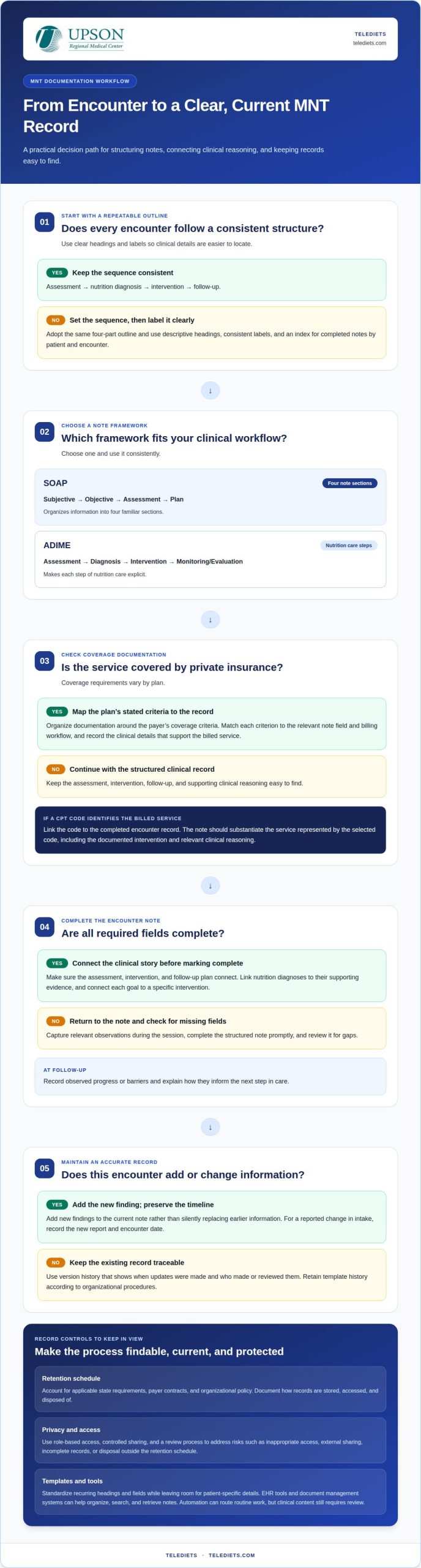
Begin with a repeatable outline for each MNT encounter: assessment, nutrition diagnosis, intervention, and follow-up. Use descriptive headings, consistent labels, and an index that helps staff locate completed notes by patient and encounter. A clear structure makes critical details easier to find and reduces errors caused by scattered records.
SOAP notes organize information as Subjective, Objective, Assessment, and Plan. ADIME uses Assessment, Diagnosis, Intervention, and Monitoring/Evaluation to make each step of nutrition care explicit. Choose the framework that fits your clinical workflow, then use it consistently.
For private insurance, organize documentation around the payer’s coverage criteria and record the clinical details that support the billed service. Requirements vary by plan, so map each payer’s stated criteria to the relevant note fields and billing workflow.
CPT codes identify billed services, while the note should substantiate the service represented by the selected code. Link the code to the completed encounter record, including the documented intervention and relevant clinical reasoning.
In the United States, record-retention schedules should account for applicable state requirements, payer contracts, and organizational policy. Document a schedule for storing, accessing, and disposing of records instead of relying on informal practices.
For an efficient encounter workflow, capture relevant observations during the session, complete the structured note promptly, and check it for missing fields. Before marking the record complete, connect the assessment, intervention, and follow-up plan. Automation can support routine routing, but clinical content still requires review.
Templates can standardize headings and recurring fields while leaving room for patient-specific details. Electronic health record tools and document management systems can organize, search, and retrieve notes. Choose features that fit your existing workflow.
Record nutrition diagnoses alongside the evidence that supports them, then connect each goal to a specific intervention. At follow-up, document observed progress or barriers and explain how they inform the next step in care.
Privacy and legal risks include inappropriate access, external sharing, incomplete records, and disposal outside the retention schedule. Use role-based access, controlled sharing, and a review process to protect sensitive information.
2. Benefits of streamlined documentation
A consistent MNT workflow reduces time spent locating details and resolving unclear entries. When every encounter follows the same sequence of fields, for example, a covering clinician can find the assessment and next planned action without searching unrelated notes. This improves efficiency and supports continuity between visits. It also helps the team distinguish new clinical information from copied text that may no longer apply.
A shared template can improve consistency across the team without forcing every case into identical wording. Standard fields capture recurring information, while open sections preserve patient-specific reasoning. When two team members review a note, a common structure helps them spot missing context or contradictory entries. Collaborative editing can also reduce duplicated work by keeping contributions in one document instead of separate versions.
Timely documentation can strengthen the quality of the record. Capturing a relevant observation during or soon after an encounter gives the clinician a concrete detail to interpret, rather than relying on memory later. The note can then connect that observation to the intervention and follow-up plan. This makes the record more useful in future care discussions and clarifies the clinical decision.
Streamlined records can also support smoother operations. A defined workflow clarifies who drafts, reviews, and completes each note, reducing back-and-forth over unfinished entries. For example, a reviewer can assess whether the documented intervention matches the assessment, while the author fills in missing context. Clear access permissions and deliberate sharing keep security in view as records move between authorized team members. These improvements help teams document consistently without treating automation as a substitute for clinical judgment.
Therapists can capture important details during treatment without writing the entire note in the session. Standardized documentation processes and templates give records a consistent format and style, helping reduce errors and inconsistencies.
Content management systems and shared resources can work with existing tools and reduce duplication when multiple team members contribute to documentation. Document management systems can let team members review and edit the same document, keeping shared work together instead of creating separate versions.
3. Keeping documentation detailed and up to date
Accurate MNT records reflect what was known at the time of each encounter. Add new findings to the current note rather than silently replacing earlier information. For example, if a patient reports a change in intake, document the new report and encounter date. This keeps the timeline clear and helps later reviewers understand what information informed each decision.
Use document management practices that preserve an identifiable version history. Records should show when they were updated and who made or reviewed the change. If a template field changes, retain the previous version or its history according to organizational procedures. Clear version control helps the team distinguish the current template from an outdated copy saved manually.
Organizations can schedule regular reviews of templates and shared guidance. Check whether field labels remain clear, repeated information can be removed, and staff still follow the current workflow. Assign responsibility for recording revisions, communicating changes, and retiring old copies. Technology can support these steps, but a designated owner helps prevent multiple versions from circulating.
CMS and Medicare documentation expectations depend on the service and applicable coverage policy. Records should substantiate the service provided and align with relevant billing and coverage instructions. The applicable policy determines the specific documentation criteria. Keep the policy reference alongside internal workflow guidance so staff can identify which requirements apply to each service.
To support ongoing accuracy, use a simple review cycle:
- Check whether encounter notes contain clear dates and relevant updates.
- Review templates for outdated fields or duplicate instructions.
- Record each approved revision and make the current version easy to identify.
- Train employees on workflow changes and remove obsolete copies from shared locations.
These steps make current records easier to maintain without erasing the history behind clinical decisions. A consistent update process also helps teams use technology thoughtfully, keeping human review central when documentation changes.
4. What information should be included in a medical nutrition therapy note?
A useful MNT note lets another qualified professional follow the clinical reasoning. Begin with the encounter context and relevant observations, such as reported changes, available clinical information, or a concern discussed. Distinguish what was observed from what the patient reported. This helps readers see which details informed the assessment, rather than treating every statement as the same kind of evidence.
Next, describe the nutrition problem and the reasoning behind it. Don’t record only a diagnosis label: include the observations that support the identified concern. Then document the skilled intervention, such as the nutrition education or counseling provided, and explain how it addressed that concern. Connect the action to its functional purpose instead of simply naming an activity completed during the encounter.
Record the patient’s response, but don’t treat it as evidence of the clinician’s skill on its own. Explain how the response informed the next clinical step. For example, note whether the discussion revealed a barrier, clarified understanding, or indicated a need to adapt the follow-up approach. Include the clinician’s interpretation to show how the information guided care planning.
A practical note can capture these connected elements:
- Observation: What was reported or observed during the encounter?
- Assessment: What nutrition concern does the information support?
- Intervention: What skilled action addressed that concern, and why?
- Response and plan: How did the patient respond, and what follow-up is appropriate?
Use a structured template for these fields while leaving room for patient-specific details and clinical judgment. A note should explain why an intervention fits the documented concern, for example, rather than repeat identical text across encounters. Review the completed entry to make sure the links between evidence, reasoning, action, and response are clear. This makes the record more useful for continuity of care and later review.
Make the clinical sequence explicit: identify the observed problem, describe the skilled action taken, and explain why the issue required skilled therapy. State the action’s functional purpose instead of merely naming an activity. A patient’s response alone does not demonstrate the therapist’s skill; document how that information shaped the next step. Templates can guide this sequence while preserving patient-specific details and clinical reasoning.
TeleDIETS
TeleDIETS supports healthcare professionals who want to connect evidence-based nutrition planning with organized practice workflows. Its Standard Series Meal Plans, Advanced Medical Series Meal Plans, and GLP-1 Meal Plan Protocols can support clinical nutrition services, while Insurance Billing & CPT Coding Tools address billing-related workflow needs.
For practices refining MNT records, TeleDIETS provides clinical nutrition software that helps teams align nutrition plans with the clinical context they document. Its platform offers Standard Series and Advanced Medical Series meal plans, plus tools for clinical workflows. Contact TeleDIETS to discuss how its platform can support your MNT practice.
Build a More Sustainable Documentation Workflow
Make documentation part of your practice’s routine rather than a separate task to revisit later. Choose a practical improvement, such as refining a note template or clarifying how updates are reviewed, and build it into the team’s workflow. As the process becomes more consistent, it can be easier to streamline MNT documentation while preserving the clinical detail each record needs.
For practices looking to connect nutrition planning with their clinical workflows, TeleDIETS offers Standard Series Meal Plans, Advanced Medical Series Meal Plans, and GLP-1 Meal Plan Protocols. These resources can complement a structured approach to documenting nutrition care and planning.
Contact TeleDIETS to discuss your needs and explore whether its offerings fit your practice. A considered next step can help your team keep documentation clear while supporting the care process.
Frequently Asked Questions
Why Should You Streamline the Documentation Process?
Streamlined documentation helps clinicians and care teams use MNT records consistently across encounters. It can make handoffs clearer, helping a team member understand the care direction and identify what needs attention next. To streamline MNT documentation, connect each note to a practical next step, such as revisiting a goal or recording a change in the care plan.
What MNT documentation rules do private insurers require for coverage and reimbursement?
Requirements vary by plan. Organize notes around each payer’s stated coverage criteria and document the clinical details that support the billed service.
What CPT codes and documentation support billing for MNT services?
CPT codes identify billed services, and the note should substantiate the service represented by the selected code. Link the code to the completed encounter record, including the intervention and relevant clinical reasoning.
Which MNT documentation templates and software tools are available?
SOAP and ADIME are documentation frameworks. Templates can standardize headings while leaving room for patient-specific details. Electronic health record tools and document management systems can organize, search, and retrieve notes.
Leave a Reply