
Personalized nutrition only becomes useful when data informs the next action. For health organizations, technology for personalized nutrition at scale can bring blood, DNA, wearable, nutrition, and lifestyle data together to shape tailored action plans. AI can help process those inputs efficiently, while nutrition professionals provide the clinical judgment that turns recommendations into practical care.
Traditional approaches can provide a starting point, but one measure or static plan may not reflect how health indicators, daily habits, and clinical needs interact. The challenge is to make personalization useful across a larger population while keeping it relevant to each person’s circumstances.
This article explains how different data sources can inform nutrition decisions, what AI can contribute, and why human oversight matters. You’ll also see how clinical nutrition technology can turn information into structured plans that support consistent care at scale.
Key Takeaways
- Learn how combining clinical measures with nutrition and lifestyle context can support more relevant nutrition decisions.
- See how computational workflows can turn complex inputs into practical action plans for larger populations.
- Understand where AI can support personalization and why nutrition professionals remain central to interpreting recommendations.
- Explore how to assess evidence for health outcomes and match structured nutrition plans to clinical needs.
Blood, DNA, wearable, nutrition, and lifestyle data
Personalized nutrition draws on several kinds of information rather than relying on a single test. Blood results describe clinical markers, DNA can indicate inherited traits, and wearable records may show activity or sleep patterns. Food records, medication history, and lifestyle details add context, including meal timing and food access. The All of Us Research Program aims to recruit one million participants and integrate genomic, electronic health record, wearable, and lifestyle data. This multimodal approach shows how different inputs can inform recommendations without treating any one measurement as the whole picture.
Gut microbiome data adds another layer. A stool test describes microbes detected in a sample, while diet and other personal factors provide context for interpreting the result. A useful workflow connects each result to a defined clinical question, checks its quality and timing, and considers it alongside the person’s diagnosis and nutrition history. For example, a blood result and food record may help a professional frame a discussion about eating patterns. Neither should automatically generate a recommendation without appropriate interpretation. Plans for adults and children also require age-appropriate clinical context.
FDA, FTC, HIPAA, and state requirements may apply differently depending on a service’s claims, data handling, provider role, and location. These factors shape which rules are relevant to a particular nutrition service, so teams should assess them before designing its data workflows and recommendations.
Personalized nutrition tests and subscriptions in the United States have no single standard price. Costs depend on the test type, laboratory processing, professional interpretation, and whether a subscription includes ongoing data review or recommendations.
Collecting DNA, blood, wearable, and food data carries privacy and security risks, such as unauthorized access, unintended sharing, or use beyond the original purpose. Clear consent, limited collection, controlled access, and secure handling can help reduce exposure, especially when children’s information is involved. Genetic and microbiome results also have limits: DNA is one input, and a microbiome sample is a snapshot. Neither provides a complete nutrition picture on its own, so professionals should interpret results alongside clinical and lifestyle context.
Computational tools for personalized action plans
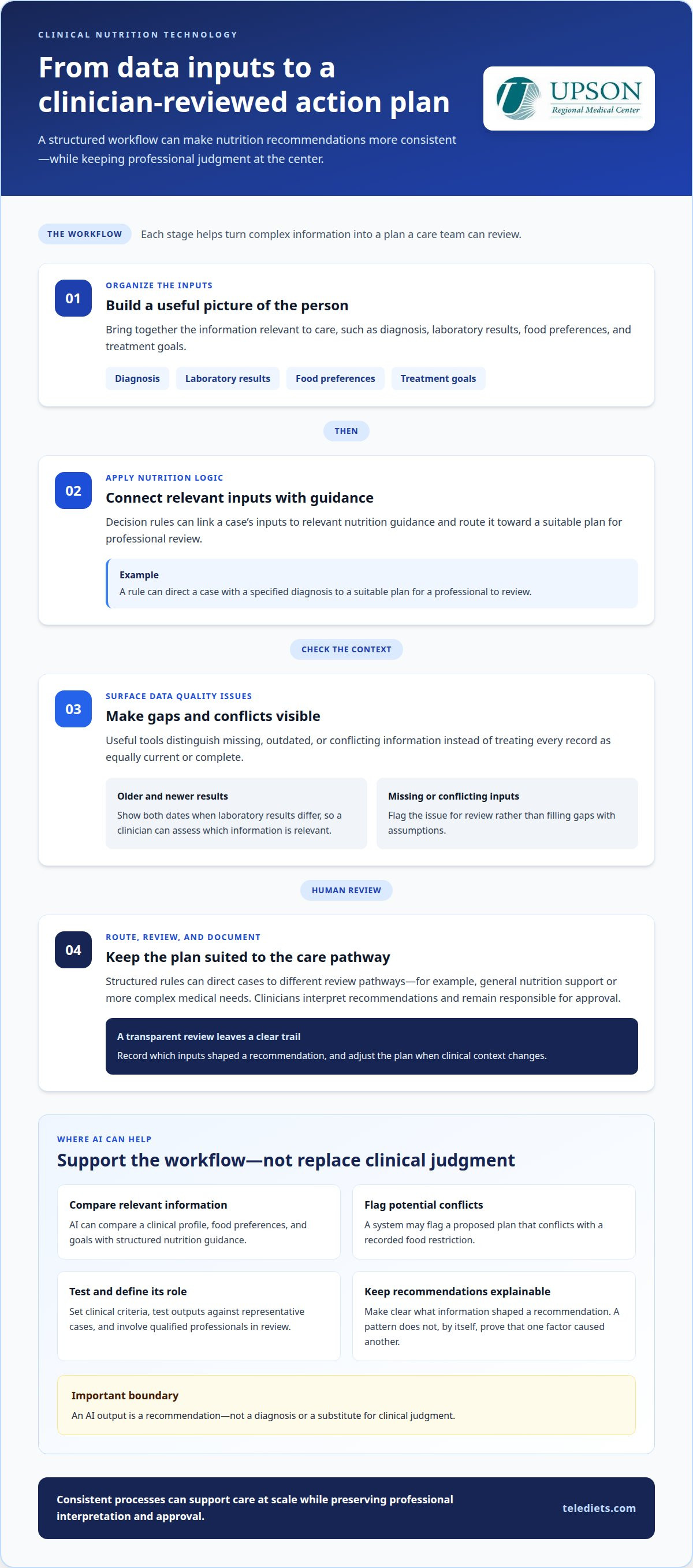
A computational workflow turns collected information into steps a care team can review. First, a platform organizes inputs such as diagnosis, laboratory results, food preferences, and treatment goals. Decision rules then connect those inputs with relevant nutrition guidance. For example, a rule can route a case with a specified diagnosis to a suitable plan for professional review. This creates a foundation for targeted recommendations without treating everyone with the same diagnosis identically.
Useful tools distinguish missing, outdated, or conflicting information. If a recent laboratory result differs from an older record, the system can show both dates for review rather than treating them as equivalent. A clinician can assess which information is relevant before approving an action plan. Clear reasoning matters: teams need to understand which inputs shaped a recommendation and adjust it when clinical context changes.
Choosing technology for personalized nutrition at scale means finding a platform that supports evidence-based nutrition logic, professional review, and workflows suited to your care model. Assess how it handles data quality, plan selection, updates, and documentation, including needs associated with ageing populations. These capabilities help teams use consistent processes while preserving professional judgment.
Technology for personalized nutrition at scale should help teams manage differences across care pathways. A practice may need one workflow for general nutrition support and another for more complex medical needs. Structured rules can direct each case to an appropriate review pathway, while clinicians remain responsible for interpreting recommendations. Before implementation, map the inputs your team uses, the decisions each rule supports, and the points that require human approval.
For organizations exploring how software can support structured nutrition workflows, a clinical nutrition planning platform can be a relevant next step. The right fit depends on whether its planning approach aligns with the team’s clinical protocols and review process.
AI-powered personalized nutrition
AI can help organize complex nutrition information and generate recommendations for professional review. A system can compare a person’s clinical profile, food preferences, and goals with structured nutrition guidance. For example, it may flag a proposed plan that conflicts with a recorded food restriction. This supports a practical workflow, but the output remains a recommendation, not a diagnosis or a substitute for clinical judgment.
Nutrition companies can scale recommendations while maintaining accuracy by defining clinical criteria, testing outputs against representative cases, and involving qualified professionals in review. An integrated workflow should flag missing or conflicting information rather than fill gaps with assumptions. Teams can also record why a recommendation appeared, helping reviewers assess whether it followed the intended criteria.
Interest in app-supported personalization is measurable: according to Cargill’s TrendTracker 2025, 45% of people aged 25 to 34 say they are likely to use apps to help create personalized nutrition plans. That interest makes clear communication important. People should understand what information shaped a recommendation and which parts require professional interpretation.
AI models can identify patterns in data, but a pattern alone does not prove that one factor caused another. A careful implementation defines the model’s role, tests its recommendations, and monitors whether updates change its behavior. For instance, a nutrition team could review cases where an algorithm suggests a targeted plan despite an incomplete dietary history. That review can reveal workflow gaps and guide changes to the criteria.
For a platform publisher, transparent logic and ongoing testing support responsible deployment. Human-AI collaboration keeps nutrition professionals central: AI can organize information and surface relevant options, while practitioners assess clinical context and decide whether recommendations fit. This approach can extend a consistent process across more cases without treating every person as interchangeable.
What is the evidence that personalized nutrition improves health outcomes?
Evidence depends on the outcome measured, the population receiving an intervention, and the comparison used. A study might assess whether a personalized plan changes food choices, improves a clinical marker, or supports adherence. These endpoints answer different questions. For example, greater engagement with recommendations does not by itself demonstrate a health change. Strong evaluation defines the intended outcome before comparing personalized care with a suitable alternative.
Look for studies that explain how personalization worked. Did the plan use a diagnosis, laboratory results, dietary patterns, or another defined input? Were recommendations delivered consistently, and did researchers track what participants followed? These details help distinguish the effect of tailored advice from other factors, such as additional professional attention. Comparing a personalized plan with general guidance can be informative, particularly when support for both groups is clearly described.
Health outcomes also require an appropriate timeframe and measurement method. A food diary can indicate reported behavior, while a clinical measure captures a different dimension of change. Researchers should explain who took part, who completed follow-up, and whether results apply across relevant groups. For instance, findings from adults with a particular diagnosis may not establish the same outcome for children or people with different clinical needs. Replication in other settings strengthens confidence that findings extend beyond one study.
For a nutrition service, evaluation can connect implementation with outcomes: record which recommendations were delivered, assess professional review, then track the predefined measures. This helps teams see whether the approach works as intended and where adjustments may be needed. It also prevents engagement, satisfaction, or algorithm performance from being treated as proof of improved health. To translate structured nutrition plans into a clinical workflow, explore personalized nutrition planning technology for your team.
TeleDIETS
TeleDIETS helps healthcare professionals turn clinical information into structured nutrition plans with medical nutrition therapy software. Physicians and clinics can use the platform to tailor evidence-based plans to laboratory results and clinical diagnoses. This gives teams a consistent process for applying personalized recommendations across their practice.
Its options include Standard Series Meal Plans, Advanced Medical Series Meal Plans, GLP-1 Meal Plan Protocols, and Insurance Billing & CPT Coding Tools. These tools are relevant when a practice wants structured nutrition planning that fits clinical workflows, rather than consumer meal delivery or direct patient consultations.
If you’re exploring how nutrition technology could fit your care model, contact TeleDIETS to discuss your needs.
Turn a clear strategy into your next step
Progress starts with a clear purpose: decide which care process you want to strengthen and how technology for personalized nutrition at scale can support it. A focused starting point helps your team align clinical priorities, operational needs, and professional oversight before expanding the approach. It also gives colleagues a shared basis for discussing workflow changes and future development.
Keep the next step practical. Choose an approach that supports how your team delivers nutrition care and can adapt as its needs evolve. Thoughtful implementation can make personalization a more consistent part of clinical practice while keeping professional judgment at the center.
Contact TeleDIETS to discuss personalized nutrition and explore a practical next step for your organization. Your team can move forward with clarity and confidence.
Frequently Asked Questions
Why are traditional approaches no longer enough?
Traditional nutrition approaches can offer useful general guidance, but fixed plans may not reflect changing clinical information or individual needs. For example, a care team may need to revisit recommendations after a patient’s diagnosis or laboratory results change. A structured digital workflow can help professionals update plans consistently while accounting for each person’s circumstances and the clinical purpose of the guidance.
What technologies enable personalized nutrition at scale?
Personalized nutrition services can combine clinical data systems, decision-support software, analytics, and digital tools for organizing nutrition information. Wearable data may add context about activity or sleep, while a rules-based engine can route cases for review. The right combination depends on the service’s workflow: systems should make inputs understandable, keep recommendations traceable, and help professionals manage cases without relying on disconnected records.
How do AI and machine learning personalize nutrition recommendations?
AI and machine learning can identify patterns in data and rank relevant nutrition options against defined criteria. For example, a system may flag a plan for review when recorded dietary preferences conflict with its recommendations. Professionals should be able to inspect the inputs and reasoning, correct inaccurate records, and approve or revise the result. This keeps automated support separate from clinical decision-making.
How are DNA, microbiome, blood, and wearable data used in personalized nutrition?
Each data source offers a different perspective, so interpretation depends on its context and quality. A blood result may inform clinical review, while wearable data can show patterns across recorded days. DNA and microbiome results call for careful interpretation, not direct conclusions about what someone should eat. A practical workflow records the source and timing of each input, then considers conflicting results before finalizing recommendations.
What are the leading personalized nutrition platforms and how do they compare?
No single platform suits every care model, and a reliable ranking requires consistent evidence about capabilities and outcomes. Compare systems based on clinical workflow fit, evidence-based planning, professional review, data handling, and documentation. TeleDIETS is medical nutrition therapy software for healthcare professionals, offered as an AI engine or SaaS application. Its purpose differs from consumer meal-delivery services and general diet apps.
Leave a Reply