
A nutrition plan is only as useful as the analysis behind it. A nutrition plan generator based on lab results can help connect clinical data with meal planning, but its output depends on accurate nutrition data and professional review.
A plan should do more than look personalized. Lab values need to be considered alongside a person’s health needs, allergies or sensitivities, and food preferences. Nutrition calculations also need to align with the plan’s targets. This article explains how bloodwork can inform nutrition planning, what affects analysis accuracy, and how allergies and preferences shape recommendations. It also covers how clinicians can use lab results in a planning workflow, where professional judgment remains essential, and how medical nutrition therapy software can support that work.
Key Takeaways
- A structured bloodwork review helps connect relevant lab findings with a person’s clinical needs before nutrition planning begins.
- Nutrition analysis is more useful when its data and calculations are assessed for accuracy, not treated as automatically reliable.
- Accounting for allergies, sensitivities, and food preferences can make recommendations more appropriate and practical.
- Explore how lab-informed planning can fit into medical nutrition therapy workflows, including specialized meal plan protocols.
Initial client assessment and bloodwork review
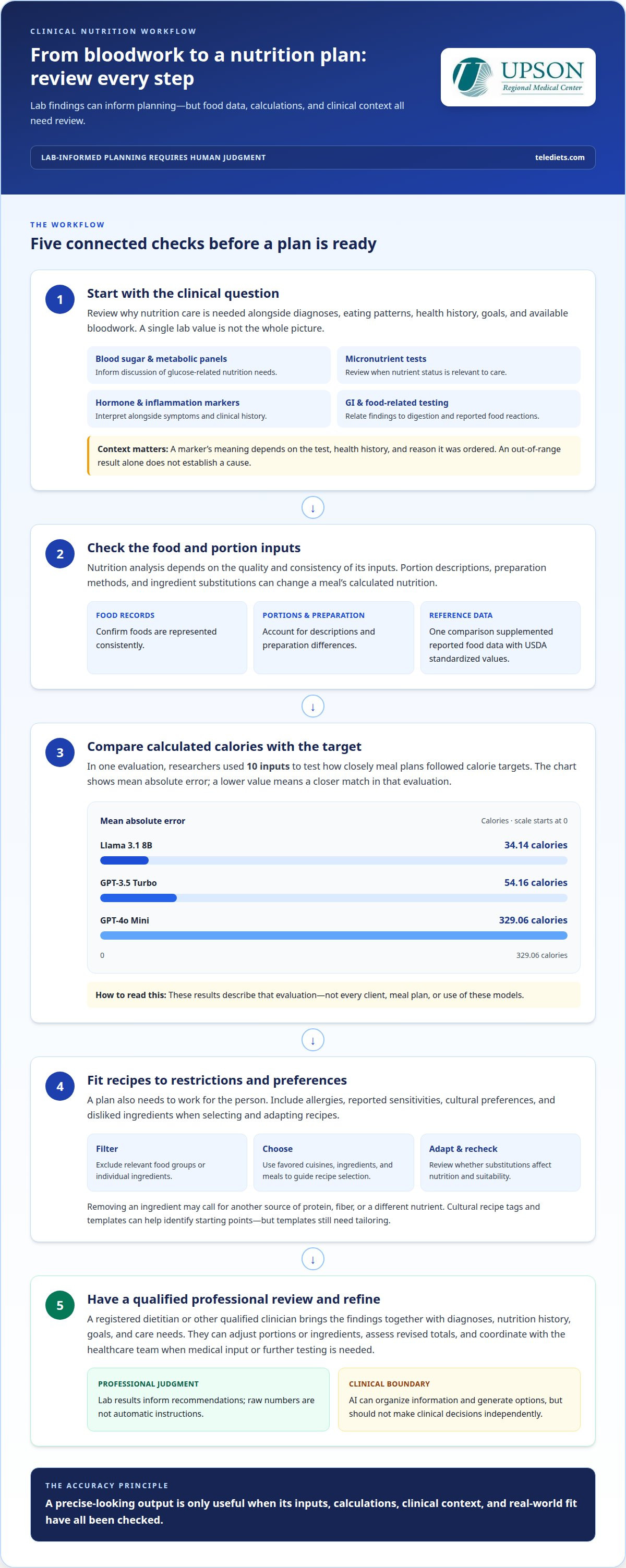
A useful assessment starts with the reason for nutrition care, relevant diagnoses, eating patterns, and available bloodwork. The practitioner reviews results alongside the person’s health history rather than treating a single lab value as the whole picture. This review can also identify whether further testing may help clarify nutrition needs.
Relevant markers depend on the clinical question. Blood sugar and metabolic panels can inform discussion of glucose-related nutrition needs. Micronutrient tests may identify levels that warrant closer review. Hormone panels may measure cortisol, estrogen, and testosterone. Food sensitivity and inflammation markers, GI mapping, and microbiome analysis offer other types of functional testing. Results need context: a marker’s meaning depends on the test, health history, and reason it was ordered.
- Blood sugar and metabolic function: Consider these when reviewing glucose-related concerns.
- Micronutrients: Review results when nutrient status is relevant to the care plan.
- Hormones and inflammation: Interpret findings alongside symptoms and clinical history.
- GI and food-related testing: Relate results to digestion and reported food reactions.
Interpreting lab results without a clinician can lead to incorrect conclusions. A result outside its reference range does not establish the cause, and a result within range may not answer every clinical question. Acting on one value alone could lead to unnecessary food restrictions or distract from an issue that needs medical assessment.
A registered dietitian reviews lab reports, diagnoses, nutrition history, and goals together. They identify findings relevant to nutrition planning, consider how results fit the broader clinical picture, and coordinate with the healthcare team when interpretation or further testing requires medical input. A nutrition plan generator based on lab results should use reviewed findings to inform recommendations, not treat raw numbers as automatic instructions. This keeps nutrition decisions connected to the person’s care needs.
Nutrition analysis accuracy
Nutrition analysis is only as dependable as its inputs, food data, and calculations. In one evaluation, researchers used ten inputs to test how closely meal plans followed calorie targets. Llama 3.1 8B had a mean absolute error of 34.14 calories, GPT-3.5 Turbo had 54.16 calories, and GPT-4o Mini had 329.06 calories. Those results describe that evaluation, not every client or nutrition plan.
A separate calculation compared estimated calories with USDA reference values. Researchers generated three meal plans per input and supplemented user-reported food data with standardized values from the United States Department of Agriculture database. This matters because portion descriptions, preparation methods, and ingredient substitutions can change a meal’s calculated nutrition. A precise-looking result may still rely on imperfect food records or inconsistent data.
For useful analysis, a professional reviews how targets were set, whether foods and portions are represented consistently, and whether calculations match the intended nutrition goals. If an output misses its target, the professional can adjust portions or ingredients and assess the revised totals. A lab result alone does not validate a meal’s calorie or nutrient calculation.
AI can organize information and generate options, but it should not make clinical decisions independently. A registered dietitian or other qualified clinician needs to interpret the output within the care plan, especially when diagnoses, medications, or complex nutrition needs affect recommendations. This review helps distinguish a mathematically plausible plan from one suited to the person’s clinical context.
In the United States, the cost of a personalized plan and dietitian consultation depends on the scope of work, clinician time, and follow-up needs. The price varies by case and is provided after a quote request.
Privacy protections for medical lab data vary among nutrition apps and services. Before sharing results, review how the service collects, stores, uses, shares, and secures health information, including its policies on data retention and deletion. Clear policies help explain how sensitive lab details are handled.
Allergies and dietary preferences
A lab-informed nutrition plan needs to reflect clinical considerations and everyday food choices. Allergies, reported sensitivities, cultural preferences, and disliked ingredients all affect which recipes may be suitable. A plan built around ingredients someone avoids can be difficult to follow, even when its nutrition analysis meets the intended targets.
In a professional workflow, food sensitivity results can guide recipe searches by excluding relevant food groups or individual ingredients. The practitioner then considers substitutions and checks their effect on the meal’s overall nutrition. Removing an ingredient, for example, may require another source of protein, fiber, or a different nutrient, depending on the meal and the person’s needs.
Preferences also determine whether a plan works in practice. Someone who prefers familiar cultural dishes may find recipes from their cuisine more suitable than generic options. Cultural recipe tags can help identify relevant choices, and meal-planning templates can offer a starting point for adaptation. Templates should be tailored, not treated as finished plans.
- Food restrictions: Record allergies and sensitivities, then filter recipes for relevant ingredients.
- Preferred foods: Capture favored cuisines, ingredients, and meals to guide recipe selection.
- Recipe changes: Review substitutions for their effect on the meal’s nutrition and suitability.
Can a plan account for medications, allergies, and chronic conditions? Yes. These factors can inform nutrition planning when included in a professional review. Medication decisions remain with the prescribing clinician, and nutrition recommendations should reflect the person’s care needs.
Clear documentation helps keep each version consistent. The practitioner can record excluded ingredients, acceptable alternatives, and preferred foods alongside the plan. If a recipe search excludes a food group, for example, the resulting options can still be assessed for clinical relevance and fit with the person’s preferences. This makes personalization specific rather than relying on a broad label such as “custom.”
Nutrition tailored to lab results
Lab findings can help set nutrition priorities, but each result needs clinical context. A practitioner can connect a relevant marker with a nutrition strategy, then tailor food choices to the person’s diagnoses, preferences, and overall care plan. A result should inform professional guidance, not trigger an automatic menu change.
For example, low vitamin D levels may prompt discussion of sun exposure and supplements. Elevated CRP may inform consideration of an anti-inflammatory eating pattern. High glucose markers can guide discussion of carbohydrate control and insulin-sensitizing nutrients. These are possible planning approaches, not universal instructions; the practitioner considers the full clinical picture before using them.
Other findings may affect recipe selection and meal structure. Poor gut markers may lead a practitioner to consider an elimination diet or gut repair protocol. Microbiome results can help tailor options toward foods a person digests easily or foods high in probiotics. Nutrient filters can also identify recipes rich in nutrients relevant to a documented deficiency.
- Match the finding: Link each nutrition focus to a relevant lab result and clinical goal.
- Review the food choice: Check whether recipes suit the person’s needs and preferences.
- Reassess the plan: Adjust recommendations when clinical information or goals change.
When labs indicate toxic load or oxidative stress, planning may include cruciferous vegetables or targeted supplements as liver support. Other lifestyle practices may also be considered as part of a broader plan. These approaches are not stand-alone treatment and should not replace clinical care. The clinician weighs the findings and determines which nutrition guidance fits the person.
A nutrition plan generator based on lab results can organize these connections into a practical starting point. Professional review remains essential for interpreting results and selecting appropriate recommendations. Explore lab-informed meal planning to support a structured clinical workflow.
TeleDIETS: GLP-1 Meal Plan Protocols
TeleDIETS supports healthcare professionals who need structured nutrition plans for clinical workflows. Its GLP-1 Meal Plan Protocols provide a specialized option for practices supporting patients using GLP-1 treatment, while Standard Series Meal Plans and Advanced Medical Series Meal Plans address broader nutrition planning needs.
TeleDIETS enables physicians and clinics to prescribe evidence-based plans tailored to lab results and clinical diagnoses. It helps translate reviewed clinical information into a structured meal plan, with professional judgment remaining central to selecting appropriate recommendations. Insurance billing and CPT coding tools also support practice workflows.
If your practice is exploring lab-informed meal planning or GLP-1 nutrition protocols, contact TeleDIETS to discuss your needs.
Build a More Connected Nutrition Workflow
Make lab-informed planning a clear part of clinical care. Define how your practice moves from reviewed results to a nutrition plan, who evaluates recommendations, and how updates are documented as care needs change. A nutrition plan generator based on lab results is most useful when it supports this professional process rather than replacing clinical judgment.
Consider where your current workflow slows down: organizing clinical information, translating nutrition priorities into meal plans, or adapting plans to different care needs. Identifying the gap can help your team choose a practical way to connect assessment with nutrition guidance. Focus on plans clinicians can review, tailor, and integrate into ongoing care.
Explore how TeleDIETS may support your practice’s nutrition planning needs. Contact TeleDIETS about your nutrition plan to discuss a thoughtful next step for individualized care.
Frequently Asked Questions
How accurate is the nutrition analysis?
Accuracy depends on the quality of food records, serving sizes, ingredient details, and nutrition data. A meal listed as “one bowl,” for example, may represent different amounts in different recipes or for different people. Reviewers can check whether portions and ingredients are clearly defined, then compare calculated totals with intended targets. Clinical suitability requires a separate professional review.
How do nutrition plan generators use blood test lab results?
They use selected lab findings alongside clinical diagnoses to guide meal plan recommendations. For example, TeleDIETS’ AI diagnostic integration can read CMP biomarker lab results and ICD-10 codes to automatically recommend appropriate meal plans. A clinician then reviews the recommendations in context and determines whether they fit the person’s care plan. Lab results inform nutrition planning, but they don’t replace clinical judgment.
What information is needed to generate a personalized nutrition plan?
A clinician typically needs the relevant lab report and diagnoses, along with information that affects food choices. This may include allergies, sensitivities, medications, preferences, and nutrition goals. Specific details make a plan easier to evaluate, such as an ingredient to exclude, a preferred cuisine, or a medication that may affect nutrition decisions. The care team uses this context to assess how well the plan fits.
How accurate are online nutrition plan generators based on lab results?
An online nutrition plan generator based on lab results can organize inputs and produce recommendations, but accuracy has more than one dimension. Calculations may be consistent even when recommendations lack relevant clinical context. Assess whether a plan uses specific portions and ingredients, reflects the information provided, and can be reviewed by a qualified professional before informing care.
Leave a Reply