
What if you could prescribe a clinical nutrition plan as efficiently as a standard medication refill? Most primary care providers recognize that lifestyle intervention is the cornerstone of managing chronic disease, yet the logistics of adding nutrition services to primary care practice often feel insurmountable. Between the surging dietary complexities of GLP-1 patients and the lack of clarity around reimbursement, your clinical time is already stretched to its limit. You likely agree that patients deserve better than a generic handout, but you can’t afford to disrupt your entire office flow to provide it.
This guide demonstrates how integrating these services can be a seamless transition that enhances patient outcomes while creating sustainable new revenue streams. You’ll learn the step-by-step process to incorporate medical nutrition therapy into your existing workflow. We will cover how to use specific CPT codes for reimbursement and how to leverage automated protocols to improve A1c and weight loss results without hiring additional staff. By the end of this article, you’ll have a clear roadmap to becoming a more comprehensive, modern practice.
Key Takeaways
- Discover how Medical Nutrition Therapy (MNT) can reduce A1c levels by up to 2% and provide the specialized support necessary for patients utilizing GLP-1 protocols.
- Compare the overhead and clinical outcomes of various integration models when adding nutrition services to primary care practice to find the right fit for your patient volume.
- Identify the specific CPT codes and billing strategies required to turn nutritional counseling into a sustainable and predictable revenue stream for your office.
- Implement a streamlined, software-driven workflow that allows you to prescribe evidence-based meal plans as easily as a standard medication.
The Clinical and Business Case for Primary Care Nutrition
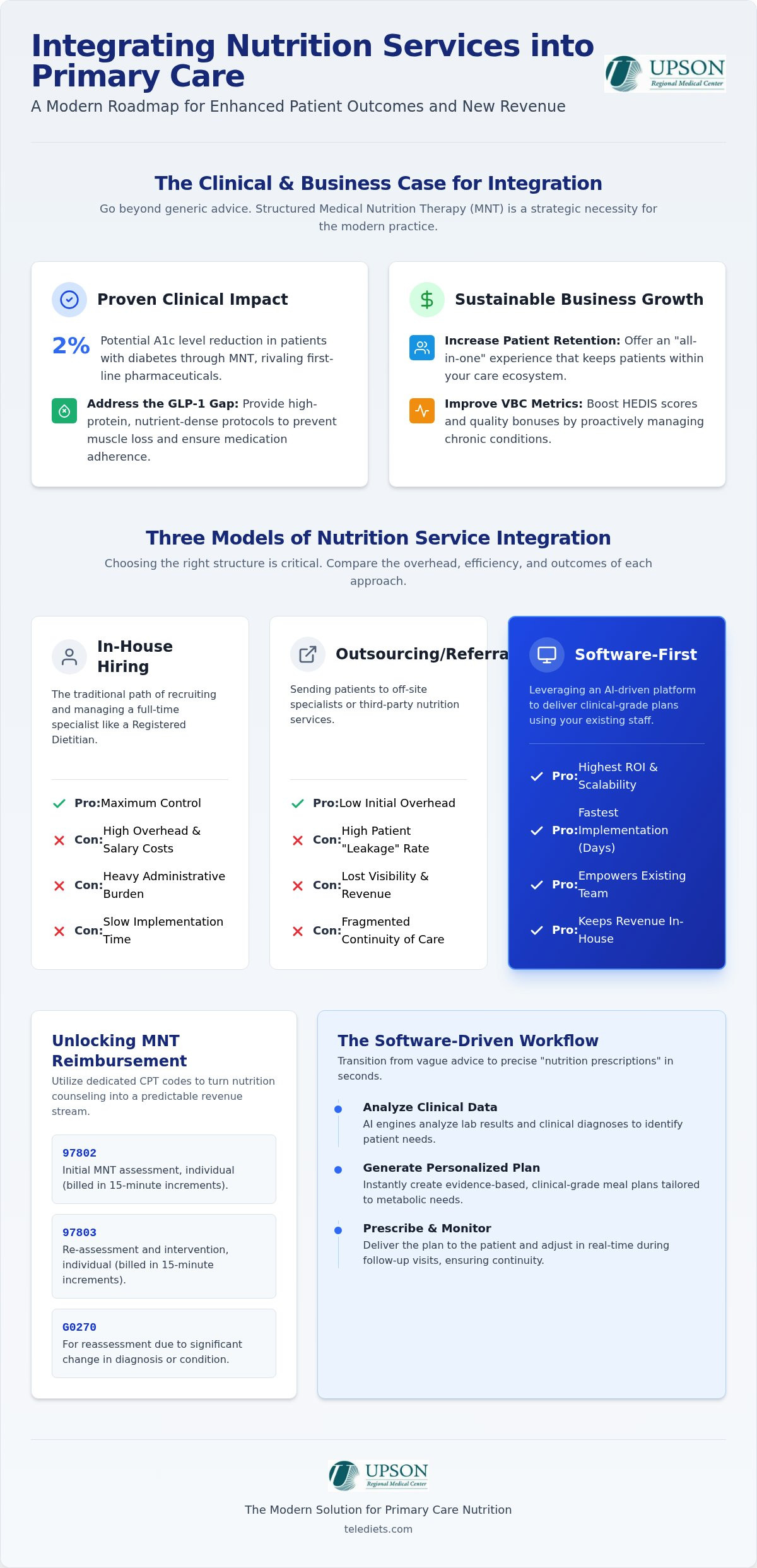
Primary care is evolving from reactive treatment to proactive management. Integrating medical nutrition therapy (MNT) isn’t just a clinical preference; it’s a strategic necessity. Research shows that MNT can reduce A1c levels by up to 2% in patients with diabetes, often rivaling the efficacy of first-line pharmaceuticals. By adding nutrition services to primary care practice, you provide the “all-in-one” experience modern patients demand. This holistic approach directly improves retention and keeps patients within your care ecosystem rather than losing them to outside specialists.
Addressing the GLP-1 Nutritional Gap
The 2026 obesity management landscape is dominated by GLP-1 receptor agonists. However, these medications present a unique challenge: significant muscle mass loss. Simple “eat less” advice is inadequate for these patients. They require high-protein, nutrient-dense protocols to maintain lean tissue and ensure medication adherence. Without structured support, patients often struggle with side effects or plateauing results. Providing specialized nutritional protocols ensures your patients achieve the body composition changes they desire while staying on track with their treatment plans.
Impact on Value-Based Care Metrics
Adding nutrition services to primary care practice significantly influences HEDIS scores and quality bonuses. By addressing chronic conditions like hypertension and obesity at their root, you reduce long-term costs for Medicare and private payers. While a registered dietitian has traditionally led these efforts, modern software allows your current team to scale these interventions effectively. Capturing untapped reimbursement for preventative services through dedicated CPT codes secures your practice’s financial health. This diversification protects your revenue against the fluctuations of standard office visit volumes.
Integration Models: Hiring vs. Outsourcing vs. Software
Choosing the right structure is critical when adding nutrition services to primary care practice. You need a model that balances clinical quality with operational reality. Traditional hiring offers maximum control but comes with steep overhead. Recruiting and managing a full-time specialist adds significant administrative weight to your office manager’s plate. Conversely, referral models are common but suffer from high “leakage” rates. When patients are sent off-site, follow-through often drops, and you lose visibility into their progress.
A software-first approach utilizes AI-driven Medical Nutrition Therapy (MNT) to deliver clinical-grade plans without hiring new staff. This model offers the fastest implementation time and the highest ROI by leveraging your existing clinical team. By automating the heavy lifting of plan creation, you can launch a new service line in days rather than months. It’s a modern solution for practices that value efficiency as much as patient care.
Why Software-Driven MNT is Scalable
Automated platforms allow you to transition from giving vague dietary advice to providing a precise “nutrition prescription.” AI engines analyze lab results and clinical diagnoses to generate personalized meal plans in seconds. This level of automation means you can provide specialized protocols to hundreds of patients without increasing your team’s workload. It’s about empowering your current staff with professional tools that ensure every patient receives evidence-based care tailored to their specific metabolic needs.
Reducing Patient Leakage
Keeping nutrition services in-house ensures that both patient data and revenue stay within your ecosystem. You can adjust plans in real-time during standard follow-up visits, ensuring continuity of care. By utilizing integrated insurance billing tools, your practice captures reimbursement that would otherwise go to third-party providers. This approach turns a fragmented referral process into a cohesive, revenue-generating service line. It’s a supportive way to guide your patients toward better outcomes while strengthening your practice’s financial foundation.
Navigating MNT Reimbursement and CPT Coding
Integrating clinical nutrition requires a firm grasp of the financial framework. When adding nutrition services to primary care practice, you must utilize specific CPT codes to ensure proper compensation. The primary codes for Medical Nutrition Therapy (MNT) are 97802 for the initial assessment and 97803 for subsequent re-assessments or follow-up visits. Both are billed in 15-minute increments. For patients experiencing a significant change in diagnosis or medical condition, code G0270 allows for additional hours of care beyond standard annual limits.
Success in an audit depends on precise documentation within your EHR. Your records must clearly justify medical necessity using appropriate ICD-10 codes, such as those for type 2 diabetes or chronic kidney disease. It’s essential to link the diagnosis directly to the nutritional intervention to secure reimbursement. Without this trail, you risk losing revenue during payer reviews. Clear documentation ensures that adding nutrition services to primary care practice doesn’t create unnecessary administrative friction.
Maximizing Reimbursement Efficiency
Nutrition billing is strictly time-based, requiring documented start and end times for every encounter to maintain audit safety. Manual tracking is often the bottleneck in a busy clinic. Utilizing integrated insurance billing and CPT coding tools automates this process, generating compliant documentation and codes based on session duration and clinical data.
Insurance Coverage Realities in 2026
In 2026, Medicare continues to cover MNT primarily for diabetes and non-dialysis renal disease. Many private payers have expanded coverage to include obesity management, especially for patients on GLP-1 protocols. For patient populations without direct coverage, many practices find success with cash-pay bundles. These bundles provide a predictable cost for the patient while ensuring your practice is compensated for the specialized care provided.
Implementation Steps for a Software-First Workflow
Adding nutrition services to primary care practice becomes a sustainable reality when you follow a structured implementation path. Start by auditing your patient panel to identify those with the highest clinical need, such as individuals managing diabetes, hypertension, or obesity. After identifying your candidates, select a clinical nutrition SaaS that integrates seamlessly with your existing EHR. This integration is vital for maintaining a single source of truth for patient data while avoiding the fragmented records common in referral-based models.
Next, train your clinical staff on lab-to-plan automation. This technology reduces physician clicks by automatically generating meal plans based on recent blood work and specific clinical diagnoses. To see immediate results, launch a pilot program specifically for patients on GLP-1 protocols. This group often sees the most dramatic improvements in outcomes, providing the clinical proof and ROI needed to scale the service across your entire practice. It’s a supportive way to prove the model’s value before a full-scale rollout.
Integrating with Telemedicine
Digital delivery is a key component of modern medical nutrition therapy. By utilizing telemedicine plugins, you can provide professional consultations and plan adjustments remotely. This flexibility improves patient engagement by providing digital meal plan access between traditional office visits. It ensures that your support is available when patients are making their daily dietary choices, not just during their quarterly appointments. This continuity is essential for long-term adherence in chronic disease management.
Scaling Beyond the Initial Pilot
Success with your initial cohort allows for natural expansion into more complex care. You can move from Standard Series meal plans to Advanced Medical Series protocols for patients with multi-system comorbidities. As your expertise grows, consider marketing these services to attract new, health-conscious patients who value a proactive approach to wellness. This transition cements your role as a trusted expert guide and transforms your practice into a sophisticated wellness hub that prioritizes long-term metabolic health.
Modernizing Your Practice Through Clinical Nutrition
The transition toward lifestyle-integrated medicine is no longer just a clinical preference; it’s a strategic necessity for the modern provider. By adding nutrition services to primary care practice, you bridge the gap between medication and long-term metabolic health. You’ve seen how evidence-based protocols can significantly reduce A1c levels and how specific CPT codes turn this essential care into a predictable revenue stream. Transitioning to a software-first workflow allows you to deliver these results without the administrative burden of new hires or fragmented referral loops.
Ready to empower your team and your patients? You can streamline your practice with TeleDIETS Medical Nutrition Software. Our platform features an automated lab-to-plan AI engine, specialized GLP-1 protocols, and integrated CPT coding tools to ensure your clinical interventions are both effective and billable. It’s time to provide the comprehensive, lab-driven care your patients deserve while securing your practice’s future. We’re here to support your journey toward a more holistic and profitable clinical model.
Frequently Asked Questions
Can a primary care physician bill for nutrition services without an RDN on staff?
Yes, physicians can provide and bill for nutritional counseling, though specific MNT codes like 97802 are traditionally reserved for registered dietitians. Many practices utilize E/M codes or Intensive Behavioral Therapy codes like G0447 to capture these services. Using professional software ensures that the documentation meets the high standards required for reimbursement, allowing you to scale these services effectively without the immediate need for a specialized new hire.
What are the most common CPT codes for adding nutrition services to a practice?
The foundational codes for adding nutrition services to primary care practice are 97802 for the initial assessment and 97803 for re-assessment. Both are time-based, billed in 15-minute units. Additionally, G0270 is available for patients who experience a change in medical condition. These codes require clinical documentation that justifies medical necessity, which automated billing tools can help generate to ensure audit safety and consistent, predictable revenue for your office.
How does medical nutrition therapy software integrate with existing EHR systems?
Integration usually happens via secure API or HL7 interfaces, allowing for a bidirectional flow of information. The software pulls relevant lab data and ICD-10 codes directly from your EHR to inform the AI-driven meal plan protocols. Once the plan is generated, the system pushes the documentation back into the patient’s record. This ensures your workflow remains efficient and centralized, preventing the fragmented data issues often seen with external referrals.
Is nutrition therapy covered by Medicare for weight loss in 2026?
Medicare covers Medical Nutrition Therapy specifically for patients with diabetes or renal disease. However, for weight loss, Medicare provides coverage for Intensive Behavioral Therapy under code G0447 for patients with a BMI over 30. As of 2026, these sessions are vital for managing the nutritional needs of patients on GLP-1 medications. Private payers often have more flexible policies, frequently covering nutrition for a wider range of preventative health needs.
How much time does it take for a provider to generate a meal plan using AI?
An AI-driven engine can generate a personalized, clinical-grade meal plan in roughly 30 to 60 seconds. By automating the analysis of patient labs and diagnoses, the software eliminates the hours of manual work typically required for nutritional planning. This speed allows your team to provide a “nutrition prescription” during the actual patient encounter. It empowers your staff to deliver high-impact care without disrupting the daily clinical schedule or increasing physician workload.
Leave a Reply