
What if consistency across your health system didn’t mean giving every patient the same nutrition plan? The goal of standardizing nutrition care across a health system is to align the care pathway, not replace clinical judgment. Yet when screening, documentation, referrals, and follow-up vary by site, it can be difficult to provide a reliable process or see where it needs improvement.
A shared workflow should make care clearer, not add avoidable steps or constrain individualized decisions. This article offers a practical framework for building consistency while preserving clinician discretion. You’ll learn how to establish governance, define shared workflow expectations, select useful measures, and roll out changes with frontline input. It also explains how technology, including nutrition protocols and billing tools, may help operationalize approved workflows once clinical requirements are clear. The result is a repeatable approach that supports coordination across sites while leaving room for care tailored to each patient’s needs.
Key Takeaways
- Standardizing nutrition care across a health system means setting shared processes and minimum expectations, not prescribing identical nutrition plans.
- Distinguish workflow steps that should be consistent from clinical decisions that require individualized assessment, and involve the right disciplines in setting standards.
- Use a staged rollout: assess current practices, agree on standards, pilot them at representative sites, refine the workflow, then expand.
- Track a focused set of adoption and workflow indicators, and review standards over time so they remain practical and aligned with organizational goals.
Why standardize nutrition care across a health system?
Nutrition-care standardization means using shared workflows and minimum expectations to guide care while preserving individualized clinical decisions.
Without a common foundation, one site may document a nutrition assessment in a way that another team can’t readily interpret, or a referral may move differently between services. These variations can complicate handoffs, make access less predictable, and leave leaders comparing measures recorded in different ways. Standardizing nutrition care across a health system creates a clearer process for delivering and reviewing medical nutrition therapy without assuming that every patient has the same needs. Clinical nutrition provides context for this work: nutritional care belongs within healthcare practice, where decisions must reflect individual circumstances.
Which parts of nutrition care should be consistent?
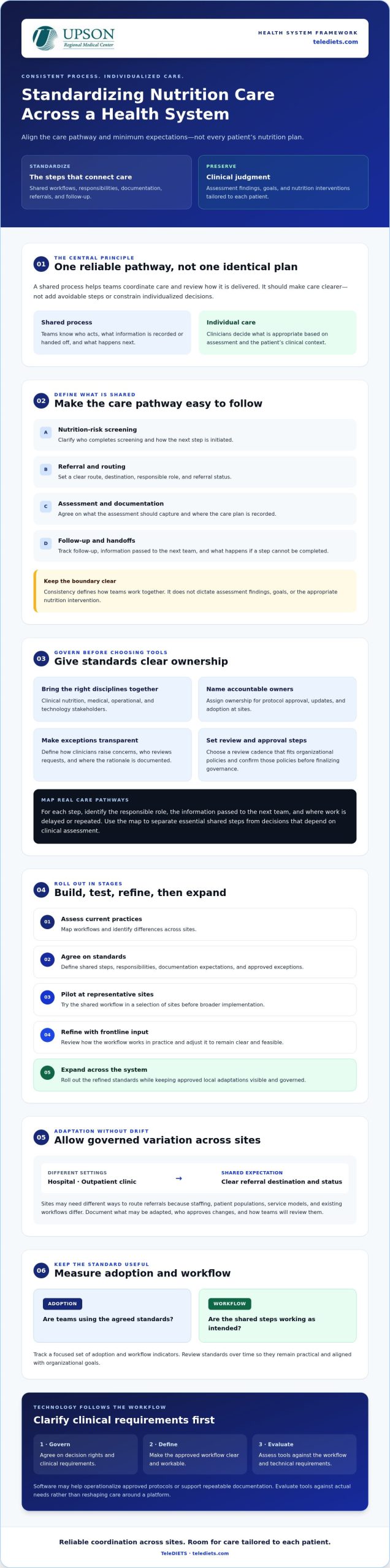
Set shared expectations for the steps that connect teams and support reliable review. These may include who completes nutrition-risk screening, how a referral is initiated and routed, what an assessment should document, where the care plan is recorded, and how follow-up is tracked. For each step, clarify the responsible role, the expected record or handoff, and what happens when the next step cannot be completed. Consistency means teams know the process; it doesn’t dictate assessment findings, goals, or the appropriate nutrition intervention. Those decisions depend on clinician judgment and the patient’s clinical context.
What should remain adaptable across sites?
Sites may differ in staffing, patient populations, service models, and established workflows. A hospital and an outpatient clinic, for example, may need different ways to route referrals while meeting the same system-level expectation that each referral has a clear destination and status. Treat these differences as governed variation: document what may be adapted, who approves changes, and how teams will review them. This preserves local feasibility without allowing essential steps to disappear informally.
Build standards that support consistent care and clinical judgment
Standardized processes create a reliable route through care; they don’t require identical nutrition plans for every patient. A system can define how a referral is handled, what the assessment should capture, and where follow-up is documented, while clinicians determine appropriate care based on individual assessment. The Academy of Nutrition and Dietetics’ Nutrition Care Process offers a structured clinical framework that supports consistency without removing professional judgment.
Create a governance model before selecting tools
Bring clinical nutrition, medical, operational, and technology stakeholders together to agree on decision rights. Name accountable owners for protocol approval, updates, and site-level adoption. Define how clinicians can raise concerns or request a justified exception, who reviews it, and where the rationale is documented. Establish review and approval steps, including a cadence that fits your organization’s policies. Confirm those policies before finalizing the governance model.
Design standards around real care pathways
Map how referrals, assessments, care planning, documentation, and follow-up work today across sites. For each step, note the responsible role, information passed to the next team, and any points where work is delayed or repeated. Use the map to distinguish essential shared steps from choices that depend on clinical assessment. For example, teams might use a common referral route and documentation expectations while retaining discretion over individualized nutrition-care decisions. Document approved exceptions and escalation routes so flexibility is transparent rather than informal.
This distinction should guide technology decisions, too. Once governance and clinical requirements are clear, software may help operationalize approved protocols or support repeatable documentation. Evaluate any tool against the actual workflow and technical requirements instead of reshaping care around a platform. That keeps the standard clinically grounded and workable for the teams expected to use it.
How to implement nutrition-care standards across multiple sites
Standardizing nutrition care across a health system works best as a staged change, not a single system-wide launch. Start by mapping current workflows across sites, then agree on the shared steps, responsibilities, documentation expectations, and approved exceptions. The Academy of Nutrition and Dietetics’ Nutrition Care Process can provide a clinical reference for organizing individualized care within a consistent process.
Use a practical rollout checklist:
- Assess: Map referrals, assessments, care planning, documentation, and follow-up. Note where processes differ, who is involved, and why.
- Agree: Confirm minimum workflow expectations, owners, training needs, and how staff can raise concerns or request an exception.
- Pilot: Test the draft at representative sites and with the roles responsible for each step.
- Refine: Review staff feedback and workflow observations, then revise through the established governance process.
- Expand: Prepare communication, training, and documentation templates before introducing the approved workflow at additional sites.
Pilot and refine before expanding
Choose pilot sites to reflect differences in readiness and care workflows, not just convenience. Include the staff who make referrals, complete assessments, document care, and coordinate follow-up. Ask where instructions are unclear, whether a step adds avoidable workload, and whether the process creates barriers to access. Check whether the expected handoff and documentation are feasible in day-to-day work. Use this feedback to refine the standard before extending it; don’t assume one rollout pace will suit every organization.
Use technology to support the agreed workflow
First check whether current systems can support protocol access, documentation, and handoffs. If gaps remain, assess clinical nutrition software against requirements already defined by clinical and operational leaders. TeleDIETS offers medical nutrition therapy software and related workflow tools; verify current capabilities and technical requirements when assessing fit. Technology should support the agreed process, not determine clinical standards.
Measure adoption, maintain standards, and choose ongoing support
After rollout, assess whether teams can and do follow the agreed workflow. Keep implementation measures distinct from clinical outcomes: adoption data can show whether a process is being used, but it can’t by itself establish that care improved. Any evaluation of clinical outcomes requires an appropriate approach and interpretation in context.
Select measures that teams can act on
Choose a focused dashboard tied to organizational goals. Useful workflow indicators may include referral completion, documentation completeness, consistency in required process steps, and staff feedback. Define each measure clearly so sites interpret it the same way. For example, specify which referrals count as eligible when tracking referral completion. Assign an owner, identify the data source and review frequency, and agree what action to take if results point to a barrier. A measure is most useful when it prompts a practical response, such as clarifying a handoff or revising a template.
Keep standards current
Set periodic reviews so approved workflows can respond to changes in evidence, local operations, and clinical needs. Invite feedback from sites and route proposed changes through the governance process. Record what changed and why, and communicate updates to the teams expected to follow the standard. This creates a controlled way to refine workflows while maintaining visibility. The review schedule should fit your organization’s policies and capacity.
Evaluate technology against system requirements
Assess technology against defined needs, including protocol configuration, workflow fit, implementation requirements, and reporting. Confirm directly with each vendor whether billing and CPT coding tools or telemedicine capabilities meet your requirements. Software may support approved workflows, but it doesn’t replace governance or demonstrate clinical outcomes on its own.
If you’re evaluating tools to support this work, review clinical nutrition software for providers and assess its current capabilities against your system’s requirements. With clear measures, accountable owners, and regular review, standardizing nutrition care across a health system can remain practical as needs evolve.
Make consistency a sustainable part of care
Effective standardizing nutrition care across a health system depends on a clear balance: shared workflows give teams a dependable framework, while clinicians retain room to tailor care to individual needs. Start with agreed processes and accountable governance, test changes with the people who use them, then monitor adoption and refine standards as practice evolves.
Technology can support this work when it fits requirements already defined by clinical and operational leaders. TeleDIETS offers medical nutrition therapy software with protocols tailored to clinical diagnoses and lab results, along with insurance billing and CPT coding tools and a telemedicine plugin. These capabilities may help operationalize approved workflows, but they don’t replace clinical oversight or establish outcomes on their own.
To assess whether TeleDIETS fits your organization’s needs, explore clinical nutrition solutions for providers and compare current capabilities with your workflows, technical requirements, and approved protocols. With thoughtful governance and ongoing review, your teams can build a more consistent process while keeping care appropriately individualized.
Frequently Asked Questions
What does standardizing nutrition care across a health system mean?
Standardizing nutrition care across a health system means setting shared workflows and minimum expectations for how nutrition care is identified, delivered, documented, and reviewed. It doesn’t mean prescribing the same plan to every patient. For example, sites can follow consistent screening and referral steps while clinicians individualize medical nutrition therapy based on their assessment. The aim is a dependable process that supports clear handoffs and preserves clinical judgment.
How can a health system standardize nutrition care without limiting personalization?
Standardize the steps that support coordination, such as referral routes, documentation expectations, and follow-up tracking, while leaving care decisions to clinician assessment. Define which workflow steps are required, where professional discretion applies, and how justified exceptions should be documented and reviewed. This gives teams a consistent framework without turning a protocol into a fixed prescription. Governance should make both expectations and flexibility clear across sites.
What are the first steps to standardize nutrition care across multiple sites?
Begin by mapping current workflows at each site, including referral, assessment, documentation, and follow-up. Bring clinical, operational, medical, and technology stakeholders together to agree on shared expectations and decision owners. Then pilot the proposed process with representative sites and roles, gather feedback, and revise the workflow before expanding. Plan communication, staff training, and documentation templates as part of implementation, rather than adding them after rollout.
How should a health system measure nutrition-care standardization?
Use a focused set of workflow measures, such as referral completion, documentation completeness, consistency in required steps, and staff feedback. Assign an owner to each measure, identify its data source, set a review frequency, and decide what action to take when results reveal a barrier. Track adoption separately from clinical outcomes: workflow measures show whether a process is used, while outcome evaluation requires appropriate methods and interpretation.
Can clinical nutrition software help standardize care across a health system?
Clinical nutrition software may support approved workflows by making protocols and related tools available within provider processes. TeleDIETS offers nutrition therapy software, protocols tailored to clinical diagnoses and lab results, insurance billing and CPT coding tools, and a telemedicine plugin. Before selecting any platform, confirm its current capabilities, configuration options, technical requirements, and fit with system workflows. Software can support implementation, but it doesn’t replace governance or prove clinical outcomes.
Leave a Reply