
A video visit is only the start; continuity is what connects remote medical nutrition therapy (MNT) from one appointment to the next. Telemedicine for clinical dietitians can make MNT more accessible, but preparation, documentation, and follow-up can become scattered across disconnected steps. A repeatable workflow helps keep the focus on the patient and the clinical decisions that guide their care.
This guide lays out a practical process for remote MNT, from reviewing relevant information before a visit to documenting decisions and planning follow-up. It also covers how to assess technology and nutrition resources for fit with your practice. Tailored protocols and billing and coding tools can support parts of the workflow, while assessment and clinical decisions remain the dietitian’s responsibility.
Key Takeaways
- Build virtual MNT around the full care cycle, not just the video appointment, to connect preparation, the visit, and follow-up.
- Review relevant records and patient updates before the visit, then document clinical decisions and agree on a clear next step.
- Telemedicine for clinical dietitians can support access and continuity, while planning helps address technology barriers and the limits of remote context.
- Evaluate tools for relevant nutrition protocols and billing support, using them to reinforce your workflow while keeping personalization and clinical decisions in your hands.
Why Telemedicine Matters for Clinical Dietitians Delivering MNT
Telemedicine MNT is clinician-led nutrition assessment, counseling, and follow-up delivered remotely as part of individualized medical nutrition therapy, not general wellness coaching. MNT connects nutrition care to a person’s clinical context, and the appointment is only one part of that work. Reviewing relevant information beforehand, documenting decisions, and setting a follow-up plan help carry care forward between visits.
For a broader overview of the term, see What is Telemedicine? In dietetics, remote appointments can support discussion of relevant health history, patient-provided updates, and available clinical records, including lab data when appropriate. The dietitian adapts how information is gathered and counseling is delivered to the virtual format, while retaining professional judgment and responsibility for individualized care.
What makes telemedicine different in clinical nutrition?
The format changes how you connect, not the purpose of MNT. A video or audio appointment can support conversation and review of shared information, but it may offer less in-person context. Consider that limitation when deciding whether the available information is sufficient for the visit. Technology supports the encounter; it doesn’t replace assessment or clinical judgment.
Which practice needs can remote MNT address?
For practices supporting chronic disease management, telemedicine can provide another way to maintain contact when travel, location, or scheduling makes an in-person appointment difficult. It can also help organize follow-up as part of ongoing nutrition care. These are workflow possibilities, not guaranteed access or health outcomes. Keep remote visits connected to the wider care process by reviewing relevant updates and documenting decisions for future follow-up.
Telemedicine for clinical dietitians is more than a video link. It is a way to deliver clinician-led MNT within a consistent process that supports individualized care across appointments.
Structuring Telemedicine MNT: Prep to Follow-Up
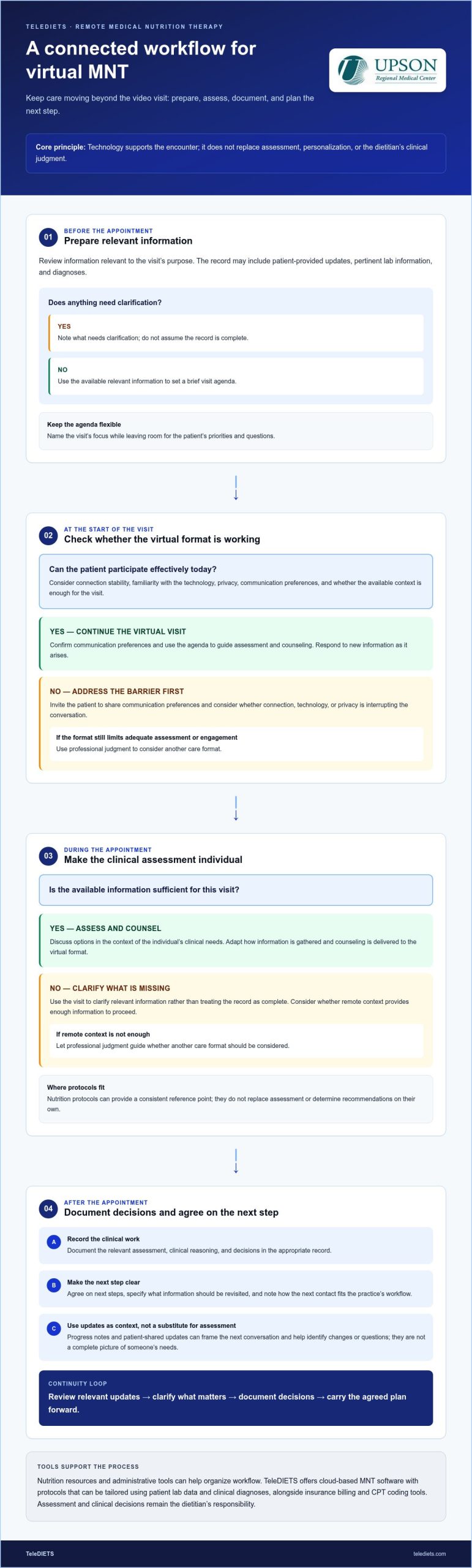
A consistent visit sequence helps connect remote care to the broader MNT workflow: prepare relevant information, conduct the visit, document clinical decisions, and plan appropriate follow-up. This sequence organizes the work without prescribing a treatment plan. Nutrition recommendations remain individualized and depend on the dietitian’s assessment and professional judgment.
Prepare for a focused virtual nutrition appointment
Before the appointment, review available records relevant to its purpose, such as patient-provided updates, pertinent lab information, and diagnoses. Identify information that needs clarification rather than assuming the record is complete. Set a brief agenda that names the visit’s focus, while leaving room for the patient’s priorities and questions. The Academy of Nutrition and Dietetics Telehealth Guidelines can provide additional professional context as you establish your telehealth process.
During the visit, use the agenda to guide assessment and counseling, but respond to new information as it arises. Discuss options in the context of the individual’s clinical needs. Nutrition protocols can offer a consistent reference point, but they don’t replace assessment or determine recommendations on their own.
Make follow-up part of the care workflow
After the appointment, document the relevant assessment, clinical reasoning, decisions, and agreed next steps in the appropriate record. Specify what information should be revisited and how the next contact fits the practice’s workflow. A clear plan supports continuity without assuming every patient needs the same schedule or approach.
Tools can help organize nutrition resources and administrative tasks as part of this process. TeleDIETS offers cloud-based MNT software with protocols that can be tailored using patient lab data and clinical diagnoses, alongside insurance billing and CPT coding tools. Clinical nutrition workflow software can be one part of organizing clinician-led MNT. These resources support the process; clinical decisions stay with you.
Addressing the Main Concern: Can Remote Dietitian Care Stay Personal and Clinically Useful?
It can, but the screen alone doesn’t determine the quality of care. Telemedicine changes how the dietitian and patient interact; clinical value still depends on attentive communication, relevant assessment, and recommendations suited to the individual. Remote visits may support access and continuity, but technology barriers or limited in-person context can make some encounters less effective.
What can make a virtual MNT visit feel less connected?
An unstable internet connection, unfamiliar technology, or a setting without enough privacy can interrupt conversation. Some patients may communicate more comfortably in person or need context that is difficult to assess remotely. At the start of the visit, establish whether the patient can participate effectively and invite them to share communication preferences. If the virtual format limits adequate assessment or engagement, use professional judgment to consider another care format.
How can dietitians support continuity between visits?
Give each visit a clear structure, make space for questions, and review the next steps together before closing. Document the agreed plan and note what information would be useful to revisit. This gives both the patient and clinician a shared reference point without assuming every patient needs the same cadence or approach.
Progress notes and patient-shared updates can help frame the next clinical conversation, but they don’t replace assessment. Use them to identify changes, clarify questions, and guide discussion rather than treating a tracking record as a complete picture of someone’s needs. In telemedicine for clinical dietitians, a personal connection comes from adapting communication while keeping clinical judgment central.
TeleDIETS clinical nutrition software includes nutrition protocols and workflow tools for clinician-led care: Explore TeleDIETS clinical nutrition software.
Choosing Telemedicine Tools That Fit a Clinical Dietitian’s Practice
Useful tools support the clinical and administrative work around a virtual appointment, not just the connection itself. For practitioners looking to streamline day-to-day operations and appointments, clinic management platforms such as MediCloud.me illustrate how administrative workflows can be simplified. When evaluating telemedicine tools for a clinical dietitian’s practice, consider how each one fits your MNT process and helps organize resources and follow-up.
Which capabilities support a telemedicine nutrition workflow?
Use this checklist to focus your evaluation:
- Clinical nutrition relevance: Does the software support clinician-led MNT rather than general wellness content?
- Protocol access: Can available nutrition protocols be tailored using relevant patient information, such as lab data and clinical diagnoses?
- Workflow fit: Do the tools align with how your practice handles visit documentation and follow-up?
- Billing support: Are insurance billing and CPT coding resources available to support your administrative workflow?
Assess how the capabilities work together in your actual process. A protocol can provide a consistent starting point, but it should inform, not dictate, recommendations. The dietitian’s assessment, clinical reasoning, and judgment remain central to personalization.
Where can clinical nutrition software fit?
Software can support clinician-led care by bringing relevant nutrition resources and practice tasks into a more organized workflow. TeleDIETS provides cloud-based MNT software for healthcare professionals, specialized meal plan protocols, insurance billing and CPT coding tools, and a telemedicine plugin. Its protocols can be tailored using patient lab data and clinical diagnoses, while the treating professional retains responsibility for determining what is appropriate.
As you evaluate tools, compare their capabilities with the needs you identified, from protocol access to billing support. The aim is practical workflow support that helps you deliver consistent care without substituting software for professional decision-making. Explore TeleDIETS for clinical nutrition workflows.
Make Your Telehealth Workflow More Connected
Effective telemedicine for clinical dietitians involves more than a virtual appointment. A focused process for preparation, documentation, and follow-up helps connect MNT across visits, while clear communication and clinical judgment keep care individualized. The format and tools should support your practice needs without replacing the dietitian’s role.
Clinical nutrition software can bring relevant resources into that workflow. TeleDIETS offers protocols that can be tailored using patient lab data and diagnoses, along with insurance billing and CPT coding tools and a telemedicine plugin. These capabilities support clinician-led care and practice operations.
See how TeleDIETS could fit your approach to virtual MNT: Explore TeleDIETS for clinical nutrition workflows. A practical structure and tools aligned to your process can help keep patient-centered care at the heart of each visit.
Frequently Asked Questions
What is telemedicine for clinical dietitians?
Telemedicine for clinical dietitians is the remote delivery of clinician-led nutrition assessment, counseling, and follow-up as part of medical nutrition therapy (MNT). It involves more than a video appointment: preparation, clinical documentation, and continuity between visits also matter. Unlike general wellness coaching, telehealth MNT applies the dietitian’s professional judgment to individualized nutrition care within a clinical context.
Can clinical dietitians provide medical nutrition therapy through telehealth?
Yes, clinical dietitians can provide MNT remotely when the visit is appropriate for the patient’s needs and the practitioner’s scope and practice requirements. Telehealth can support nutrition assessment, counseling, and follow-up, but it doesn’t remove the need for professional judgment. Before offering care, dietitians should account for applicable licensure, payer, and documentation requirements relevant to their practice.
How can dietitians maintain continuity during virtual nutrition care?
Connect each appointment to the previous assessment and the next planned step. Review relevant records and patient updates before the visit, document clinical decisions and agreed actions afterward, and make the follow-up plan clear. Progress updates can help focus future conversations, but they are one source of information and don’t replace individualized clinical assessment.
What should clinical dietitians look for in telemedicine nutrition software?
Look for tools that fit clinical nutrition workflows, provide access to relevant protocols, and assist with documentation, follow-up, and billing tasks. TeleDIETS provides cloud-based MNT software with protocols that can be tailored using patient lab data and diagnoses, insurance billing and CPT coding tools, and a telemedicine plugin. These resources support workflow; clinicians retain decision-making responsibility.
Does telemedicine replace in-person care for clinical dietitians?
No. Telemedicine is another way to deliver nutrition care, not a universal substitute for in-person appointments. Its suitability depends on the patient’s needs, clinical context, communication, and whether the remote format allows an appropriate assessment. Technology barriers or limited in-person context may affect the encounter. Dietitians can use professional judgment to determine which format best supports the care process.
Leave a Reply