
Renal diet software for clinics can help organize fluid intake and monitor sodium, protein, phosphorus, and potassium against each patient’s nutrition plan. The targets aren’t one-size-fits-all: protein needs, for example, can differ between early kidney disease and dialysis care.
Tracking these details across food and fluids can be demanding, especially as a person’s care needs change. The right workflow gives clinicians a clearer way to review intake and support individualized nutrition counseling. This article explains what to track, how clinic software can support monitoring, and what to consider when evaluating a platform for renal diet care.
Key Takeaways
- Track fluid intake alongside food choices to make daily patterns easier to review during renal nutrition care.
- Monitor sodium, potassium, phosphorus, and protein in context, since nutrition priorities can vary with kidney disease stage and dialysis status.
- Assess software by how clearly it supports nutrient tracking, individualized care plans, and the workflows of your clinical setting.
- Explore structured meal plan options when your practice needs support delivering evidence-based nutrition care for chronic conditions.
Fluid intake tracking
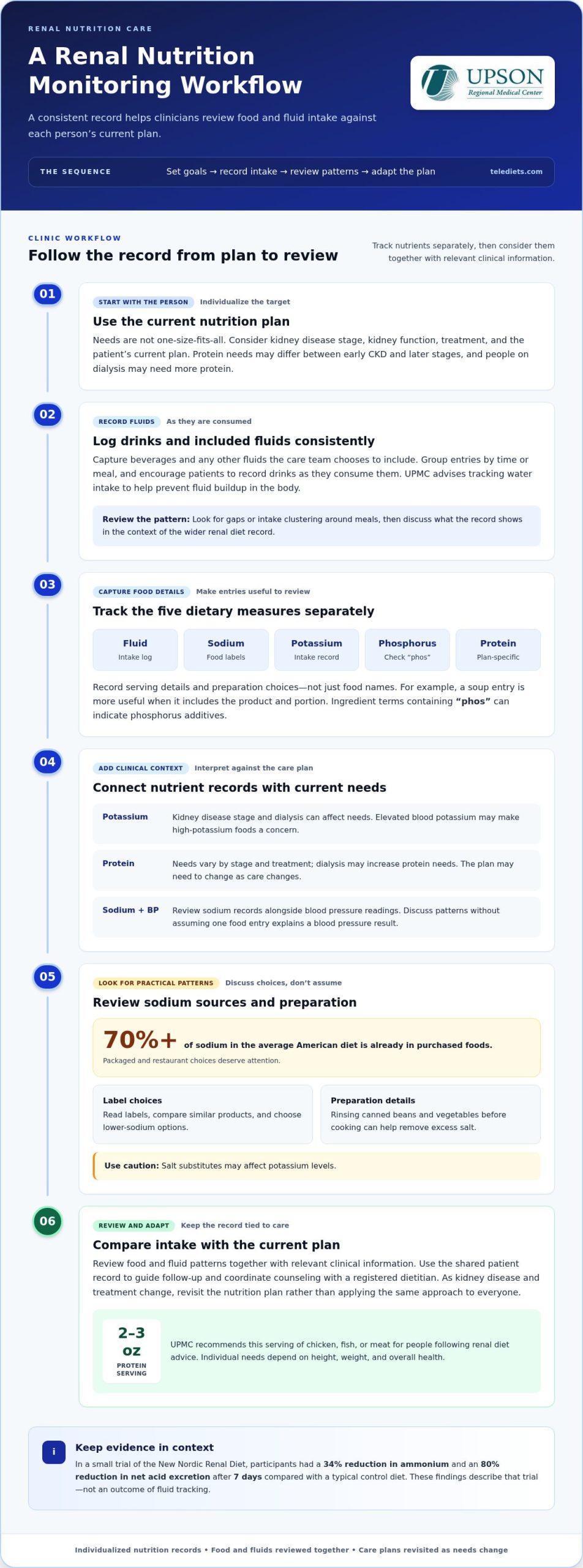
Fluid tracking helps clinicians review intake alongside kidney function, food choices, and the care plan. A daily log can capture beverages and other fluids the care team chooses to include, with entries grouped by time or meal. UPMC advises tracking water intake to help prevent fluid buildup in the body. Reviewing patterns can help a clinician connect reported intake with the patient’s wider renal diet record.
Use a consistent recording method at each visit. Encourage patients to log drinks as they consume them, then review gaps and patterns together. For example, the record may show intake clustering around meals, or sodium-rich choices coinciding with increased thirst. Sodium, potassium, and phosphorus records can add context. Food labels show sodium content, while ingredient terms containing “phos” can indicate phosphorus additives. Potassium intake may also need attention when blood potassium is elevated.
Protein needs depend on chronic kidney disease stage and treatment. Needs may differ between early CKD and later stages, and people on dialysis may need more protein. As kidney disease and treatment change, the nutrition plan may need to change too. Software should help clinicians compare recorded intake with the patient’s current plan, rather than apply the same approach to everyone.
Keep the record tied to individualized care. National Kidney Foundation resources can support patient education, while clinicians use the person’s plan and relevant clinical information to guide counseling. In a small trial of the New Nordic Renal Diet, participants had a 34% reduction in ammonium after 7 days compared with a typical control diet, according to The study authors. The study authors also reported an 80% reduction in net acid excretion after 7 days compared with a typical control diet. These findings describe that trial, not a fluid-tracking outcome. A consistent record gives clinicians a clearer basis for discussing fluid, sodium, potassium, phosphorus, and protein together.
Potassium, phosphorus, protein, sodium, and fluid monitoring
A useful monitoring workflow brings food and fluid records together with relevant clinical information. It should help the care team review dietary patterns against each person’s current nutrition plan.
Nutrient Monitoring
Track potassium, phosphorus, protein, sodium, and fluid as distinct entries, then compare them with the patient’s dietary goals. Potassium needs can change with kidney disease stage and dialysis; elevated blood potassium may make high-potassium foods a concern. Phosphorus records should capture additives, including ingredients containing “phos.” Protein needs also vary: early kidney disease may call for less, while dialysis can increase needs.
Sodium and Blood Pressure Tracking
Pair sodium records with blood pressure readings so the registered dietitian can review both during nutrition therapy. This can help identify patterns to discuss, such as frequent high-sodium meals alongside changing readings, without assuming one entry explains a blood pressure result. Sodium guidance is individualized, and the care plan reflects overall health and kidney function.
Food preparation offers practical ways to reduce sodium. Encourage patients to read labels, compare similar products, and choose lower-sodium options. More than 70% of sodium in the average American diet is already in purchased foods, so packaged and restaurant choices deserve attention. Rinsing canned beans and vegetables before cooking can help remove excess salt. Salt substitutes require care because they may affect potassium levels.
For consistent review, record serving details and preparation choices, not just food names. A soup entry, for example, is more useful when it includes the product and portion. Software should make these details easy to review alongside fluid and dietary records. Nephrology teams can use the shared patient record to guide follow-up and coordinate counseling with a registered dietitian.
UPMC recommends a protein serving of two to three ounces of chicken, fish, or meat for people following renal diet advice; individual needs depend on height, weight, and overall health.
Renal diet app features
Useful features make nutrition records easier for the care team to review and use. Prioritize clear intake summaries, adaptable goals, and workflows that fit clinic practice.
EHR and Clinic System Integration
Which renal diet software integrates with EHRs and dialysis clinic systems? Compatibility depends on the platform’s supported connections and the clinic’s existing systems. Before adoption, map how patient details, nutrition plans, and progress notes should move between tools. Test a typical workflow, from opening a record to documenting a dietitian’s follow-up, and note where duplicate entry occurs.
For implementation, assign a workflow lead, configure the selected processes, and train dietitians on routine tasks. Patient instruction can demonstrate food entry and explain how to record eating patterns consistently. Start with a defined clinic workflow, then use staff and patient feedback to improve training materials.
Privacy and Security Requirements
What privacy, HIPAA, and security requirements apply in the United States? Clinics should assess how a platform handles health information in light of their applicable privacy and security obligations. Review access controls, user permissions, data storage, and how records are protected and managed. The clinic’s compliance lead can assess its obligations; this is an operational review, not legal advice.
Also review how access is managed when staff roles change and how users can report a concern. Clear procedures help dietitians understand which records they may view and update.
Distinguish a useful feature from a proven outcome. Review what published evaluations measure, such as adherence or clinical outcomes, and whether the findings apply to the clinic’s patients. Without outcome evidence, app use alone does not prove that adherence or health improved.
Risks include incomplete food entries, inaccurate selections, outdated nutrition information, and goals that no longer reflect changing kidney disease or kidney function. A provider should review recorded intake in clinical context, including relevant blood pressure readings and lab levels. Patient education and dietitian oversight can help identify errors before records inform care decisions.
How do renal diet software platforms compare for dialysis clinics and nephrology practices?
Compare platforms by how well their workflows fit the practice, not by feature counts alone. A dialysis clinic may prioritize recurring nutrition reviews and coordination around treatment, while a nephrology practice may focus on planning across changing stages of kidney disease. In either setting, staff should be able to find the current plan and document follow-up without unnecessary duplicate work.
Use one patient journey to compare platforms: a clinician reviews the record, updates a nutrition plan, and prepares for the next visit. Check whether each platform supports the steps your team needs:
- Care setting: Match the workflow to dialysis visits or longitudinal nephrology care.
- Documentation: Review how staff record plans, education, and follow-up notes.
- Information flow: Map where patient details are entered and reviewed.
- Team access: Identify how dietitians and other authorized staff use the same record.
For a dialysis clinic, test whether the software supports nutrition review within the existing patient workflow. For a nephrology practice, examine how it handles plan updates as clinical needs change. In either setting, have staff complete the same sample task, then note duplicate data entry, unclear handoffs, or missing information.
Assess usability with the people who will use the platform. A dietitian can test plan creation, while administrative staff assess routine documentation. Patient-facing steps should also be clear, such as entering a meal or reviewing guidance. A smooth demonstration is useful only if it reflects actual clinic tasks.
Before choosing, document the practice’s priorities, test a representative workflow, and record where each platform fits or requires workarounds. Include training and record-management processes in the assessment. This helps dialysis clinics and nephrology practices compare software on operational fit instead of assuming one platform suits every care model.
TeleDIETS: Standard Series Meal Plans
TeleDIETS supports clinical nutrition workflows with Standard Series Meal Plans and Advanced Medical Series Meal Plans. For practices extending nutrition care across chronic conditions, these structured plans can support clinicians’ established assessment and follow-up processes. They complement clinical judgment and do not replace individualized renal nutrition planning or nutrient and fluid monitoring.
Clinics can also use TeleDIETS Insurance Billing & CPT Coding Tools within their practice workflow. These offerings support teams seeking structured meal plan resources and related billing tools, while renal-specific targets remain under clinician direction.
Contact TeleDIETS to discuss how its meal plans and billing tools can support your clinic’s nutrition workflow.
Build a Workflow That Supports Your Care Model
Start by defining where nutrition planning fits into your clinic’s routine. Identify who prepares plans, how clinicians review them, and what information supports follow-up. These decisions help you assess whether renal diet software for clinics aligns with your workflow and care priorities.
TeleDIETS offers Standard Series Meal Plans and Advanced Medical Series Meal Plans for clinical nutrition workflows, along with GLP-1 Meal Plan Protocols. Consider which offering aligns with your practice’s nutrition services and how it complements your existing clinical processes. The goal is a practical fit between structured meal plan resources and the way your team delivers care, with patient-specific decisions remaining within clinical practice.
Explore how these options may fit your clinic’s needs and planned workflow. Contact TeleDIETS about clinic software to discuss a next step for your practice. A thoughtful workflow decision can help your team move forward with clarity and confidence.
Frequently Asked Questions
What software do clinics use for renal diet counseling and nutrition management?
Clinics use medical nutrition therapy software to organize nutrition planning within provider workflows. TeleDIETS is a software platform for healthcare professionals, available as an AI engine or SaaS application. Its AI diagnostic integration can read CMP biomarker lab results and ICD-10 codes to automatically recommend appropriate meal plans. Clinics seeking renal diet software for clinics should distinguish plan support from clinical assessment and patient-specific decisions.
What features should clinics look for in renal diet software?
Prioritize features that fit your team’s work, including clinical nutrition plans, clear documentation workflows, and tools that support administrative tasks. Consider whether staff can prepare and review plans without unnecessary duplicate entry. A practice, for example, may need billing and CPT coding tools alongside meal plan protocols. Define essential tasks first, then assess how the software supports each one.
Does renal diet software include kidney-friendly recipes, meal plans, and nutrient analysis?
Some platforms provide meal plans, while recipes and nutrient analysis vary by product. TeleDIETS offers Standard Series and Advanced Medical Series Meal Plans, plus a digital library of over 8,000 pre-designed meal plans. A plan library is distinct from a recipe planner. For renal care, clinicians should assess whether available plan resources fit their workflow and how they will apply clinical judgment to individual nutrition needs.
How does renal diet software track sodium, potassium, phosphorus, protein, and fluid intake?
Software can organize food and fluid entries so clinicians can review intake alongside an individual’s nutrition goals. A patient might record a packaged food and its serving information, then the care team can review relevant nutrient details and discuss the entry. Accuracy depends on complete records and appropriate food data. Clinicians interpret the information in context rather than treating an app total as a clinical decision.
Leave a Reply