
Connecting nutrition AI to an EMR requires privacy safeguards as well as a working data interface. For systems handling sensitive health and dietary data, the applicable regional standards include HIPAA in the United States and GDPR in the European Union, according to the U.S. Department of Health and Human Services and the European Union. Integrating nutrition AI into an existing EMR also means planning how information moves between systems and where clinical review remains part of the workflow.
It’s understandable to focus first on whether the technology can exchange data with your current records system. But a reliable integration also depends on using compatible clinical data, limiting exposure of sensitive information, and making the AI’s role clear to the care team. This article explains the regional privacy and compliance considerations, how interfaces such as HL7 FHIR APIs can connect nutrition platforms with hospital EHRs, and how validation, professional judgment, and ongoing monitoring support responsible clinical use.
Key Takeaways
- Use shared clinical vocabularies such as ICD-10, SNOMED CT, and LOINC to make nutrition data more consistent across systems.
- Design the workflow so AI can retrieve and summarize information, while clinicians verify structured data and retain professional judgment.
- Consider privacy-preserving approaches such as federated learning, differential privacy, and homomorphic encryption when handling sensitive data.
- Assess nutrition AI after deployment by monitoring performance, model drift, and clinical impact, with clear governance for its role in care.
Privacy safeguards for sensitive nutrition and health data
Nutrition AI can combine dietary details with diagnoses, laboratory results, and other sensitive health information. That creates confidentiality and data-protection concerns when systems retrieve, process, or share patient records. AI-driven nutrition systems handling sensitive health and dietary data should comply with GDPR and HIPAA, according to the European Union and the U.S. Department of Health and Human Services. Privacy planning should therefore account for the data used, who can access it, and where it moves across clinical workflows.
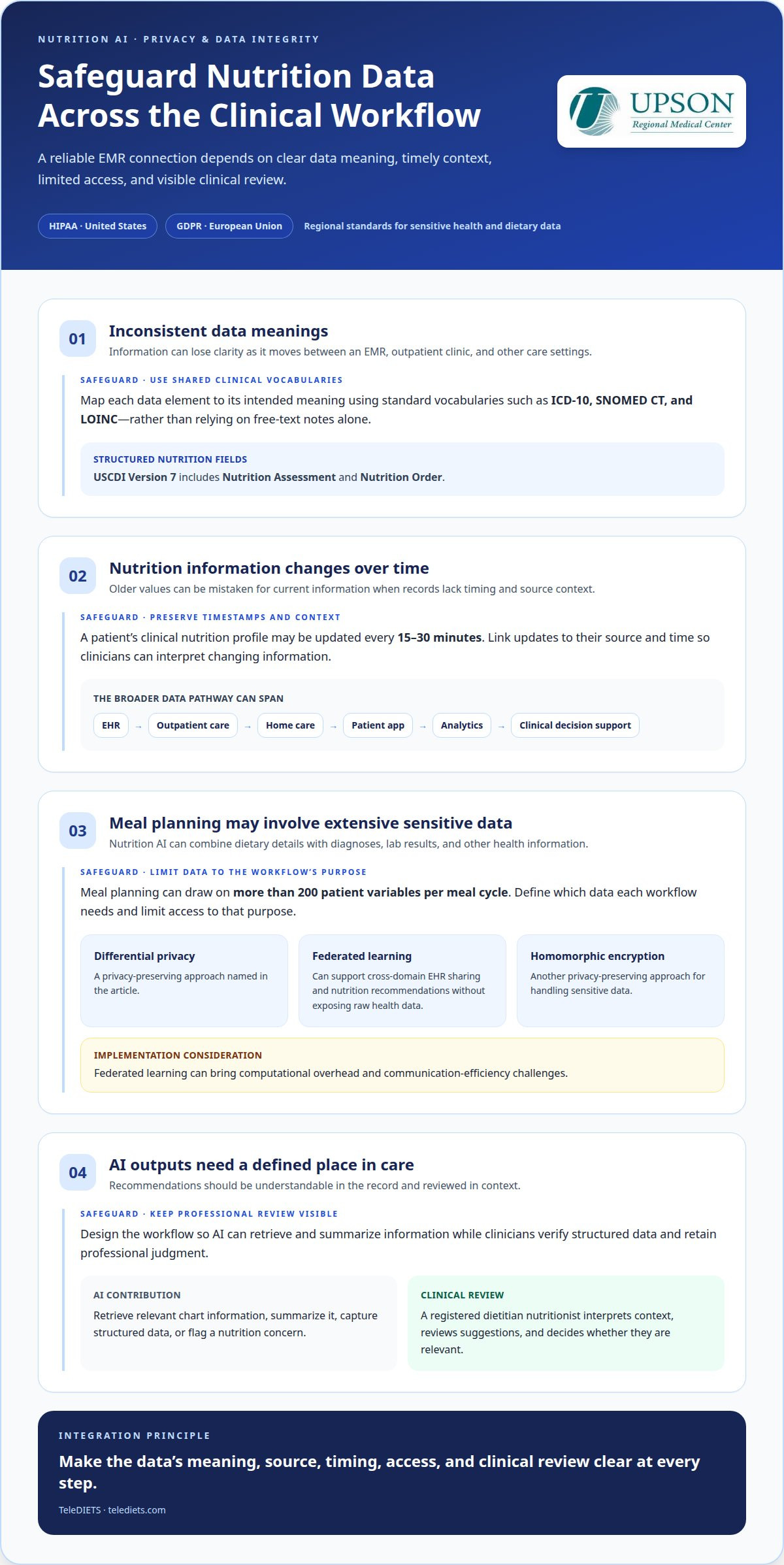
Consistent data definitions also matter. ICD-10, SNOMED CT, and LOINC are standard vocabularies that help normalize healthcare information across systems. USCDI Version 7 includes Nutrition Assessment and Nutrition Order, supporting structured representation of nutrition-related clinical information. When integrating these fields, teams can map each data element to its intended meaning, rather than relying on free-text notes alone. That can help preserve clarity as records move between an EMR, an outpatient clinic, and other care settings.
Nutrition information often changes over time, so longitudinal records need clear timestamps and context. A patient’s clinical nutrition profile may be updated every 15-30 minutes, while the broader data pathway can span the EHR, outpatient care, home care, a patient app, analytics, and clinical decision support. Linking updates to their source and time helps clinicians interpret changing dietary or health information without treating older values as current.
Meal planning can draw on more than 200 patient variables per meal cycle, making careful data handling essential for accuracy and outcomes. Privacy-preserving approaches include differential privacy, federated learning, and homomorphic encryption. Federated learning can support cross-domain EHR sharing and nutrition recommendations without exposing raw health data. It also brings practical challenges, including computational overhead and communication efficiency. Defining which data each workflow needs, and limiting access to that purpose, helps connect safeguards to real clinical use.
Clinical integration of AI-driven nutrition systems
Clinical integration works best when AI supports a defined nutrition task within existing care decisions. Teams can evaluate its fit through clinical validation, professional review, workflow measures, and outcomes aligned with its purpose.
Clinical Nutrition Workflows
An AI-supported nutrition workflow retrieves relevant chart information, summarizes it, captures structured data, and presents outputs for professional review. Recommendations should support care decisions, not sit outside the record. Registered dietitian nutritionist judgment remains central: the clinician interprets context, reviews suggestions, and decides whether they are relevant. For example, machine learning may flag a nutrition concern, while the clinician confirms its significance before acting. A well-scoped approach to integrating nutrition AI into existing EMR workflows connects each output to this review process.
Validation and Regulatory Barriers
Clinical validation assesses whether a system performs reliably for its intended use and patient population. The absence of standardized validation methods remains a barrier to adopting AI-driven nutrition technology in medical practice. Evaluation can include real-world clinical trials, inclusive models, and studies of how outputs affect care. Research priorities include integrating recommendations into clinical guidelines. A system that flags missing documentation has a different role from one that recommends an intervention, so teams should define its intended use and establish appropriate review and governance.
Measuring Integration Outcomes
Healthcare organizations assess ROI by comparing a defined baseline with workflow and care outcomes after integration. Track documentation completeness, adherence to review processes, and clinician responses to relevant recommendations. Pair operational measures, such as chart-review effort, with clinical outcomes tied to the system’s purpose. This helps determine whether the application supports care and resource use, rather than simply counting AI outputs. For teams integrating nutrition AI into existing EMR platforms, monitor performance over time and review whether changes in data or workflows require adjustments to governance.
Privacy, compliance, and governance
Governance turns privacy principles into clear decisions about how nutrition AI uses health data. For AI-driven systems handling sensitive health and dietary data, GDPR and HIPAA are relevant standards, according to the European Union and the U.S. Department of Health and Human Services. Their applicability depends on the system’s operating context and data flows, so governance should document which information the application processes and how teams oversee its use.
Nutrition documentation should make the digital workflow understandable after a recommendation appears. Record the information considered, the AI output, the review performed, and the resulting clinical decision. For example, a note can distinguish an AI-generated dietary suggestion from one reviewed and accepted by a clinician. This supports traceable analysis and helps teams assess whether an outcome followed from the tool, professional judgment, or both.
A useful governance model also defines the AI’s role before deployment. A brief dated 8.21.26 distinguishes an AI assistant that flags missing documentation from an AI clinical actor that recommends or initiates an intervention. These roles call for different oversight. A missing-field alert can prompt documentation review; a proposed intervention requires a defined clinical review point before it influences care.
- Document data use: identify the health data and dietary information used for each function.
- Record accountability: specify who reviews recommendations and how decisions are captured in the clinical record.
- Review performance: use governance oversight to assess system behavior and relevant outcomes over time.
Transparency and informed consent are central to user-focused privacy frameworks for AI-driven nutrition. Explain how information supports the application and where human review occurs. If analytics identify inconsistencies in nutrition documentation, governance can assign responsibility for resolving them and tracking the response. This creates a practical audit trail without treating an AI-generated insight as a clinical decision on its own.
Connecting AI nutrition platforms to hospital EHR systems
Connection design determines how nutrition data reaches clinical workflows and returns as useful documentation. In the United States, integrations commonly use HL7 FHIR APIs, embedded modules, or custom interfaces.
Implementation Steps
Implementation means defining data exchange, workflow placement, and oversight before clinical use. Start by identifying the nutrition task, such as using relevant chart information to create a personalized plan. Map the required EHR data to the nutrition platform, then specify where its output appears and who reviews it. Test data flow and documentation in the intended workflow before expanding use. This makes the source and purpose of each recommendation easier to interpret.
Available Integration Vendors
Available integration options include nutrition AI platforms using HL7 FHIR APIs, embedded modules, and custom interfaces. These describe connection approaches rather than a directory of named vendors. Each approach supports a different workflow: an embedded module can place a function within the EHR, while a custom interface can connect separate systems. The choice depends on the organization’s existing platform, data exchange needs, and the point where clinicians need AI-supported information.
Define what the AI reads and writes. A platform might retrieve relevant clinical data, create a draft nutrition summary, and return it for review. A clear workflow distinguishes source information from generated recommendations, while human review keeps clinical judgment visible. It also helps teams trace documentation when a plan changes or new information is added to a patient record.
For a mid-size hospital, nutrition AI integration typically takes 4-8 weeks. The implementation work includes configuring interfaces, testing data exchange, and aligning outputs with local workflows. Local optimization matters: a model should support the organization’s intended nutrition task, not add unrelated alerts or duplicate documentation. The practical measure is whether clinicians can find, review, and use the relevant information in their existing EHR workflow.
TeleDIETS
TeleDIETS supports healthcare professionals with evidence-based nutrition planning that can complement an EMR-connected clinical workflow. Its AI engine or SaaS application enables physicians and clinics to prescribe nutritional plans tailored to lab results and clinical diagnoses. This can be useful when your organization is defining how nutrition recommendations fit alongside existing clinical information and professional review.
Available options include Standard Series Meal Plans, Advanced Medical Series Meal Plans, GLP-1 Meal Plan Protocols, and Insurance Billing & CPT Coding Tools. These offerings support clinical nutrition planning and related practice workflows, rather than replacing your organization’s decisions about data access, privacy safeguards, or EMR interfaces. Consider TeleDIETS when you need evidence-based plan options for clinical practice as you shape your nutrition workflow. Contact TeleDIETS to discuss how its offerings fit your needs.
Build a Practical Next Step
Turn the integration plan into a focused operational decision: identify the nutrition workflow you want to support, the information it needs, and how your team will assess its fit. A clear scope keeps technology aligned with clinical priorities. As you integrate nutrition AI into an existing EMR, treat implementation as an evolving capability that can be refined through staff feedback and ongoing governance.
TeleDIETS offers Standard Series Meal Plans, Advanced Medical Series Meal Plans, and GLP-1 Meal Plan Protocols. These options can support evidence-based nutrition planning across clinical needs, while your organization determines how recommendations fit its records, review practices, and care processes. The next step is to consider which plan options align with your clinical nutrition workflow.
For a discussion about how TeleDIETS offerings may fit your needs, contact TeleDIETS. A considered, well-scoped next step can help your team move forward with clarity and confidence.
Frequently Asked Questions
What compliance standards apply to AI nutrition systems in different regions?
HIPAA is relevant in the United States, while GDPR applies to personal health data in the European Union. For systems serving people across regions, map where data originates, is processed, and is stored. That map helps teams identify which privacy framework applies to each data flow and assess cross-border handling.
How do you integrate nutrition AI software with an existing EMR?
Start by defining the clinical task and the information needed to support it. Map relevant fields, such as diagnoses and lab results, to the nutrition platform, then choose an interface approach, such as an API, embedded module, or custom interface. Test representative records, including missing or updated values, and confirm how draft outputs appear for clinical review before expanding the workflow.
Which EMR systems support nutrition AI integration through FHIR or HL7?
EMRs that expose HL7 FHIR APIs or support embedded modules and custom interfaces can be candidates for nutrition AI integration. The relevant question is whether the system can exchange the specific nutrition and clinical data your workflow requires. For example, confirm that the intended interface can retrieve diagnoses and return nutrition documentation in a form clinicians can review within their normal record workflow.
What nutrition data should an AI tool read from and write to an EMR?
Use only the information needed for the intended nutrition task, such as diagnoses and lab results. The U.S. Core Data for Interoperability includes Nutrition Assessment and Nutrition Order, which can guide structured data exchange. For example, an AI workflow may use a diagnosis and relevant lab result to prepare a draft nutrition assessment or order for clinician review, preserving the source and timestamp.
What are the HIPAA and FDA requirements for nutrition AI integrated with an EMR?
HIPAA is relevant to protected health information handled in the United States, while FDA considerations depend on the system’s intended function and claims. An assistant that flags missing documentation has a different role from a tool that recommends or initiates an intervention. Define the system’s role clearly and assess its actual functions. An EMR connection alone does not establish FDA approval or regulatory status.
How do nutrition AI tools handle patient consent, privacy, and data security?
Responsible workflows make data use transparent, address informed consent, and limit access to information needed for the clinical task. Define which team members can view inputs and outputs, how generated recommendations are reviewed, and how decisions are recorded. For example, keep an AI-generated suggestion distinguishable from a clinician-approved plan so patients and care teams can understand its role.
Leave a Reply