
Managing ketosis can be challenging when adherence, clinical monitoring, and patient suitability are handled separately. Potential side effects of ketogenic diet therapy include low blood sugar, excessive blood acidity, nausea, constipation, kidney stones, and nutritional deficiencies, as identified by UCLA Health. Ketogenic diet software for clinical use can help organize care information and follow-up, but it does not replace clinical assessment or supervision.
A digital tool can make tracking more consistent, but its value depends on how well it fits the care team’s workflow, helps identify adherence patterns, and keeps relevant patient information accessible when clinicians assess progress or concerns.
This article explains how software can support ketosis management, what to consider when assessing patient suitability, and how digital tools fit alongside individualized clinical judgment. It also covers how structured nutrition plans and practice-management tools can support clinicians providing medical nutrition therapy.
Key Takeaways
- Use consistent monitoring and adherence information to help clinicians identify patterns and guide ketosis management.
- Assess suitability by considering clinical context, relevant laboratory findings, nutritional needs, and the capacity for ongoing follow-up.
- Evaluate clinical software by how it supports care-team workflows; don’t assume it connects with electronic health records or laboratory systems without confirming that capability.
- Structured medical nutrition plans and billing tools can support clinical practice, while treatment decisions and safety oversight remain part of clinician-led care.
1. Ketosis management and adherence
Nutritional ketosis is a metabolic state in which the body uses fat rather than carbohydrates for energy. Clinical management involves more than recording ketone results. Clinicians also need to consider food intake, symptoms, laboratory findings, and whether the prescribed plan remains appropriate.
For pediatric epilepsy clinics, software options should support diet therapy workflows, including structured nutrition planning and organized follow-up. No specific pediatric software product can be identified from the available information here. A digital tool can organize clinical information, but it cannot independently determine whether a child is suitable for therapy or replace a specialist team.
Protocols should reflect clinician-led assessment, nutritional needs, and monitoring for potential complications. UCLA Health describes ketogenic diet therapy as safe and effective when initiated and supervised at a specialized epilepsy center by a skilled diet therapy team. Before treatment, UCLA Health requires blood and urine laboratory tests to screen for genetic conditions or nutritional deficiencies that could worsen.
Software can help teams keep assessment details, dietary plans, follow-up notes, and monitoring results together. It should support the clinic’s established protocol, not make treatment decisions automatically. Clinicians remain responsible for interpreting findings and adjusting care.
Start implementation by mapping the existing workflow. In a hospital, define how assessment, plan documentation, and follow-up fit inpatient care. In an outpatient practice, establish how staff record and review patient information between visits. Train the clinicians and staff who will use the workflow, then review whether documentation is complete and useful.
UCLA Health identifies low blood sugar, excessive blood acidity, nausea, constipation, kidney stones, and nutritional deficiencies as potential side effects. A clinic workflow should make relevant symptoms and results visible for review and establish a clear route for clinical follow-up. Software can support consistency, but it does not replace monitoring or professional judgment.
3. What clinical software is available for managing ketogenic diet therapy?
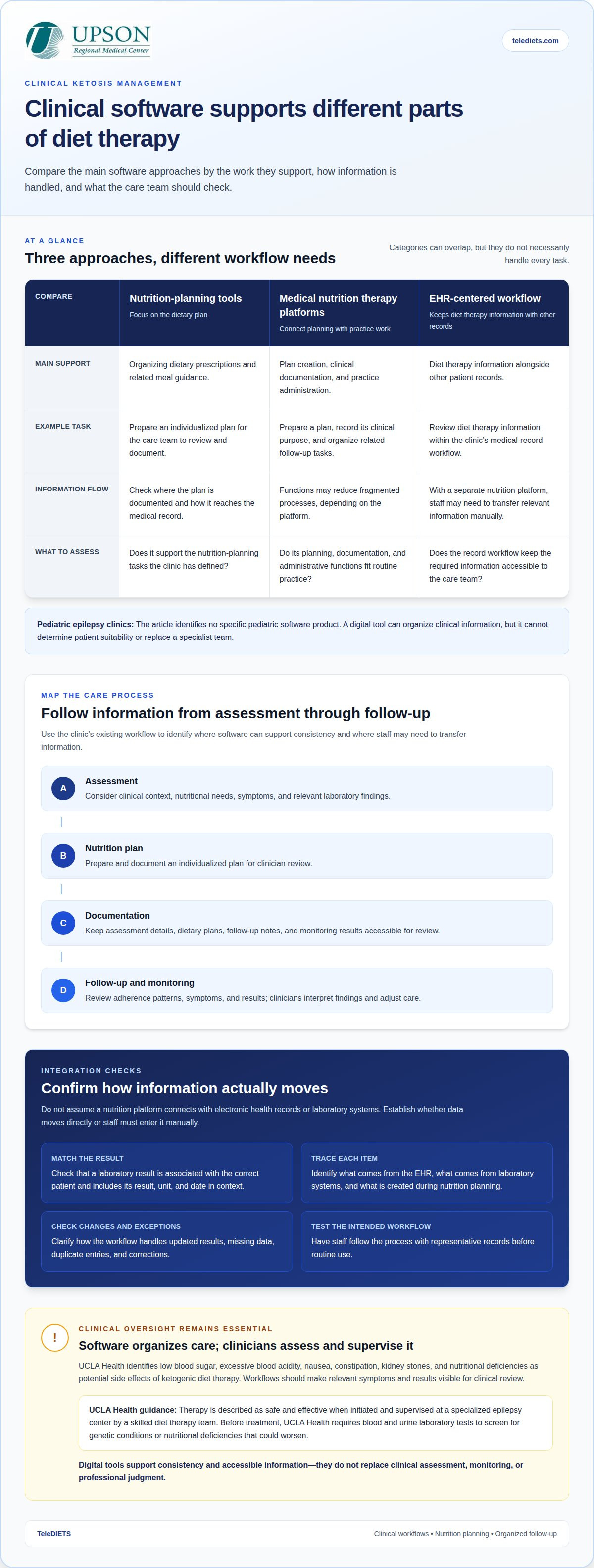
Clinical software for ketogenic diet therapy generally supports nutrition planning, clinical documentation, or practice workflows. These categories can overlap, but they address different needs. Selecting ketogenic diet software for clinical use means first identifying which part of care needs support, rather than assuming one tool handles every task.
Nutrition-planning tools help clinicians organize dietary prescriptions and related meal guidance. For example, a pediatric epilepsy service may need to prepare an individualized plan for the team to review and document. Software can support preparation, while clinicians assess the patient and determine the treatment approach.
Medical nutrition therapy platforms can connect plan creation with documentation and practice administration. A clinician might prepare a plan, record its clinical purpose, and organize related follow-up tasks within one workflow. This can reduce fragmented processes, depending on the platform’s functions.
An EHR-centered workflow may suit a clinic that wants diet therapy information alongside other patient records. With a separate nutrition platform, staff may need to transfer relevant information into the medical record. Before choosing an approach, map the steps from assessment to planning and documentation, and identify where manual entry occurs.
When evaluating ketogenic diet software for clinical use, match its capabilities to the clinic’s defined tasks. Check whether it supports the required nutrition planning, who will use it, and how records fit into routine practice. A clear workflow map helps distinguish useful functions from features that do not address the clinic’s needs.
Practices developing medical nutrition workflows can also explore clinical nutrition software as one potential resource. The best-fit category depends on the service being delivered and how the care team manages its work.
4. What ketogenic diet software integrates with electronic health records and laboratory systems?
Integration means relevant information can move between a nutrition workflow, an electronic health record, and laboratory systems. Find out whether the systems exchange data directly or staff must enter it manually. For example, a clinician reviewing a laboratory result needs the correct patient, result, unit, and date in context.
Begin by mapping information flow. Identify which details come from the EHR, which arrive from laboratory systems, and which are created during nutrition planning. Then trace each item to its destination. A lab result may appear in the medical record, while a dietary plan may be documented separately if the systems do not share information.
Integration quality also depends on how information is matched and displayed. A result without its date or measurement unit can be harder to interpret, while a plan linked to the wrong record creates a different risk. Define the data fields and workflow steps clinicians need before deciding whether a connection supports the practice.
Ask what happens when information changes. For example, determine whether an updated laboratory result appears in the relevant record or staff must enter it again. Clarify how the workflow handles missing data, duplicate entries, and corrections. These questions help distinguish a system connection from a process that relies on manual transfer.
Before routine use, test the intended workflow with representative records. Have staff follow a sample from laboratory result review through nutrition documentation, noting any extra data entry or navigation. This shows whether the EHR and laboratory systems support the clinic’s ketogenic diet workflow or a separate documentation step is still needed.
Because ketogenic diet therapy is a high-fat, low-carbohydrate treatment used to improve seizure control in people with epilepsy whose seizures do not respond to traditional seizure medications alone, documentation can keep the treatment context alongside results. The Royal Children’s Hospital Melbourne recommends electronic weighing scales accurate to 1 gram for home ketogenic diet equipment, a detail that may also be recorded in care workflows.
4. What evidence supports the safety and effectiveness of software-supported ketogenic diet care?
Evidence should distinguish ketogenic diet therapy from the software used to organize care. Clinical outcomes describe the therapy; software performance concerns workflows such as plan documentation, information tracking, and follow-up. These questions are related, but evidence for one does not establish the other.
For children with epilepsy, reported outcomes vary. Across children with all types of epilepsy, just over one in three have more than a 50% reduction in seizure frequency on ketogenic diet therapy. Less than one in ten have more than a 90% reduction, and less than one in twenty become seizure free. These figures describe therapy outcomes, not results caused by software.
UCLA Health says ketogenic diet therapy may improve almost any type of medication-resistant epilepsy, but may not result in complete seizure freedom. It also describes the therapy as safe and effective when started and supervised at a specialized epilepsy center by a skilled diet therapy team. Specialist oversight is therefore central to evaluating care quality.
Clinics can assess software-supported care through practical process measures. For example, they can review whether clinicians document suitability decisions, record follow-up information consistently, and find relevant results when reviewing a patient’s care. These measures show whether a tool supports the intended workflow. On their own, they do not prove improved seizure control or fewer adverse effects.
To assess effectiveness responsibly, match the clinical question to the evidence. A therapy study can inform expectations about seizure outcomes; a workflow evaluation can show whether documentation or follow-up processes work as intended. Keep those conclusions separate and interpret patient outcomes within clinician-led care.
For practices building structured nutrition workflows, explore clinical nutrition software designed to support medical nutrition therapy planning.
TeleDIETS
TeleDIETS provides healthcare professionals with medical nutrition therapy software and structured clinical plans. Its platform helps physicians and clinics prepare evidence-based nutrition plans tailored to laboratory results and clinical diagnoses. For practices building nutrition workflows, it offers a structured starting point while clinicians retain responsibility for patient assessment and care decisions.
Available resources include Standard Series Meal Plans, Advanced Medical Series Meal Plans, GLP-1 Meal Plan Protocols, and Insurance Billing & CPT Coding Tools. Together, these offerings support nutrition planning and practice workflows across clinical needs. They aren’t a substitute for specialist oversight of ketogenic diet therapy or proof that software alone improves treatment outcomes.
Contact TeleDIETS to discuss how its clinical nutrition tools may fit your practice.
Build a workflow your care team can sustain
Start by defining what your clinical team needs from its nutrition workflow. Consider how patient assessment, care planning, documentation, and follow-up should connect in daily practice. A clear understanding of these needs can help you evaluate whether a digital platform supports your work without adding unnecessary steps.
The right ketogenic diet software for clinical use should complement clinician judgment and fit the way your team delivers care. Keep that standard in mind when evaluating medical nutrition therapy tools. TeleDIETS supports healthcare professionals with structured nutrition plans and practice tools designed for clinical workflows.
Contact TeleDIETS to discuss your needs and consider how its tools may fit your practice. A thoughtful workflow decision can help your team move forward with greater clarity and confidence.
Frequently Asked Questions
What problems can arise?
Challenges can include inconsistent adherence, incomplete clinical records, or difficulty connecting nutrition plans with the rest of a patient’s care. For example, if reported intake differs from the documented plan, the care team may have less context for reviewing progress. A software workflow can help organize information, but clinicians still need to interpret discrepancies and respond to clinical concerns.
How do ketogenic diet programs and clinical software differ for epilepsy, diabetes, and weight management?
Programs define the nutrition approach; clinical software supports how providers organize and deliver that care. For epilepsy, care involves a specialized diet therapy context. Diabetes and weight management workflows may focus on different diagnoses and nutrition goals, as determined by clinicians. Software should accommodate the practice’s intended clinical plans and documentation, rather than apply one generic program across these distinct care needs.
What features should clinicians look for in ketogenic diet software?
Look for functions that fit the practice’s workflow: evidence-based plan options, support for tailoring plans to diagnoses and laboratory results, and tools for documenting nutrition services. TeleDIETS offers secure integration with clinical systems, a telemedicine plugin, and insurance billing and CPT coding tools. Consider whether these capabilities fit the team’s processes for preparing plans and handling related administrative tasks.
What clinical guidelines and protocols should ketogenic diet software follow?
Protocols should reflect clinician-led suitability assessment, nutritional needs, and monitoring for potential complications. Before treatment, patients should have blood and urine tests to screen for genetic conditions or nutritional deficiencies that could worsen. Care should be initiated and supervised by a skilled team at a specialized epilepsy center.
Leave a Reply