
Medical weight loss meal planning software can help reduce the time spent preparing nutrition protocols while keeping personalization and clinical judgment in the provider’s hands. The challenge is to align recommendations with diagnoses, available lab results, and established care workflows. The right software should support that work, not make care decisions for you.
For a useful evaluation, look beyond a feature list. Consider how clinical information informs protocols, how providers review the output, and whether billing tools and telemedicine capabilities fit your team’s process. This guide covers practical ways to assess clinical relevance, personalization, and workflow fit, while keeping clinician review central.
Key Takeaways
- Assess medical weight loss meal planning software as a provider tool for protocol support, not as a consumer dieting app.
- Use a clear workflow to review clinical context, select a relevant protocol, and apply clinician judgment before incorporating it into care.
- Evaluate whether protocols, billing tools, and telemedicine capabilities suit your practice’s needs. Confirm product details before assuming integrations.
- Compare TeleDIETS’ Standard Series, Advanced Medical Series, and GLP-1 meal plan protocols against your clinical workflow and review process.
What medical weight loss meal planning software does for clinical teams
Medical weight loss meal planning software is a provider-facing tool that can support the development and review of nutrition protocols using clinical context, such as diagnoses and available lab information. It can help organize work within medical nutrition therapy, but it does not independently diagnose, prescribe, or make care decisions. The clinician assesses whether a protocol is suitable, reviews the output, and decides how it may fit the patient’s care plan.
How clinical meal planning differs from consumer meal planning
Consumer meal-planning tools often focus on recipes, food preferences, or calorie tracking. Clinical tools serve a different purpose: supporting nutrition therapy and professional workflows. Clinical nutrition considers nutrition in relation to health conditions. A provider-facing tool may therefore help teams consider diagnoses and relevant lab information when reviewing a protocol. Look for a process that makes clinician review and follow-up part of the work, rather than treating generated material as a final recommendation.
Who may evaluate this type of software
Physicians, dietitians, and clinic leaders can assess whether medical weight loss meal planning software fits their medical nutrition therapy workflow. Start by identifying who will review protocols, how approved material will be incorporated into care, and whether the process fits existing appointments or telemedicine visits. This is software for professional use, not a direct patient consultation service or meal-delivery program. Defining those boundaries helps teams understand what the tool supports and where provider judgment remains essential.
How clinical meal planning software turns patient context into provider-reviewed protocols
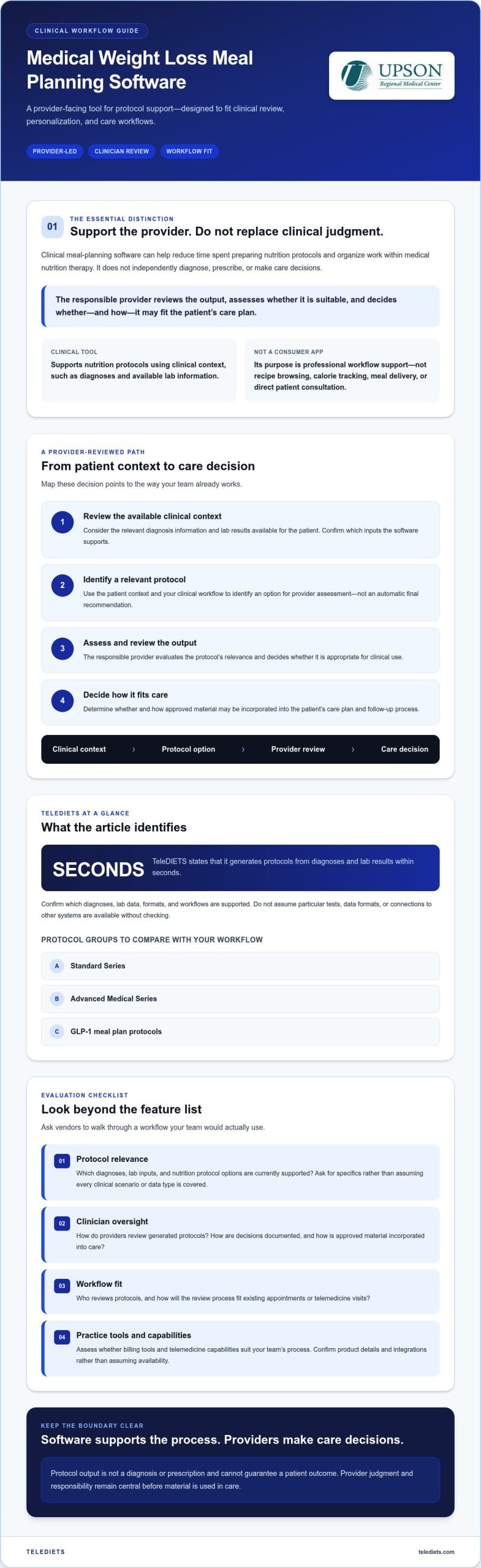
A useful workflow keeps clinical judgment at each decision point: review the available context, identify a relevant protocol, assess the resulting material, and decide whether and how to incorporate it into care. Before evaluating software, map these steps to your team’s current process. This makes it easier to see where the tool may support consistency and where a provider must make a decision.
TeleDIETS offers protocols informed by diagnoses and lab results, and generates protocols from this information within seconds. When reviewing the platform, confirm which data types, formats, and workflows are supported and whether they fit your practice. The American Medical Association discusses lifestyle interventions among evidence-based tools for obesity, providing context for nutrition support as part of care.
What patient information may inform a nutrition protocol
TeleDIETS identifies clinical diagnoses and lab results as inputs for its protocols. When assessing a protocol, consider whether the available information is relevant to the clinical context under review. Ask the vendor which diagnoses and lab data the platform supports, how information is entered or used, and whether the workflow fits your team. Do not assume specific tests, data formats, or connections to other systems are available without confirmation.
Where clinician review belongs in the workflow
Review is not an optional final check. Before clinical use, the responsible provider assesses the protocol’s relevance and decides whether it is appropriate to incorporate into care. Software output is not a diagnosis or prescription, and it cannot guarantee a patient outcome. Providers retain responsibility for care decisions.
When evaluating medical weight loss meal planning software, ask whether your team can identify the clinical context used to inform a protocol and establish a clear review step before it is used. That process supports personalization while keeping protocol use deliberate and provider-led.
How to evaluate medical weight loss meal planning software for your practice
Evaluate medical weight loss meal planning software against your clinical needs and existing processes, not just the number of features on a product page. A suitable platform should make protocol options understandable, leave room for provider review, and clearly define what it supports. Ask vendors to walk through a workflow your team would actually use, from reviewing clinical context to incorporating approved material into care.
Questions to ask during a software evaluation
- Protocol relevance: Which diagnoses, lab inputs, and nutrition protocol options does the platform currently support? Ask for specifics rather than assuming every clinical scenario or data type is covered.
- Clinician oversight: How do providers review generated protocols? What options are available for documenting decisions and incorporating approved material into care?
- Data handling and access: Ask how patient information is handled, who can access it, and what information the vendor can provide about its practices. Have the appropriate people at your organization assess these details.
Check workflow fit before adoption
Map the tool against your team’s process, from protocol review through follow-up. If insurance billing and CPT coding tools matter to your practice, confirm what they support and whether that matches your billing workflow. If your team provides care through telemedicine, ask how the available telemedicine capability fits that process. Do not assume a connection to a particular EHR, billing system, or other platform without confirmation.
Before committing, request clear details about implementation requirements and the scope of technical support. Confirm who handles setup, what your team needs to provide, and how questions are addressed. These practical details can reveal workflow constraints that a feature list will not.
Use your evaluation criteria to determine whether TeleDIETS’ clinical nutrition workflow software fits your practice’s needs. Explore clinical nutrition workflow software.
How TeleDIETS supports provider-led medical weight loss meal planning
Once you have defined your clinical requirements and workflow, assess whether TeleDIETS’ provider-facing clinical nutrition platform is a suitable fit. Its offerings include Standard Series Meal Plans, Advanced Medical Series Meal Plans, and GLP-1 Meal Plan Protocols. The platform provides protocols informed by diagnoses and lab results, along with insurance billing and CPT coding tools and a telemedicine plugin for provider workflows.
Match the platform’s offerings to your practice needs
Compare each protocol offering with the nutrition-planning needs your team has identified. Confirm the scope of the available protocols, then assess how providers will review the material and make care decisions. The software supports the workflow; it does not replace clinician judgment or promise a particular patient outcome.
If billing tools are relevant to your process, ask what the insurance billing and CPT coding tools cover and how your team would use them. Discuss how the telemedicine plugin fits your current approach to care as well. Confirm compatibility and workflow details rather than assuming connections to particular systems or services.
Plan a practical next step
Before discussing the platform, prepare questions about protocols, the diagnoses and lab results used to inform them, provider review, billing workflows, telemedicine, and implementation requirements. This helps your team assess the offering against real clinical and operational needs and identify details to confirm directly with TeleDIETS.
For a closer look, Review TeleDIETS for clinical practice and discuss whether its available protocols and workflow tools fit your team.
Build a Workflow That Keeps Clinicians in Control
The right medical weight loss meal planning software should support a clear provider-led process: clinical context informs protocol options, clinicians review the material, and care decisions remain with the provider. Evaluate whether the available protocols match your practice’s needs and whether billing and telemedicine features fit the way your team works.
TeleDIETS offers protocols informed by lab results and clinical diagnoses, insurance billing and CPT coding tools, and a telemedicine plugin for provider workflows. These capabilities can be part of your evaluation. Confirm their details and fit for your team’s processes before adoption.
Bring your questions about protocols, review, workflow, and implementation to the discussion. Explore TeleDIETS clinical nutrition software to learn more about the platform and assess whether it suits your practice. The aim is a more structured nutrition-planning process that keeps clinical judgment at the center of care.
Frequently Asked Questions
What is medical weight loss meal planning software?
Medical weight loss meal planning software is a provider-facing tool that supports clinical nutrition planning and related care workflows. Depending on the platform, clinicians may use information such as diagnoses or lab results to inform nutrition protocols. The software should assist, not replace, provider assessment and decision-making. Before relying on a feature, confirm what the vendor currently supports and how clinicians review its outputs.
How does meal planning software support a medical weight-management practice?
A clinical platform may help a team organize nutrition protocols within its existing care workflow, rather than prepare every plan from scratch. Assess how it handles clinical inputs, provider review, documentation, and follow-up. Capabilities vary by vendor. Do not assume a platform includes direct patient consultations, meal delivery, or a complete weight-management program. Ask the vendor to clarify the scope of its offerings.
Can meal planning software use diagnoses and lab results?
Some provider platforms are designed to use clinical information to inform nutrition protocols. TeleDIETS describes protocols informed by diagnoses and lab results, but you should confirm which data types and workflows are currently supported. Providers remain responsible for assessing whether a protocol is appropriate for the clinical context and their practice processes. Do not assume specific tests, data formats, or system integrations are available.
Does medical meal planning software replace a dietitian or physician?
No. Software can support protocol preparation and clinical workflows, but it does not replace qualified clinical judgment. Providers review the relevant context, decide whether available material fits their care process, and make the clinical decisions. Before introducing a platform into medical nutrition therapy, clarify how it supports provider oversight and ensure your team understands its role and limitations.
What should a clinic look for in medical weight loss meal planning software?
Evaluate clinical relevance, available protocols, provider review, workflow fit, and clear information about data inputs and implementation. If billing tools or telemedicine capabilities matter to your clinic, ask what is included and how each feature fits your existing process. Request current capability details from the vendor. Do not assume particular integrations, reimbursement, or clinical outcomes without confirmation.
Leave a Reply