
Choosing oncology nutrition therapy software starts with a clear view of the work it needs to support. For oncology teams, the practical questions are whether a platform fits the nutrition service workflow, makes its data inputs clear, and helps staff access and review resources efficiently.
This guide outlines criteria for assessing automation, clinical scope, and workflow integration. It also explains how TeleDIETS supports clinical nutrition workflows through AI-assisted meal plan recommendations and provider-focused tools. Use the criteria to compare a platform’s stated functions with your team’s needs and define what you want to evaluate before moving forward.
Key Takeaways
- Evaluate oncology nutrition therapy software by the tasks it supports and the boundaries of its stated functions.
- Review the platform’s data inputs, meal plan resources, clinical-system integration, and fit with daily team workflows.
- Map team roles, workflow friction, and the nutrition service the software needs to support before assessing adoption.
- TeleDIETS’ web-based SaaS application or AI engine can support clinical nutrition workflows, with professional decisions remaining with the care team.
What Oncology Nutrition Therapy Software Can, and Cannot, Support
Oncology nutrition therapy software can support provider-led nutrition workflows. Depending on the platform, that may include organizing nutrition tasks, providing access to meal plan resources, or structuring parts of a service workflow. Software functions should be distinguished from clinical assessment and care decisions, which remain with qualified professionals. Since Oncology concerns cancer and its care, nutrition services are delivered within a broader clinical team and treatment context.
Quotable definition: Clinical nutrition software helps organize and support nutrition services. Treatment-decision software diagnoses conditions, prescribes care, or determines cancer treatment. Automation or the use of clinical data alone does not mean a tool performs those treatment decisions.
Where software fits in an oncology nutrition workflow
Assess whether a platform can help coordinate administrative steps, make plan resources easier to access, and support consistent documentation. These are workflow functions, not evidence that software can assess an individual’s nutritional status or determine an appropriate intervention. The clinical team interprets information, assesses each person’s needs, and decides what care is appropriate.
Map each handoff before evaluating features. Record who reviews information, who selects or adapts resources, and who documents the care plan. Then check whether the platform makes those responsibilities clear. A useful workflow should support staff in their assigned roles, rather than make it easy to mistake an automated recommendation for a clinical decision.
Why oncology-specific claims need careful evaluation
Separate general clinical nutrition functions from functions supported by evidence for oncology use. A meal plan library or recommendation feature may support nutrition workflows, but it does not by itself show that the feature has been validated for a particular cancer, treatment phase, or oncology population. For any oncology-specific claim, identify the intended use, the data involved, and the evidence supporting that use.
Apply the same distinction when reviewing product language. TeleDIETS provides clinical nutrition workflow support. Its general platform capabilities are not oncology-specific protocols or treatment recommendations. Evaluating a platform’s defined scope and evidence boundaries helps teams assess its fit while keeping professional judgment central to care.
Which Software Capabilities Matter for Oncology Nutrition Teams?
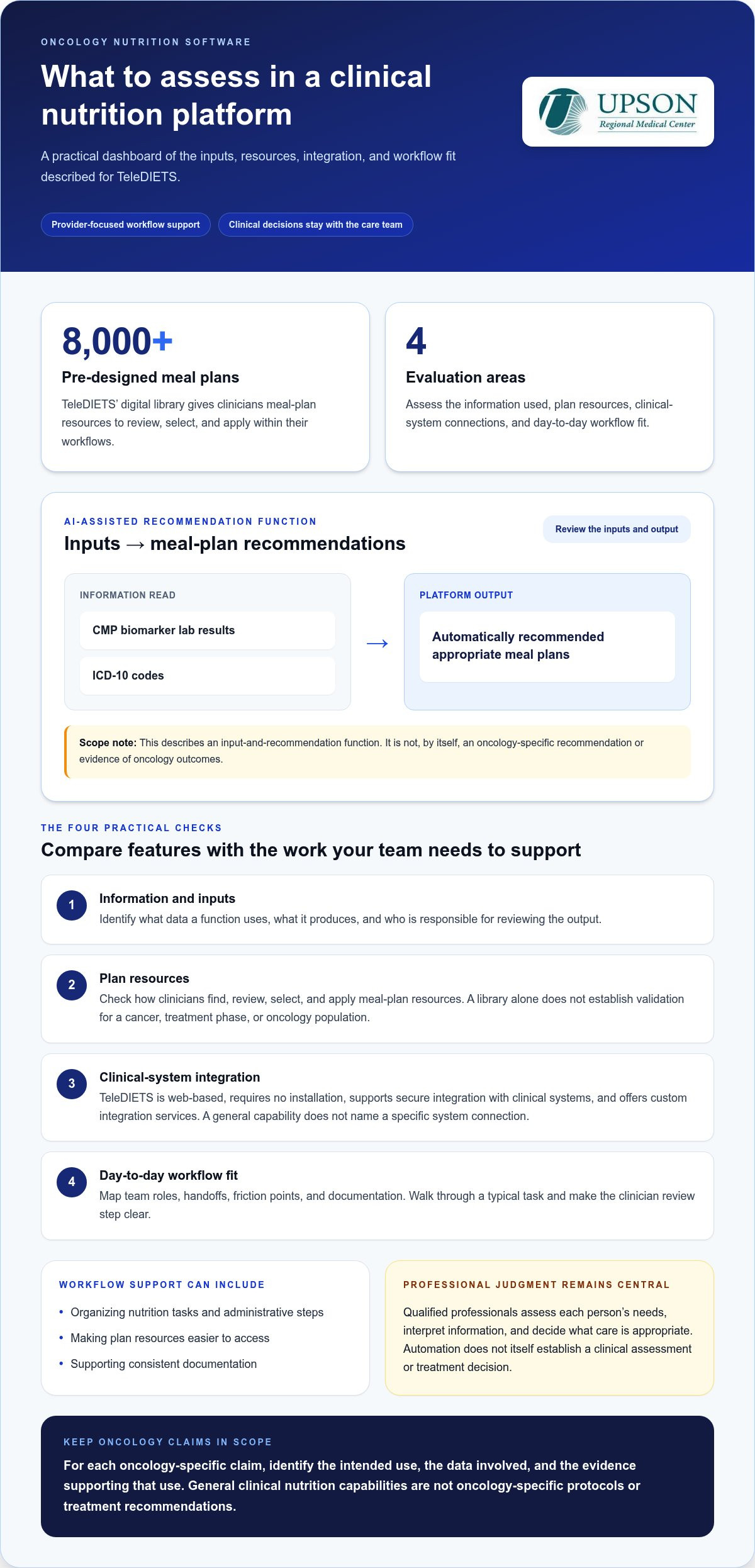
Assess oncology nutrition therapy software across four practical areas: the information it uses, the plan resources it provides, how it connects with clinical systems, and how well it fits the team’s day-to-day work. For each feature, identify its purpose, its inputs and outputs, and the clinician responsible for reviewing it.
Assess inputs, plan libraries, and clinical review
Start with data inputs. TeleDIETS’ AI diagnostic integration can read CMP biomarker lab results and ICD-10 codes to automatically recommend appropriate meal plans. In short: the platform reads CMP biomarker lab results and ICD-10 codes to automatically recommend appropriate meal plans. This describes the input and recommendation function. It is not an oncology-specific recommendation or evidence of oncology outcomes.
Next, examine the resources clinicians can access. TeleDIETS has a digital library of over 8,000 pre-designed meal plans. When assessing any platform, determine how clinicians review, select, and apply its resources within their workflows. Guidance from the National Cancer Institute’s Diet and Nutrition Recommendations provides an authoritative cancer-information context; it does not validate a software feature for oncology use.
Check integration and day-to-day usability
Trace how information moves into and through the workflow. TeleDIETS is web-based, requires no installation, and supports secure integration with clinical systems. Custom integration services are also available. Consider which staff need access, how the integration fits existing processes, and where a clinician reviews a recommendation before it informs care. A general integration capability does not identify a connection with a specific system.
During an evaluation, walk through a typical task with the people who will use the platform. Can they find relevant plan resources and see which inputs inform a recommendation? Is the clinical review step clear? These questions help the team assess day-to-day usability and distinguish workflow support from disease-specific claims. For a concrete example, review TeleDIETS’ clinical nutrition workflow capabilities.
How to Evaluate Oncology Nutrition Software Before Adoption
Start with the people and service involved. Identify team roles, points of friction in the current process, and the specific nutrition service the software would support. For example, decide whether the priority is organizing plan resources, reducing repetitive administrative steps, or supporting documentation. A defined use case makes it easier to assess oncology nutrition therapy software against real workflow needs rather than a broad feature list.
Map the clinical workflow and user responsibilities
Trace a typical workflow from preparation through service delivery and documentation. Record who prepares nutrition plans, who reviews them, who delivers the service, and who completes the record. Note where information is re-entered, handoffs slow down, or responsibilities are unclear. Review one representative workflow with the relevant team before considering broader implementation. This helps surface practical fit issues and keeps review responsibilities explicit.
Review evidence, data, and integration fit
For each automated function, document the information it uses, the evidence supporting it, and what its output is intended to do. Identify who can review recommendations and how secure integration with clinical systems would fit existing processes. Keep the assessment focused on the software’s stated functionality and the team’s workflow needs, rather than making assumptions about clinical validation.
Evaluation checklist: Define the service and users, map the workflow, examine evidence and data inputs, assign review responsibilities, and assess integration and usability.
Set realistic measures for evaluating fit
Choose operational measures before an evaluation, such as time spent on a workflow, the number of administrative steps, and staff feedback on clarity or usability. Compare observations with the current process. Record where the tool helps, adds work, or needs adjustment. These measures show operational fit, not improved patient-level clinical outcomes. A focused review gives decision-makers concrete information to use when planning next steps.
To see how a clinical nutrition platform may fit provider workflows, review TeleDIETS’ clinical nutrition software.
How TeleDIETS Supports Clinical Nutrition Workflows
With evaluation criteria in place, compare a platform’s functions with your team’s needs. TeleDIETS is clinical nutrition software for healthcare professionals, offered as a web-based SaaS application or an AI engine. It supports provider workflows; it is not an oncology-specific product or a tool for making cancer treatment decisions.
Match confirmed platform functions to provider needs
TeleDIETS offers Standard Series and Advanced Medical Series Meal Plans, with evidence-based meal plans created by registered dietitians. Its digital library contains over 8,000 pre-designed meal plans. These resources provide clinicians with meal plan options within a provider-led service, while clinicians review and apply materials in context.
For AI-assisted recommendations, the function is specific: AI diagnostic integration can read CMP biomarker lab results and ICD-10 codes to automatically recommend appropriate meal plans. This describes the inputs and recommendation function. It does not establish oncology-specific recommendations or clinical outcomes.
Workflow configuration is another evaluation point. TeleDIETS provides secure integration with clinical systems, custom integration services, and private-label branding. The platform can scale from individual providers to enterprise-level telehealth systems. Consider how these functions fit your team’s roles, existing processes, and review responsibilities.
Explore a clinical nutrition platform
Use your team’s needs to guide the assessment: define the service being supported, the information used, how staff access plan resources, and where clinical review takes place. This keeps the evaluation focused on workflow value and evidence boundaries, rather than treating a general nutrition capability as an oncology protocol. TeleDIETS is web-based and requires no installation, which may be relevant when considering how staff will access the platform.
Explore TeleDIETS clinical nutrition software to see how its functions relate to a provider workflow. Keep the assessment centered on your team’s needs and professional review process.
Turn Your Evaluation Into a Clear Next Step
Turn your team’s priorities into a practical evaluation brief. Define the nutrition service in scope, identify who will use and oversee the workflow, and state what the software should support. Also clarify which decisions remain with the care team. This gives stakeholders a shared basis for reviewing platform functions and discussing implementation without relying on broad claims about clinical impact.
Use the brief to focus a product discussion on how oncology nutrition therapy software could fit your team’s processes, what information informs its functions, and how staff would review and use its outputs. TeleDIETS offers a digital library of over 8,000 pre-designed meal plans, evidence-based plans created by registered dietitians, and a web-based platform available as SaaS or an AI engine. Assess these capabilities against your defined workflow, not as oncology-specific protocols.
Explore TeleDIETS clinical nutrition software to evaluate how its platform could support your provider workflow.
Frequently Asked Questions
What is oncology nutrition therapy software?
Oncology nutrition therapy software supports provider-led nutrition services in an oncology setting; it is not a cancer-treatment system. Depending on its functions, it may help a clinic coordinate nutrition resources and organize parts of its service workflow. A practice can assess whether the platform fits its referral and nutrition follow-up processes, while clinicians retain responsibility for individual assessment and care decisions.
Can nutrition software create oncology-specific meal plans?
Some software may offer oncology-focused resources, but a general meal plan library or automated recommendation does not by itself show that plans are validated for people with cancer. Review the intended population, data used, and evidence behind any oncology-specific function. TeleDIETS’ general meal plan and recommendation capabilities are not oncology-specific protocols or treatment recommendations.
How should a clinic evaluate oncology nutrition software?
Start with a defined service and a representative workflow. Then assess whether the software’s actual inputs and outputs suit that use. Identify what would make an evaluation useful, such as fewer handoffs or clearer resource access, and decide how the team will document issues or exceptions. Keep operational criteria separate from evidence of clinical effectiveness.
Does AI nutrition software replace an oncology dietitian?
No. AI may support parts of a nutrition workflow, but it does not replace an oncology dietitian’s assessment, interpretation, or professional judgment. Define who reviews software-generated recommendations and what happens when a recommendation does not fit the clinical context. The care team remains responsible for deciding whether information or resources are appropriate for the service.
What data can TeleDIETS use to recommend meal plans?
TeleDIETS’ AI diagnostic integration can read CMP biomarker lab results and ICD-10 codes to automatically recommend appropriate meal plans. This describes the stated inputs and function; it does not mean the system evaluates cancer type, treatment stage, or oncology-specific needs. Clinicians interpret recommendations through their established review process and determine whether they are appropriate for the care context.
Leave a Reply