
What if reliable reimbursement depends less on memorizing codes and more on repeating the right checks at every stage? Insurance billing for dietitians can be challenging when coverage varies by payer, claim details must align, and billing tasks compete with patient care. A consistent workflow helps make those steps manageable, without treating any code or process as a guarantee of payment.
This guide follows a claim from eligibility and payer requirements through documentation, submission, and payment review. You’ll learn where claims commonly stall, which checks can catch avoidable errors, and how consistent records and coding support the process. You’ll also see where billing and CPT coding tools can fit into a clinical workflow, so your team can organize administrative work while keeping professional review at the center.
Key Takeaways
- See how insurance billing for dietitians connects payer participation, benefit checks, documentation, coding, submission, and payment review.
- Learn why a submitted claim is not the same as an approved claim or a payment.
- Use payer-specific references to catch coverage assumptions, incomplete records, claim mismatches, and untracked rejections.
- Understand how billing tools can support routine workflow tasks while clinical judgment and coding accountability remain with professionals.
Insurance Billing for Dietitians: What the Process Covers
Insurance billing for dietitians is the administrative process that connects a nutrition service to its supporting records, a claim, and a payer’s decision. It includes confirming relevant coverage details, documenting the service, preparing and submitting the claim, and reviewing the response. This process is part of the broader Medical billing cycle, but nutrition claims also depend on how a particular plan treats medical nutrition therapy (MNT) and the provider’s circumstances.
Billing accuracy depends on matching the service delivered, the records that support it, and the payer’s specific requirements. A submitted claim is a request for payment, not confirmation that the payer has accepted it or will reimburse it. A claim may be paid, adjusted, denied, or returned for correction. A benefits check is not a payment guarantee either: the final decision depends on the plan’s terms and the information reviewed when the claim is processed.
Which parts of dietitian billing depend on the payer?
The administrative sequence is consistent: identify the applicable plan, document the service, submit accurate claim information, and follow up on the outcome. The requirements that shape payment are less universal. Coverage, referral or prior-authorization requirements, documentation standards, network participation, and claim-submission rules may vary by plan, and sometimes among a payer’s plan options.
MNT coverage can depend on the plan, service, diagnosis, and provider circumstances. A service covered under one member’s plan may not qualify under another, even when the visits appear similar. An eligibility check helps establish whether coverage is active; a benefits check clarifies the plan’s stated terms. Neither replaces careful documentation or the payer’s review of the submitted claim.
Keep payer-specific requirements in a reference that staff can update and use during billing. This lets you standardize the workflow without assuming coverage decisions or claim requirements are the same for every plan. Record the requirement, its source, and when it was last checked so the team can distinguish current guidance from outdated notes.
How a Dietitian Insurance Claim Moves from Visit to Payment
A reliable workflow gives each claim a clear path from appointment preparation to payment review. For insurance billing for dietitians, the sequence matters: a correct code cannot make up for an unverified benefit or a record that doesn’t support the service. Use these steps as a framework, then apply the relevant payer’s current rules.
- Establish participation. Confirm the provider’s network status and effective participation date for the specific plan.
- Verify benefits. Check active eligibility, MNT coverage, visit limits, and any referral or authorization requirements.
- Document the service. Record what was provided, the clinical rationale, and details that support the claim.
- Select the code. Choose a code that reflects the service and documentation. See dedicated guides to CPT 97802 and CPT 97803 for code-specific detail.
- Review and submit. Compare patient, provider, diagnosis, service, and payer details for consistency before sending the claim.
- Track the outcome. Review the payer response and remittance information, then note any correction or follow-up needed.
What should happen before the appointment?
Verify the patient’s plan details and eligibility, then check relevant benefits and whether the visit requires a referral or authorization. Confirm that the provider’s participation applies to the specific plan, not just the insurer generally. Record where and when you obtained the information, such as a payer portal or call reference, along with any stated limits or requirements. This creates a useful trail for staff and helps keep payer-specific guidance current. For Medicare coverage information, consult the Centers for Medicare & Medicaid Services (CMS).
What should happen after the service?
Complete the record promptly, then select a code consistent with the service delivered and its supporting documentation. Before submission, compare the claim with the record and check for missing or mismatched details, including patient and provider information, diagnosis, and service date. After filing, track the claim response and review the remittance for payment adjustments, denials, or other explanations. Correct errors or pursue an appeal through the applicable payer process, following its stated requirements and timelines.
Claim submission starts payer adjudication; it does not itself mean approval or payment. TeleDIETS provides integrated insurance billing and CPT coding tools to support a more structured workflow. Professionals remain responsible for documentation, coding decisions, and follow-up.
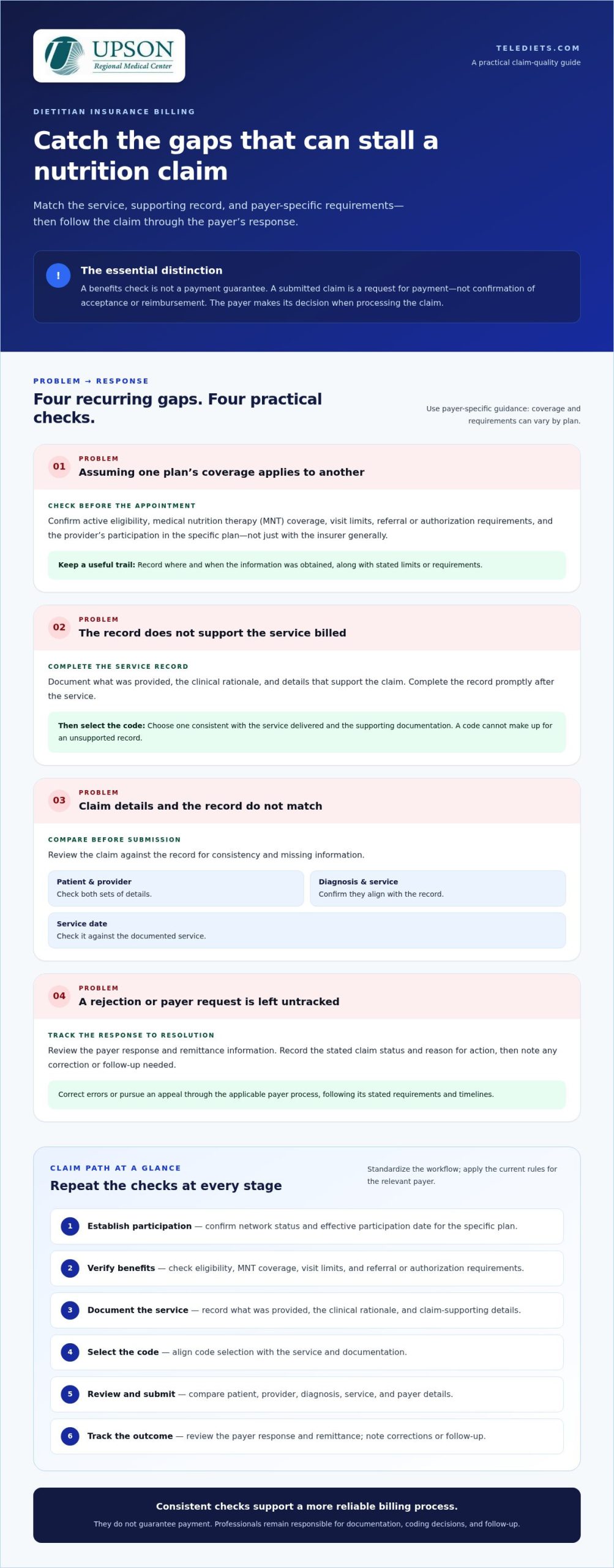
How to Reduce Avoidable Billing Issues Without Assuming Every Plan Is the Same
In insurance billing for dietitians, recurring claim issues often point to a process gap, not simply a coding problem. Review patterns such as:
- Assuming a service is covered because another plan covers it.
- Missing or insufficient documentation to support the service billed.
- Patient, provider, diagnosis, or service details that don’t match across the record and claim.
- Rejections or payer requests that aren’t logged and followed up.
These checks can improve consistency, but they can’t guarantee payment. Record the payer’s stated claim status and reason for action rather than relying on informal labels. For coding reference, consult current resources from the Academy of Nutrition and Dietetics, and follow applicable payer guidance.
What should a billing quality check include?
Before submission, compare patient and payer details with the current plan information. Check that the service record supports the billed service, code selection aligns with the documentation, and required claim fields are complete. Use a consistent review log to note submission dates, payer responses, corrections, and next steps. When a claim is returned or denied, record the reason and action taken. Over time, these records can reveal repeated issues, such as a missing field or recurring mismatch, so the practice can address the process instead of treating each claim as an isolated problem.
How should a practice handle payer differences?
Maintain a payer-specific reference that identifies the plan, the requirement, its source, and when it was last verified. Update it as new guidance becomes available, and avoid applying one plan’s coverage or administrative rules to another. If a requirement is unclear, escalate coding questions to a qualified billing or coding professional, and legal or compliance questions to an appropriate professional. This gives staff a consistent path without substituting a universal rule for plan-specific guidance.
TeleDIETS offers integrated insurance billing and CPT coding tools to support a structured clinical workflow. Use the tools alongside professional review and payer-specific references.
Where Billing and CPT Coding Tools Fit in a Dietitian’s Workflow
Billing software is most useful when it supports the handoffs between clinical documentation and administrative follow-through. It can help organize billing and coding tasks within a nutrition-care workflow, but it doesn’t replace professional judgment or determine whether a payer will cover a service. For insurance billing for dietitians, keep responsibilities clear: tools support the process, while clinicians and billing professionals remain accountable for their decisions.
What can billing software support?
Consider each stage separately. A clear workflow helps staff see what needs attention, who owns the next step, and where follow-up belongs. When evaluating a tool, compare its stated functions with the specific handoffs or repeated tasks your practice wants to organize.
| Workflow stage | Potential software support | Human review |
|---|---|---|
| Documentation and coding | Keep billing and coding tasks connected to clinical workflow. | Confirm the record reflects the service and the code is appropriate. |
| Claim preparation | Organize information for the billing process. | Check payer-specific details and required claim fields. |
| Submission and follow-up | Provide a structured place for billing tasks. | Monitor responses, review remittance, and decide on corrections or appeals. |
Software can support coordination, but clinical judgment determines what the record says. The responsible provider or coding professional remains accountable for coding, and the payer makes coverage and payment decisions.
How can practices assess workflow fit?
Map your current steps from documentation through claim follow-up. Identify where information is re-entered, where handoffs are unclear, and which tasks need a consistent process. Then compare those needs with the software’s intended role. TeleDIETS provides healthcare professionals with a cloud-based medical nutrition therapy platform and integrated insurance billing and CPT coding tools. Its clinical nutrition workflows support personalized dietary protocols based on patient lab data and diagnoses.
If you’re evaluating how software could fit your practice, explore clinical nutrition software as a next step.
Make Your Next Workflow Improvement Deliberate
You don’t need to overhaul every billing task at once. Choose one recurring point of friction, such as unclear handoffs or time spent reconciling claim details, and define a process change your team can apply consistently. Before changing a step, note where work pauses, what information is missing, and who owns the next action. Then review whether the change makes responsibilities clearer and follow-up easier to manage. This measured approach can strengthen insurance billing for dietitians without mistaking a smoother workflow for a guarantee of payer approval.
Technology can support that improvement when it aligns with clinical and administrative processes. TeleDIETS is clinical nutrition SaaS for healthcare professionals, with integrated insurance billing and CPT coding tools. Its platform also supports personalized dietary protocols based on patient lab data and diagnoses, helping connect nutrition planning with provider workflows.
Explore TeleDIETS for your practice to see how its clinical nutrition platform and billing tools could fit your team’s workflow. Start with one practical improvement and keep professional review and clinical care at the center.
Frequently Asked Questions
Do all insurance plans cover medical nutrition therapy from a dietitian?
No, MNT coverage isn’t universal. Benefits can depend on the member’s specific plan, diagnosis, service, and provider circumstances. For example, Medicare coverage for MNT is limited to people with diabetes, non-dialysis renal disease, or a kidney transplant within the last 36 months. A benefit available under one policy shouldn’t be assumed to apply to another, even when both plans come from the same insurer.
Can dietitians bill insurance for nutrition services?
Yes, dietitians can bill insurance for eligible services when they meet the applicable payer requirements. Those requirements may involve provider qualifications, network participation, covered service types, and claim-submission procedures. For example, a dietitian who participates in one plan may have different billing options for a patient enrolled in another plan from the same insurer. Confirm the relevant plan and provider arrangement before relying on reimbursement.
What information should a dietitian verify before submitting an insurance claim?
Check that the patient’s name and member ID match the insurance record, and confirm the correct payer and plan. Also verify provider identifiers, the service date, diagnosis information, and any referral or authorization details the plan requires. For example, a single transposed digit in a member ID can prevent a claim from matching the patient’s coverage. Keep the source of key plan details available for later reference.
Why might an insurance claim for dietitian services be denied?
A claim may be denied because the service isn’t covered under the plan, the documentation doesn’t support the billed service, or the submitted information contains coding or administrative errors. Filing after the payer’s deadline can also affect a claim. For example, a record that doesn’t explain the clinical basis for a service may not support the payer’s medical-necessity review. Review the payer’s stated reason before deciding how to respond.
Does billing software guarantee reimbursement for dietitian services?
No. Software can help organize billing tasks, but it can’t guarantee that a plan covers a service or that a payer will approve a claim. A claim may be complete and still fall outside the member’s benefits, or the payer may require additional review. Treat software as workflow support, then rely on professional judgment, accurate records, and the payer’s decision to guide next steps.
Leave a Reply