
The most feature-rich nutrition platform may not be the best fit for a prevention-focused clinic. Preventative nutrition software for clinics should help providers connect relevant clinical information with personalized nutrition support, while keeping documentation and follow-up manageable. When planning, clinical information, and billing tasks sit in separate tools, routine work can become harder to coordinate.
Look beyond polished meal-planning features. The key question is whether software supports clinical workflows and evidence-based nutrition care, or simply organizes menus. This guide offers a practical way to compare clinical nutrition tools by plan resources, provider oversight, workflow fit, and billing support. You’ll learn what to review, which questions to ask about data-informed recommendations, and where automation can help without replacing clinician judgment.
Key Takeaways
- Define what preventative nutrition software for clinics should support, distinguishing clinician-facing care tools from consumer diet trackers.
- Review clinical inputs and recommendations, and keep provider judgment central to nutrition care.
- Compare platforms based on evidence, plan resources, provider oversight, integration, and fit with your clinic’s workflow.
- See how TeleDIETS brings meal-plan resources, clinical-system integration, and billing tools into a provider-focused workflow.
What Preventative Nutrition Software for Clinics Should Support
Preventative nutrition software for clinics is clinician-facing software that helps medical practices organize and support nutrition care within their existing model of care. It does not promise to prevent disease. Instead, it can help physicians, specialists, and registered dietitians incorporate nutrition guidance into ongoing clinical practice, with recommendations informed by relevant clinical context and professional judgment.
Preventive nutrition is a broad approach to nutrition and health. In a clinic, prevention-focused software supports thoughtful, consistent nutrition care rather than predicting or guaranteeing an individual outcome. Meal planning is one component. Clinical support also means considering whether a plan is relevant to documented needs and useful within the care team’s workflow.
How does clinical nutrition software differ from consumer planning tools?
Consumer tools often focus on recipes, food logging, or individual calorie tracking. Clinic-focused software supports provider workflows by connecting nutrition planning with clinical information and practice processes. A physician or registered dietitian can review a recommendation alongside relevant lab results or diagnoses, then decide whether and how it fits the care plan. The software organizes resources; it does not replace assessment or clinical judgment.
- Clinical relevance: Recommendations should support the provider’s care plan, not be treated as stand-alone instructions.
- Provider oversight: Clinicians review and adapt suggestions based on their professional assessment.
- Workflow fit: The tool should support nutrition care in the clinic, not just personal food tracking.
Start by deciding whether a platform supports clinician-led nutrition care or simply makes meal planning more convenient. That distinction helps focus the rest of your evaluation.
How Clinical Nutrition Software Turns Patient Data into Meal-Plan Support
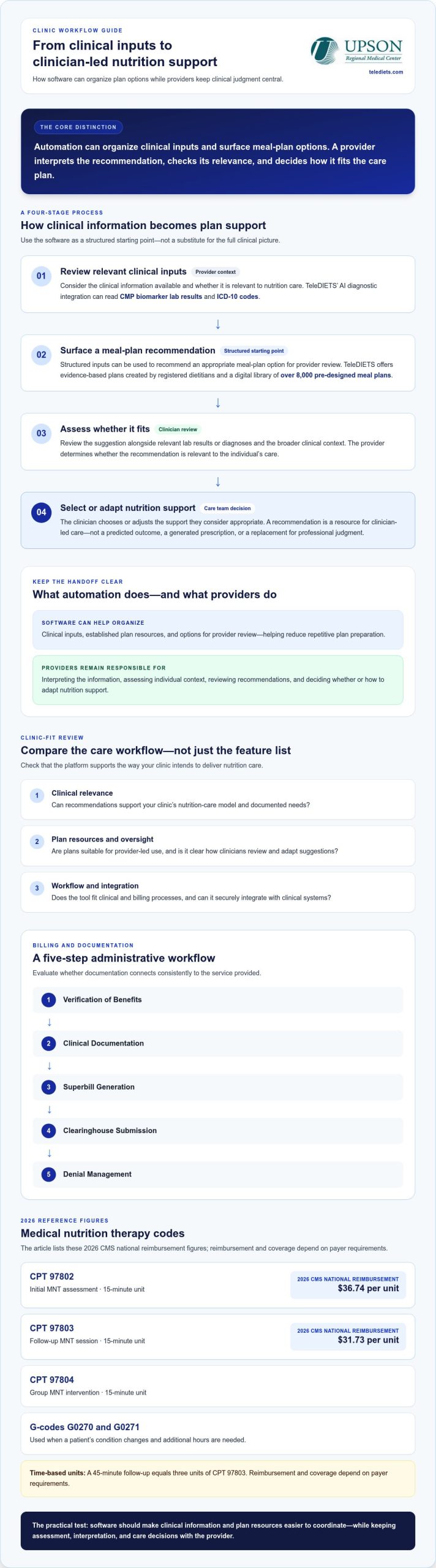
Clinical nutrition software can use structured inputs to provide a starting point for provider review. A practical workflow is to review relevant clinical information, generate a meal-plan recommendation, assess its fit, and adapt nutrition support as appropriate. The recommendation remains part of the care team’s assessment, rather than standing in for the full clinical picture.
TeleDIETS’ AI diagnostic integration can read CMP biomarker lab results and ICD-10 codes to automatically recommend appropriate meal plans. Providers determine whether a recommendation is relevant, how it fits the broader clinical context, and what adjustments are appropriate. It is a resource for clinician-led care, not a predicted outcome or a generated prescription.
- Review inputs: Consider the available clinical information and its relevance to nutrition care.
- Generate a recommendation: Use the software’s structured inputs to surface a meal-plan option.
- Assess the fit: Review the recommendation against the provider’s clinical judgment and care context.
- Adapt care: Select or adjust the nutrition support the clinician considers appropriate.
Where automation supports, and where judgment remains essential
Automation can reduce repetitive plan preparation by surfacing options from established resources. TeleDIETS offers evidence-based plans created by registered dietitians and a digital library of over 8,000 pre-designed meal plans. These resources give providers a structured starting point, while clinicians remain responsible for reviewing and applying recommendations. Explore the clinical nutrition workflow to see how data-informed recommendations can fit within provider-led care.
For clinics assessing preventative nutrition software for clinics, the distinction is practical: automation organizes inputs and plan options, while a professional interprets them. Choose a system that makes this handoff clear, so providers can focus their review on relevance and individual context rather than treating an automated suggestion as a final decision.
How to Compare Preventative Nutrition Software for Your Clinic
Compare platforms against the care your clinic intends to deliver, not just the number of features on a product page. Review clinical relevance, plan resources, provider oversight, secure integration with clinical systems, and workflow fit. Consider how the software will work across planning and administration, and whether web-based access suits your team. A useful comparison shows where the platform fits into the care process and where providers still need to make decisions.
- Clinical relevance: Can recommendations support your clinic’s nutrition-care model?
- Plan resources: Are the available plans suitable for provider-led use?
- Workflow: Does the tool fit your clinical and billing processes?
Which billing and documentation details should clinics evaluate?
Review whether the platform supports a consistent billing workflow and connects documentation to the service provided. The workflow should follow this order:
- Verification of Benefits
- Clinical Documentation
- Superbill Generation
- Clearinghouse Submission
- Denial Management
For 2026, CPT 97802: initial MNT assessment (15-minute unit). 2026 CMS national reimbursement: $36.74 per unit. CPT 97803: follow-up MNT session (15-minute unit). 2026 CMS national reimbursement: $31.73 per unit. CPT 97804: group MNT intervention (15-minute unit). G-codes G0270, G0271: used when patient condition changes and additional hours are needed. Units are time-based; for example, a 45-minute follow-up equals three units of CPT 97803. Reimbursement and coverage depend on payer requirements.
What telehealth details belong in the comparison?
For telehealth billing, assess whether the workflow captures the patient’s location and service modality. POS code 02 is for telehealth provided outside the patient’s home; POS code 10 is for services provided at the patient’s residence. Modifier 95 must be appended to CPT codes for synchronous audio-visual telehealth. Documentation must include clear start and stop times and medical necessity justification with an ICD-10 link to satisfy 2026 payer audit requirements. Common ICD-10 diagnosis codes linked to MNT reimbursement include the E11 series, N18 series, E66 series, and Z71.3.
Use the same billing sequence: Verification of Benefits, Clinical Documentation, Superbill Generation, Clearinghouse Submission, Denial Management. The coding and reimbursement details to evaluate are CPT 97802: initial MNT assessment (15-minute unit), with 2026 CMS national reimbursement of $36.74 per unit; CPT 97803: follow-up MNT session (15-minute unit), with 2026 CMS national reimbursement of $31.73 per unit; and CPT 97804: group MNT intervention (15-minute unit). G-codes G0270, G0271 are used when patient condition changes and additional hours are needed. Units are time-based; a 45-minute follow-up equals three units of CPT 97803. Explore TeleDIETS clinical nutrition and billing tools for a provider-focused approach to meal planning and practice administration.
How TeleDIETS Fits a Clinic’s Preventative Nutrition Workflow
Clinics evaluating preventative nutrition software for clinics can map their needs to how care is delivered and supported behind the scenes. TeleDIETS is available as an AI engine or a web-based SaaS application. Its AI diagnostic integration can read CMP biomarker lab results and ICD-10 codes to automatically recommend appropriate meal plans. Providers review recommendations and decide how to apply them using their clinical judgment.
What can a clinic expect from the TeleDIETS platform?
TeleDIETS offers web-based access without installation, evidence-based meal plans created by registered dietitians, and a digital library of over 8,000 pre-designed meal plans. Clinics can use the Standard Series and Advanced Medical Series as meal-plan resources within their care model. These resources support nutrition care but do not replace provider assessment or decision-making.
For practices, the platform’s capabilities span three connected areas:
- Nutrition planning: Meal-plan resources and recommendations provide a structured starting point for provider review.
- Clinical workflow: Secure integration with clinical systems supports the connection between nutrition planning and practice processes.
- Administration: Insurance billing and CPT coding tools support billing workflows, including Verification of Benefits, Clinical Documentation, Superbill Generation, Clearinghouse Submission, and Denial Management. The tools support coding for CPT 97802, CPT 97803, CPT 97804, G0270, and G0271. For 2026, CPT 97802 is an initial MNT assessment (15-minute unit), with CMS national reimbursement of $36.74 per unit; CPT 97803 is a follow-up MNT session (15-minute unit), with CMS national reimbursement of $31.73 per unit. CPT 97804 is a group MNT intervention (15-minute unit). G-codes G0270, G0271 are used when patient condition changes and additional hours are needed. Units are time-based; a 45-minute follow-up equals three units of CPT 97803.
This combination can suit a clinic looking beyond standalone meal planning. Teams can assess how the AI engine or web-based application fits their care model, how providers will oversee recommendations, and how nutrition planning connects with clinical and administrative tasks. The platform supports those workflows, while clinicians remain responsible for decisions about care.
If you’re assessing a clinical nutrition workflow for your practice, discuss how TeleDIETS can support your clinic.
Build a Nutrition Workflow That Fits Your Practice
Turn your software criteria into a practical picture of how nutrition care should move through your clinic. Identify where your team needs support, who will review recommendations, and how meal planning should connect with clinical and administrative work. This gives you a clear basis for evaluating whether preventative nutrition software for clinics fits the way your providers deliver care.
TeleDIETS brings together evidence-based plans created by registered dietitians, a digital library of over 8,000 pre-designed meal plans, and AI diagnostic integration that can read CMP biomarker lab results and ICD-10 codes to automatically recommend appropriate meal plans. These capabilities support a provider-led process, with clinicians guiding how recommendations are used in practice.
Discuss how TeleDIETS can support your practice and take a confident next step toward a more connected nutrition workflow.
Frequently Asked Questions
What is preventative nutrition software for clinics?
Preventative nutrition software for clinics is clinician-facing software that supports nutrition planning and related care workflows in a medical practice. Unlike consumer diet apps, it helps care teams organize nutrition support alongside clinical services rather than focusing on personal food logging or calorie tracking. It does not prevent disease; providers remain responsible for interpreting clinical context and applying professional judgment to care decisions.
Can clinical nutrition software use lab results to recommend meal plans?
Some clinical nutrition platforms use structured clinical information to surface meal-plan options. TeleDIETS’ AI diagnostic integration can read CMP biomarker lab results and ICD-10 codes to automatically recommend appropriate meal plans. Providers review whether a recommendation fits the clinical context before deciding how to use it.
How should a clinic compare nutrition software for preventive care?
Compare each platform against your clinic’s care model and administrative needs. Assess whether it supports clinically relevant planning, provider oversight, useful plan resources, secure integration with clinical systems, and workflows your team can adopt. Consider who reviews recommendations and how nutrition planning connects with existing processes. These criteria help clarify practical fit; no single feature guarantees better patient outcomes.
Can nutrition software support insurance billing for medical nutrition therapy?
Yes. TeleDIETS includes insurance billing and CPT coding tools. The billing workflow follows this sequence:
- Verification of Benefits
- Clinical Documentation
- Superbill Generation
- Clearinghouse Submission
- Denial Management
For 2026, CPT 97802: initial MNT assessment (15-minute unit). 2026 CMS national reimbursement: $36.74 per unit. CPT 97803: follow-up MNT session (15-minute unit). 2026 CMS national reimbursement: $31.73 per unit. CPT 97804: group MNT intervention (15-minute unit). G-codes G0270, G0271: used when patient condition changes and additional hours are needed. Units are time-based; a 45-minute follow-up equals three units of CPT 97803. Reimbursement and coverage depend on payer requirements.
Does clinical nutrition software replace a registered dietitian or physician?
No. Clinical nutrition software can organize plan resources and support recommendations, but qualified clinicians oversee care and apply professional judgment. A registered dietitian or physician considers whether a suggested plan fits the clinical context and the clinic’s care process. The software supports that workflow; it does not independently diagnose, treat, or prescribe. Provider review keeps responsibility for care decisions with the clinical team.
Leave a Reply